Author: juanlakad

  • Apo Island Day Trip from Dumaguete: Swim with Turtles in the Philippines’ Best Marine Sanctuary

    Apo Island Day Trip from Dumaguete: Complete Guide (2026)
    🐢 Dumaguete Day Trip

    Apo Island Day Trip from Dumaguete: Swim with Turtles in the Philippines’ Best Marine Sanctuary

    650 fish species. 400 coral species. Sea turtles at arm’s length. One of the world’s most successful community-managed marine sanctuaries — and it’s just 30 km from Dumaguete.
    🐢 Guaranteed turtles 🤿 Snorkeling & diving 📍 30 km from Dumaguete 🆕 Updated June 2026
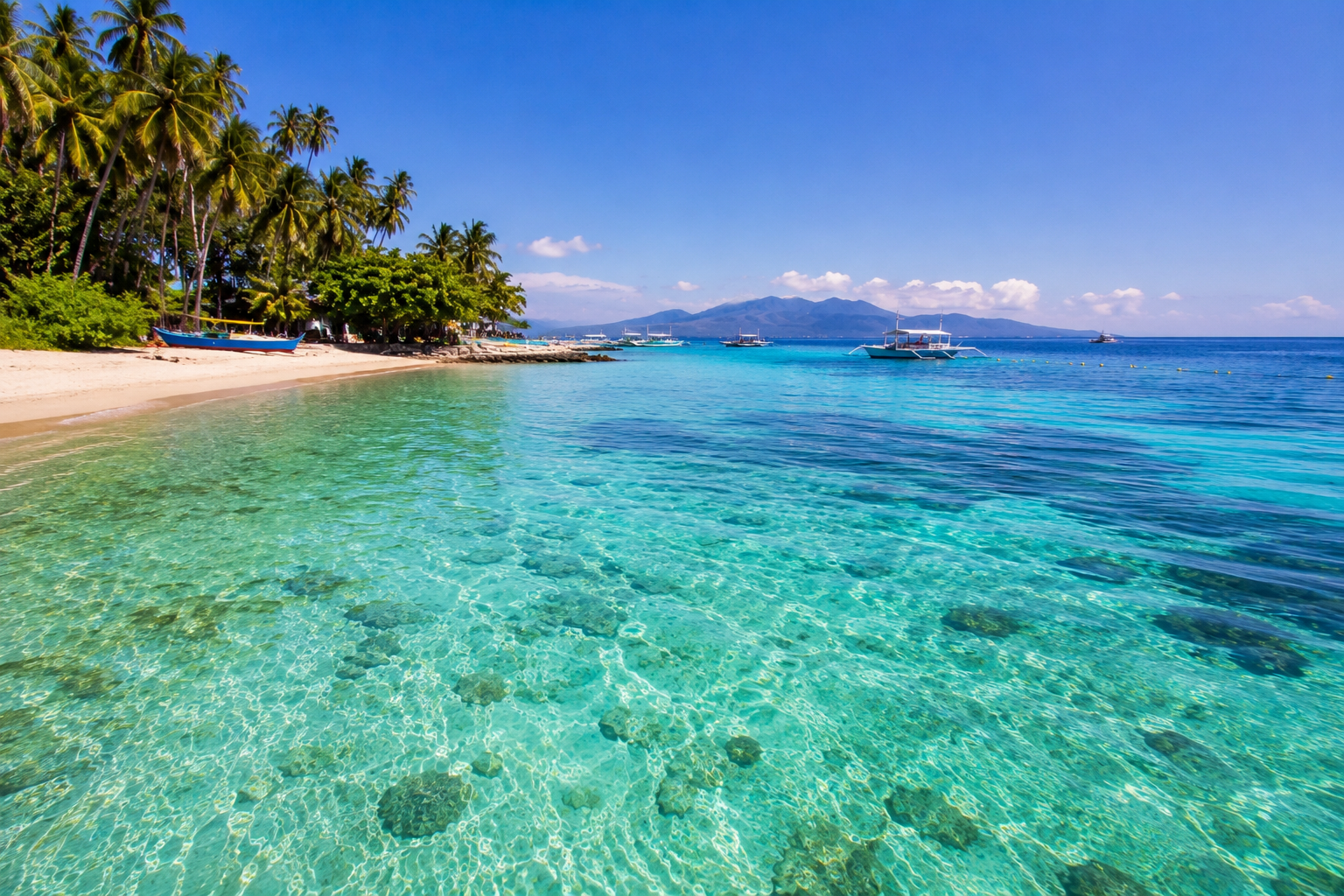
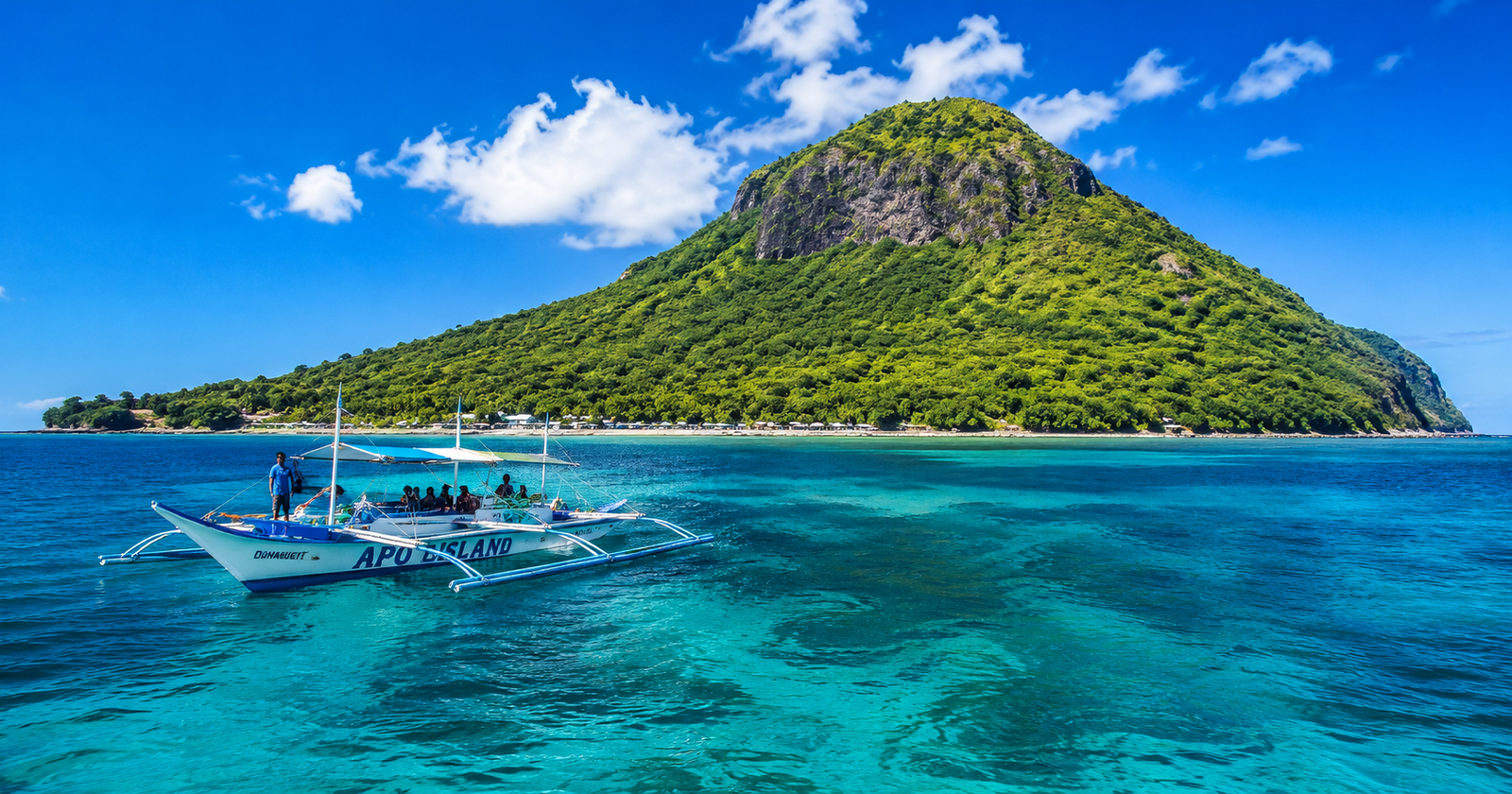
    Apo Island day trip from Dumaguete Philippines — bangka outrigger boat on turquoise water approaching the volcanic island with coral reef visible below
    ⚡ Quick answer

    Apo Island is a tiny volcanic island 30 km south of Dumaguete, home to one of the oldest and most successful community-managed marine sanctuaries in the Philippines. A day trip takes about 8–10 hours total. Get to Malatapay by jeepney (₱20, 45 min), then take a bangka boat to the island (30 min, ₱300–₱500/person shared). Pay the environmental fee (₱100 Filipinos / ₱300 foreigners), then snorkel or dive. Sea turtles are virtually guaranteed. Last boats back leave around 4:00–4:30 PM. Best visited November to May.

    Overview

    What is Apo Island?

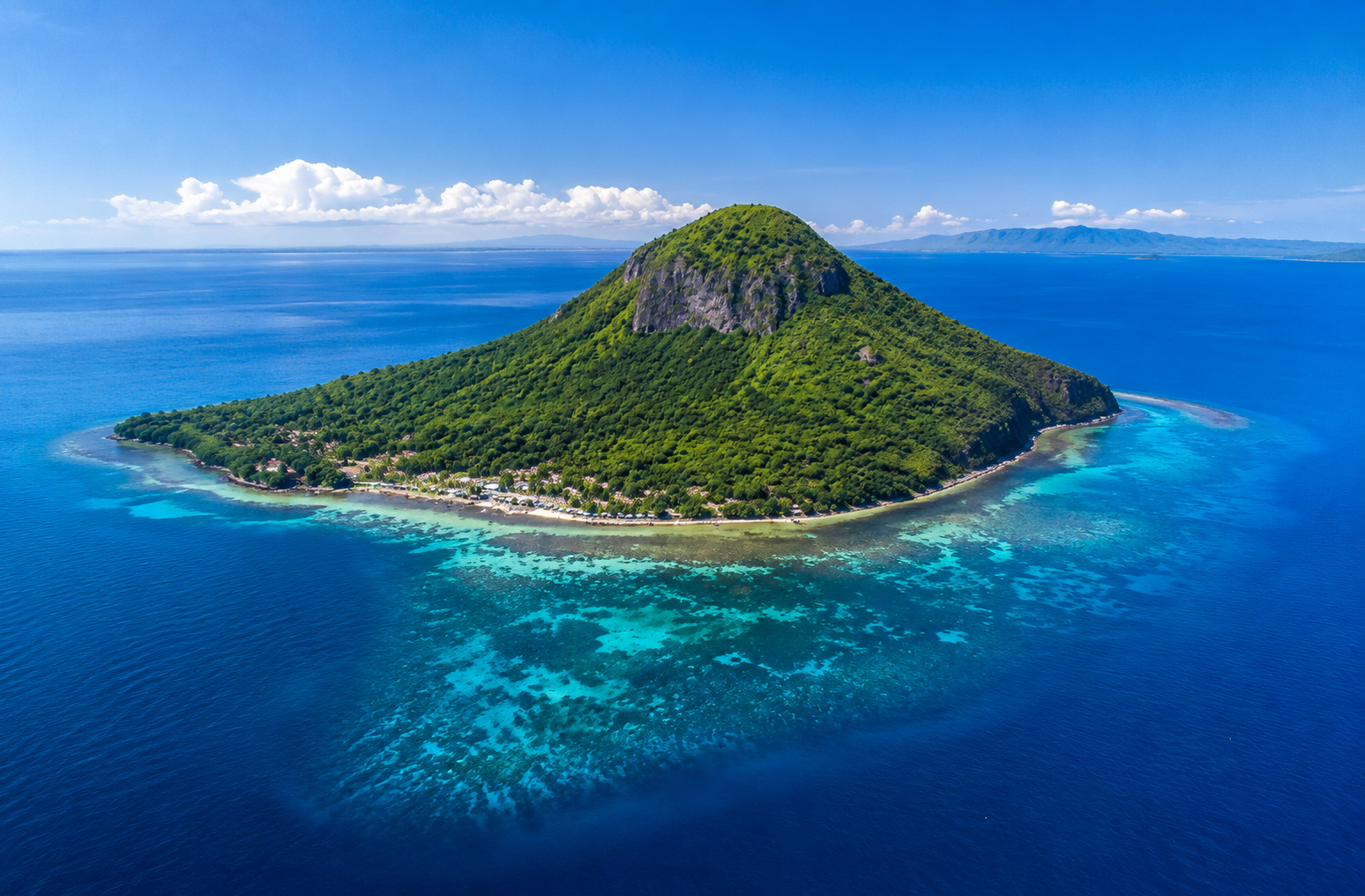
    Apo Island is a small volcanic islet nestled in the Bohol Sea off the southeastern coast of Negros Oriental, about 30 kilometers south of Dumaguete City. It is tiny — just 0.74 square miles of land — but what surrounds it underwater is extraordinary.

    In 1982, the island’s roughly 920 residents made a radical decision: they banned all fishing within a portion of the reef and established one of the first community-managed marine sanctuaries in the Philippines. Over four decades later, the results speak for themselves. The sanctuary spans approximately 7 square kilometers of vibrant coral reef, home to over 650 species of fish and around 400 species of hard coral — nearly all the coral species found in the Philippines. Fish populations have increased eightfold since protection began.

    For visitors, Apo Island delivers one experience above all others: swimming with sea turtles. Both green sea turtles and hawksbill turtles are permanent residents of the sanctuary and feed in shallow water just meters from snorkelers. It is one of the most reliable places in Southeast Asia to see wild sea turtles at close range, without cages, feeding, or manipulation — just nature doing its thing.
    📍30 kmfrom Dumaguete
    🐢Guaranteedsea turtle sightings
    🐠650+fish species
    🪸400+coral species
    📅Since 1982protected sanctuary
    8–10 hrsfull day trip
    Aerial view of Apo Island Philippines — small volcanic island surrounded by turquoise water and vibrant coral reef, Negros Oriental
    Apo Island from above — 0.74 square miles of land surrounded by 7 square kilometers of one of the world’s most successful marine sanctuaries.

    Transport

    How to Get to Apo Island from Dumaguete

    Getting to Apo Island requires two legs: first, a road journey south from Dumaguete to Malatapay in Zamboanguita, then a short bangka (outrigger boat) crossing to the island. The whole journey takes about 1.5 hours each way.

    Step-by-step: Dumaguete → Malatapay → Apo Island

    1
    Get to Malatapay from Dumaguete

    From Dumaguete City, take a southbound jeepney or bus toward Bayawan and tell the driver you want to get off at Malatapay in Zamboanguita. The journey takes about 45 minutes. Jeepney fare is ₱20 per person. Bus fare is ₱55–₱110. Leave by 7:30–8:00 AM to make the most of your day.

    2
    Walk or tricycle to Malatapay pier

    From the Malatapay highway drop-off, the pier is a short walk or ₱20–₱30 tricycle ride through the market road toward the coast. Follow the signs. At the pier you’ll see the coast guard post and the bangka boats ready for departure.

    3
    Take a bangka boat to Apo Island (30 minutes)

    Small bangka outrigger boats depart from Malatapay throughout the day depending on demand. A shared boat costs ₱300–₱500 per person each way. A private boat charter (fits 3–9 people) costs ₱2,000–₱3,500 round trip. Note: you’ll need to wade out to board the boat — you may get your feet or knees wet.

    4
    Register and pay fees on arrival

    Upon arriving at Apo Island beach, go to the registration office to register your party and pay the environmental and sanctuary fees. Keep your receipt — it may be checked at entry points to the snorkeling area.
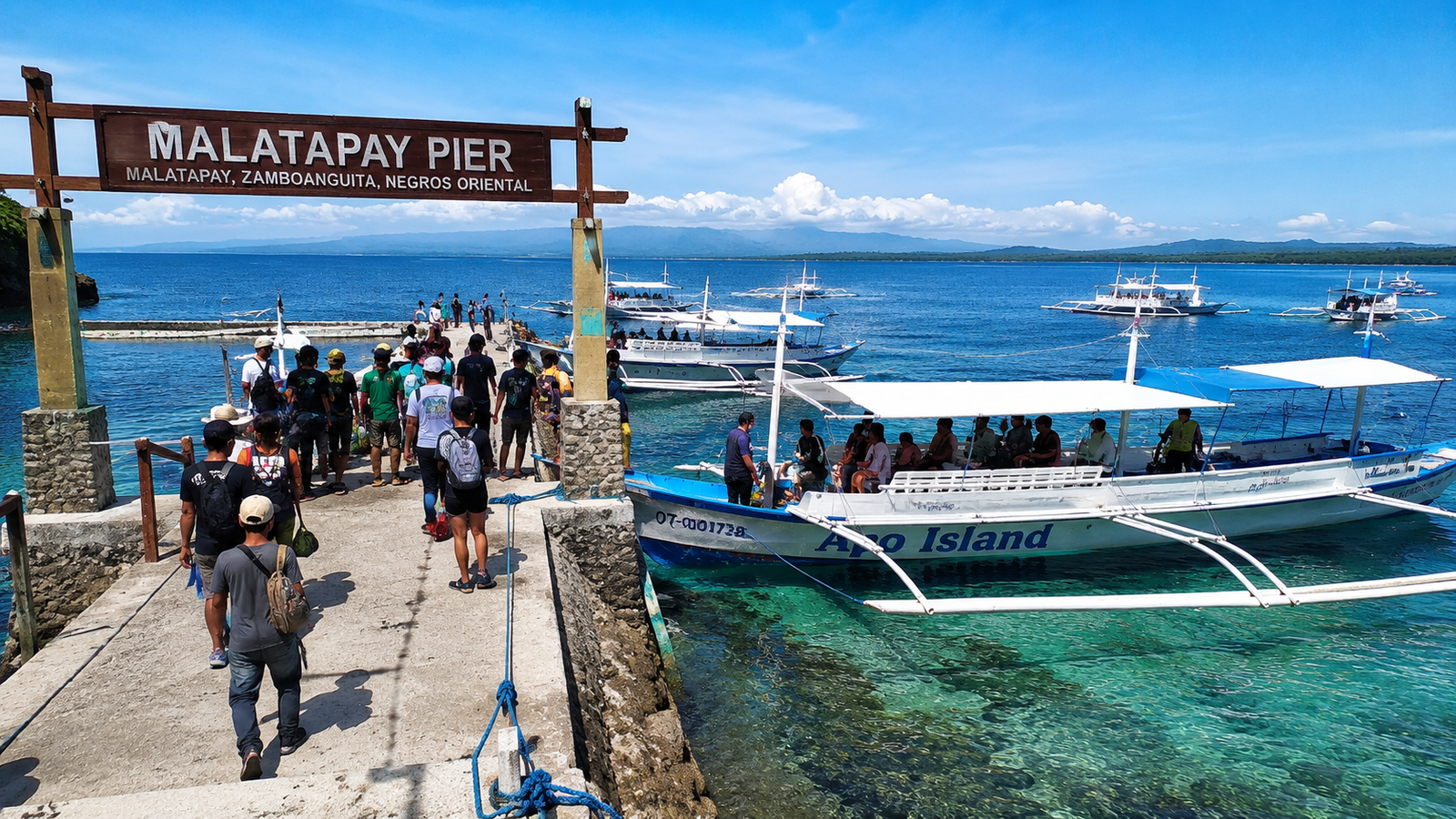
    Malatapay pier with bangka outrigger boats lined up ready to depart for Apo Island — passengers boarding at the Zamboanguita boat terminal Negros Oriental Philippines
    Malatapay pier — the departure point for all boats to Apo Island. Arrive early to share a boat and cut costs.
    Route legOptionDurationCost
    Dumaguete → MalatapayJeepney (southbound)~45 min₱20/person
    Dumaguete → MalatapayBus to Bayawan~45 min₱55–₱110
    Dumaguete → MalatapayPrivate car / Grab~40 min₱400–₱700
    Malatapay → Apo IslandShared bangka boat~30 min₱300–₱500/person
    Malatapay → Apo IslandPrivate boat charter~30 min₱2,000–₱3,500 total
    Leave early — last boat back is around 4 PM

    Leave Dumaguete by 7:00–7:30 AM at the latest. Boats back from Apo Island leave for Malatapay at around 4:00–4:30 PM. If you miss the last boat, you’ll need to stay overnight on the island. Arriving early also means you beat the day-tripper crowds and get the reef to yourself for the first hour.

    🏨
    Also accessible from Dauin

    If you’re staying at a dive resort in Dauin (20 minutes south of Dumaguete), most resorts like Atlantis Dive Resort and Atmosphere Resort run their own morning boat transfers directly to Apo Island — often including gear, guide, and lunch in a package. This is the most comfortable and efficient option for divers.
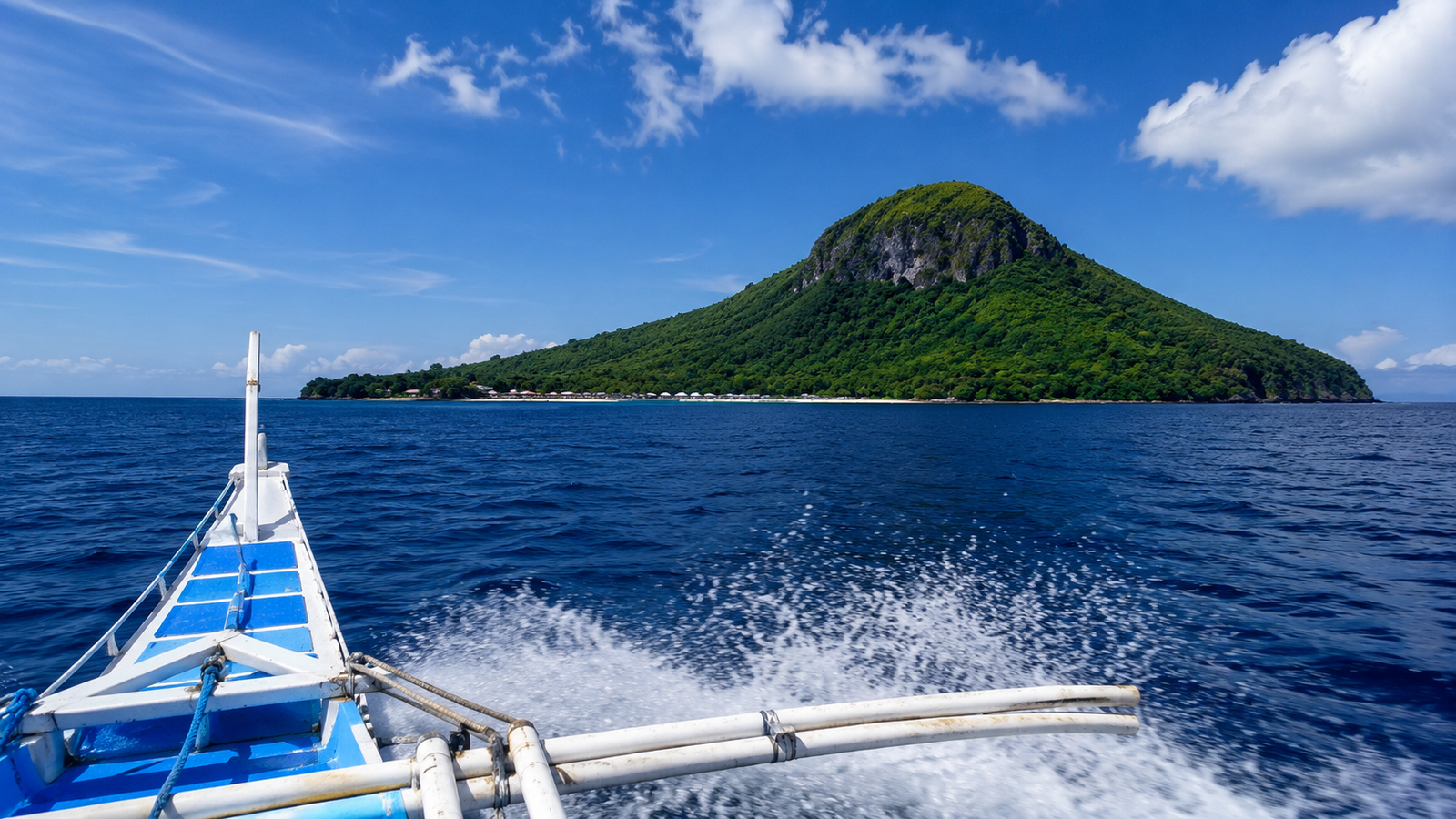
    View from a bangka outrigger boat crossing to Apo Island — open sea with spray and Apo Island's volcanic peak visible on the horizon Negros Oriental Philippines
    The 30-minute bangka crossing from Malatapay — open water, sea spray, and Apo Island growing larger on the horizon.

    Fees & Costs

    Entrance Fees & Day Trip Budget

    Fee / ExpenseFilipinoForeign visitor
    Environmental / Marine sanctuary fee₱100₱300
    Snorkeling guide fee (up to 4 persons)₱200–₱300 per group
    Snorkel gear rental (mask + fins)₱100–₱200
    Bangka boat — shared (each way)₱300–₱500/person
    Bangka boat — private charter (round trip)₱2,000–₱3,500
    Jeepney Dumaguete–Malatapay₱20/person each way
    Lunch on the island₱150–₱300/person
    Diving (if certified)₱1,500–₱2,500/dive incl. gear

    💰 Estimated total budget per person

    Budget DIY (shared boat, own gear): ₱800–₱1,200 per person
    Mid-range (private boat, rented gear, lunch): ₱1,500–₱2,500 per person
    Organized tour package from Dumaguete: ₱1,500–₱3,500 per person (all-in)
    Dive package from Dauin resort: ₱3,000–₱5,000 per person (incl. 2 dives)


    Sample Schedule

    Full Day Trip Itinerary

    Here’s a realistic schedule for a DIY day trip from Dumaguete. Organized tours follow a similar flow but with transport and meals included.

    6:30 AM
    🏙️ Depart Dumaguete — jeepney to Malatapay

    Catch a southbound jeepney from the Dumaguete terminal toward Bayawan. Tell the driver “Malatapay” — it’s a well-known stop. Fare is ₱20. Journey takes about 45 minutes along the coastal road.

    ₱20 jeepney fare💡 Leave early to beat crowds
    7:30 AM
    ⛵ Board bangka at Malatapay pier

    At the pier, negotiate with boat operators for a shared or private boat. Shared boats depart when they have enough passengers — arriving early means more people to share with and a lower cost. The 30-minute crossing is open sea, so expect some spray. Keep your valuables in a dry bag.

    ₱300–₱500/person shared💡 Bring a dry bag for electronics
    8:00 AM
    🏝️ Arrive Apo Island — register & pay fees

    Walk up the beach to the registration office. Pay your environmental fee (₱100 Filipino / ₱300 foreign) and register your group. If you need snorkel gear, rent here. Hire a snorkeling guide (mandatory for the sanctuary zone, ₱200–₱300 per group of up to 4) — they know exactly where the turtles feed each morning.

    ₱100–₱300 entrance💡 Snorkeling guide knows turtle locations
    8:30 AM
    🐢 Snorkeling at Turtle Point — morning session

    This is the highlight of the entire trip. Turtle Point is just a short swim from the beach, where green sea turtles graze on seagrass and coral algae in 1–4 meters of water. Most mornings you’ll spot multiple turtles within minutes of entering the water. The reef here is dense, colorful, and full of fish. Spend at least 1.5–2 hours here. Do not touch the turtles — observe from a respectful distance and let them come to you.

    🐢 Multiple turtles almost guaranteed before 10 AM⚠️ Never touch turtles or corals
    11:00 AM
    🍽️ Lunch — fresh seafood on the island

    The island has several small eateries and family-run food stalls. Lunch is typically grilled fish caught outside the sanctuary boundaries using sustainable methods, served with rice, vegetables, and fresh buko juice. Expect to pay ₱150–₱300 per person. It’s simple, fresh, and genuinely local. Sit under the coconut palms, dry off, and refuel.

    🐟 Order: grilled fresh fish + rice + buko₱150–₱300/person
    12:30 PM
    🚶 Village walk & lighthouse hike (optional)

    After lunch, explore the island on foot. Walk through the small fishing village — fishermen repair nets under coconut palms, children play in sandy courtyards, and the pace of life is beautifully unhurried. For the adventurous, hike the 369 steps up to the lighthouse for a panoramic view of the marine sanctuary and surrounding sea. Takes about 30–45 minutes round trip.
    🏔️ Lighthouse hike: 369 steps, worth every oneFree
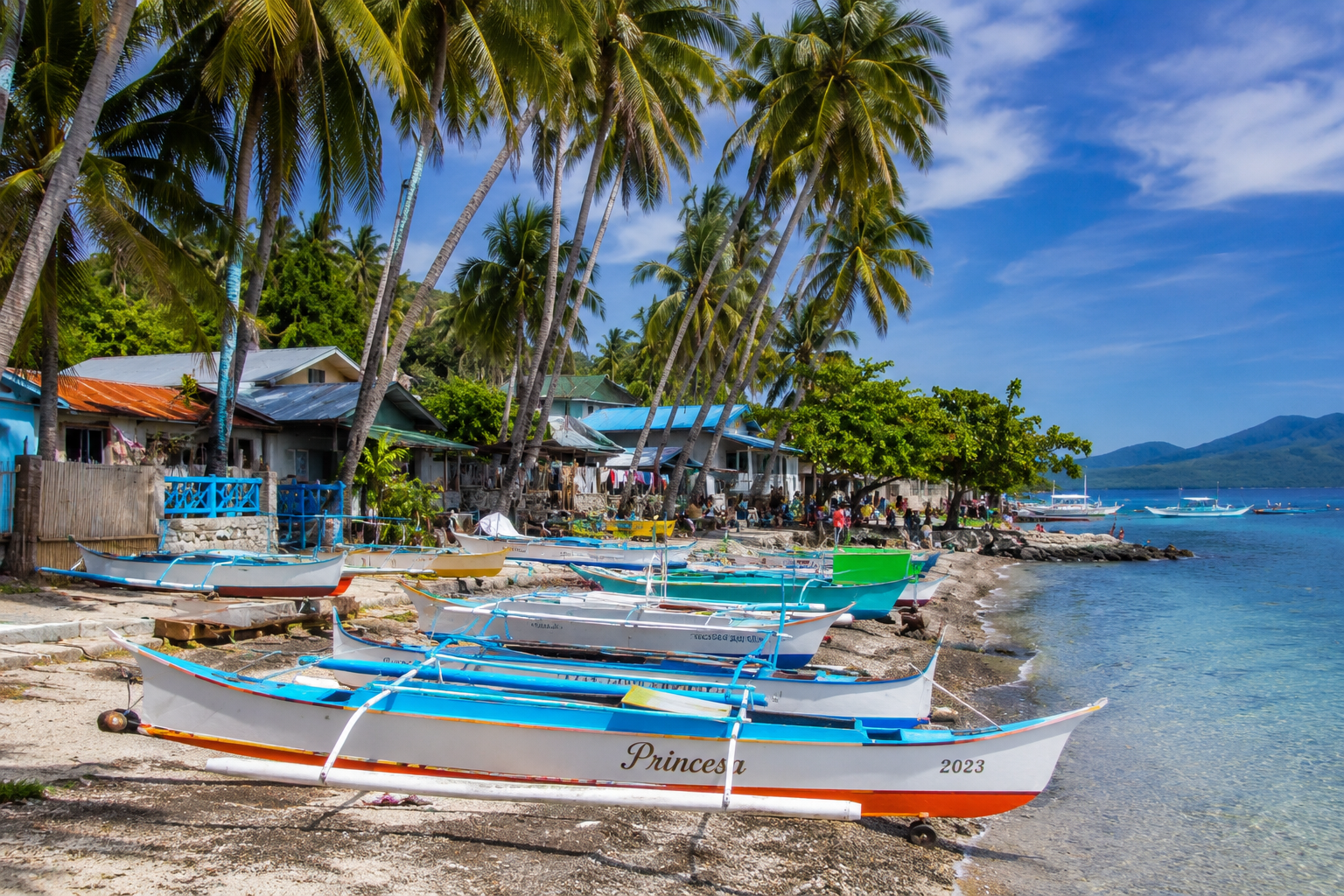
    Apo Island fishing village with colorful bangka boats on the beach and coconut palms — the lighthouse trail path visible leading up the volcanic hill Philippines
    The Apo Island village and lighthouse trail — a slow walk through local life, followed by 369 steps and a panoramic view that makes the climb worth it.
    2:00 PM
    🤿 Afternoon snorkel — second session

    The afternoon light is different — lower angle, longer shadows across the coral, often stunning. Many visitors go for a second snorkel session after the village walk. The crowds from day-tripper boats have thinned by early afternoon. Try snorkeling on the other side of the village for a different reef section with fewer people.

    📸 Afternoon light is best for underwater photography
    3:45 PM
    🛶 Board the last boat back to Malatapay

    Be at the beach and ready to board by 3:45–4:00 PM. The last boat back to Malatapay typically departs around 4:00–4:30 PM. Missing it means spending the night — the island has limited and basic accommodation. From Malatapay, catch a jeepney or bus back to Dumaguete (another 45 minutes). You’ll be back in town before dark.

    ⚠️ Last boat ~4:00–4:30 PM — don’t be late₱300–₱500 return boat fare

    Snorkeling

    Snorkeling at Apo Island: What to Expect

    You do not need to be a diver to have a world-class experience at Apo Island. The snorkeling here is as good as it gets in the Philippines — arguably better for turtles than anything in Palawan or Boracay.

    Snorkeling is done in the zones just outside the sanctuary’s inner boundary, marked by floating buoys. The water depth ranges from 1–5 meters in the main snorkeling areas, making it accessible for beginners. The sanctuary protects over 400 coral species, nearly 90% of all Philippine coral varieties — including massive brain corals, delicate staghorn formations, and colorful soft corals visible from the surface.

    Key snorkeling spots

    SpotDepthBest for
    Turtle Point1–4 mSea turtles grazing on seagrass — the #1 spot
    Main reef (west side)2–5 mHard coral gardens, clownfish, parrotfish
    East side reef3–6 mLess crowded, more diverse fish life
    South corner4–8 mDeeper coral formations, occasional reef sharks
    🐢
    The turtle experience

    Green sea turtles and hawksbill turtles are permanent residents of the Apo Island sanctuary — not seasonal visitors. They feed on seagrass and coral algae in the shallow reef zone daily. Most morning snorkelers spot multiple turtles within the first 15 minutes. The turtles are completely accustomed to human presence and often swim directly toward snorkelers out of curiosity. Never touch, chase, or block their path to the surface to breathe.
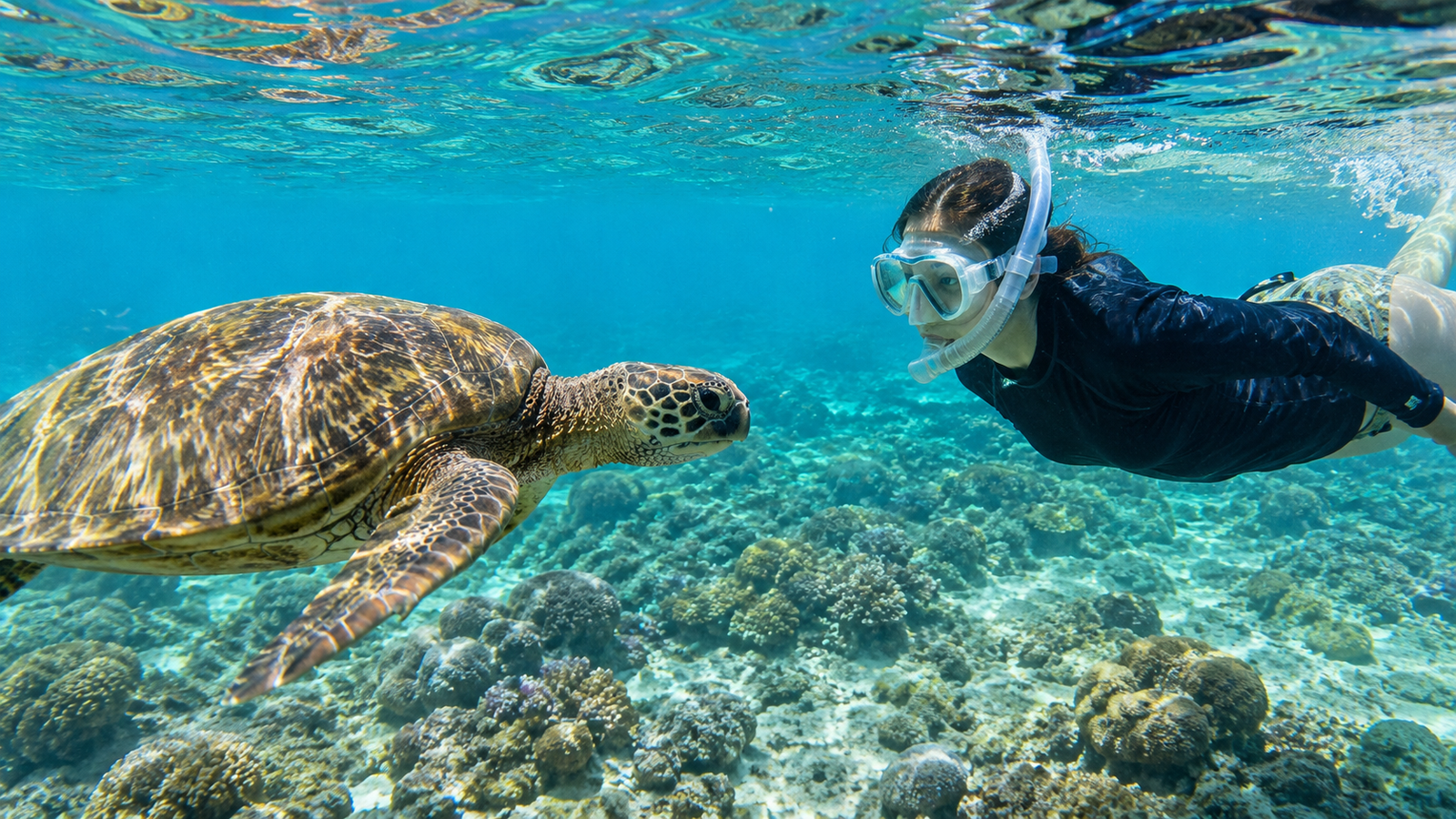
    Snorkeler face to face with a green sea turtle at Turtle Point Apo Island Philippines — shallow clear turquoise water with coral reef visible below
    Turtle Point, Apo Island — where green sea turtles graze in 1–4 meters of water, completely unbothered by snorkelers. This encounter is virtually guaranteed before 10 AM.
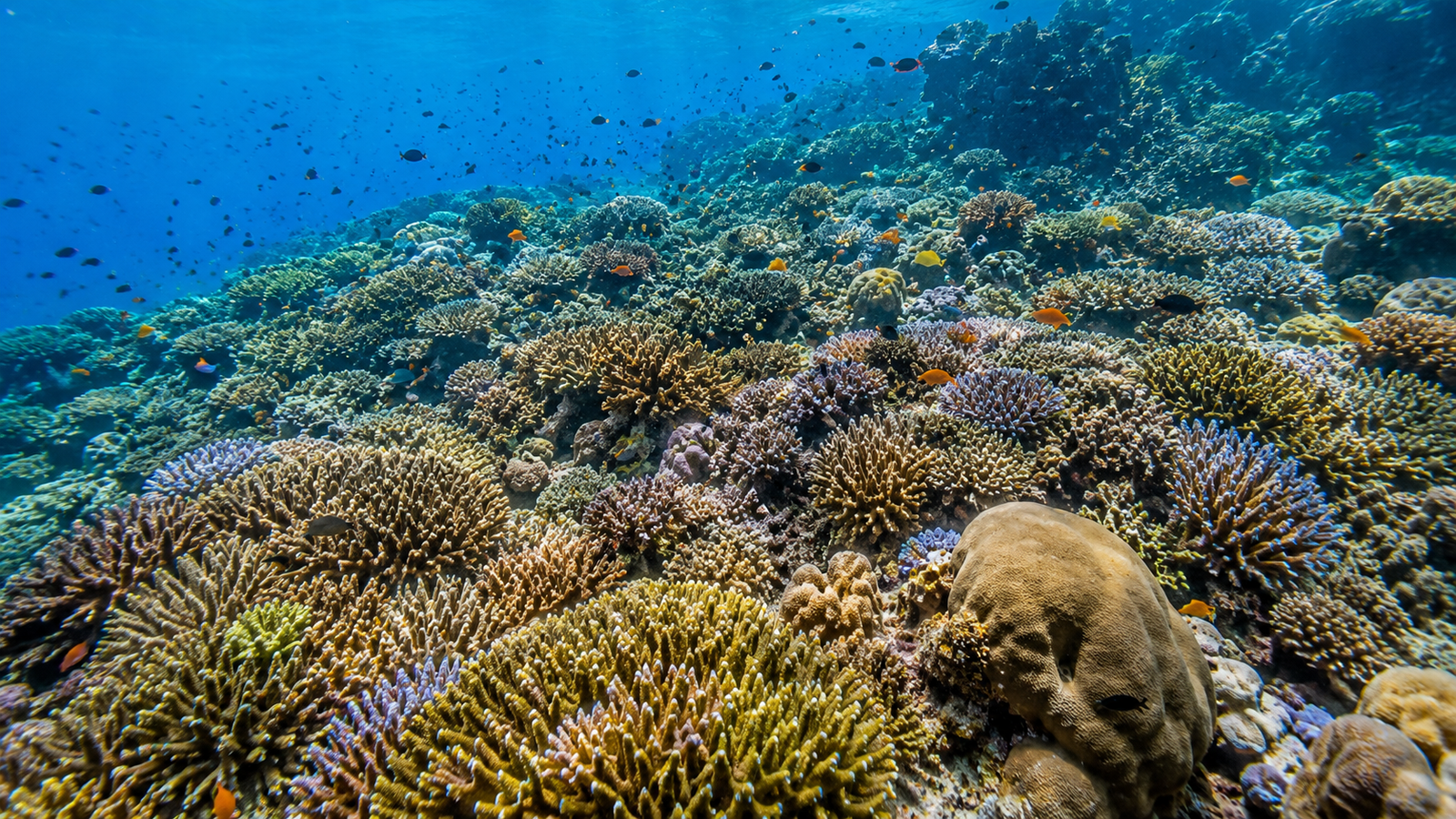
    Apo Island coral reef from above snorkeling — dense hard coral garden with colorful tropical fish in clear blue water Philippines marine sanctuary
    The Apo Island reef from a snorkeler’s perspective — 400+ coral species and 650+ fish species packed into one of the healthiest marine sanctuaries in the Philippines.

    Diving

    Diving at Apo Island

    Apo Island is one of the top dive destinations in the Philippines and has been in every serious diver’s bucket list for decades. While snorkeling covers the top 1–5 meters, diving reveals the full spectacle: dramatic walls, gorgonian sea fans, swim-throughs, and marine life density that surprises even experienced divers.

    Best dive sites

    Dive siteDepthHighlights
    Coconut Point5–30 mClassic wall dive, gorgonian fans, abundant fish life, excellent visibility
    Rock Point East5–28 mCoral bommies, schooling jacks, turtles at depth
    Mamsa Point8–25 mFrogfish, nudibranchs, macro photography paradise
    Chapel Point5–20 mSoft corals, sea fans, hawksbill turtles
    Katipanan10–30 mThe wall dive — sheer drop with sea fans and sponges
    🤿
    How to arrange diving

    Diving at Apo Island is best arranged through a dive resort in Dauin (20 min from Dumaguete), such as Atlantis Dive Resort or Atmosphere Resort. They provide equipment, dive guides, boat transfers, and marine sanctuary fees in their packages. Walk-in diving from the island is also possible with the local dive operators based at Apo Island Beach Resort. A single dive with full equipment typically costs ₱1,500–₱2,500.
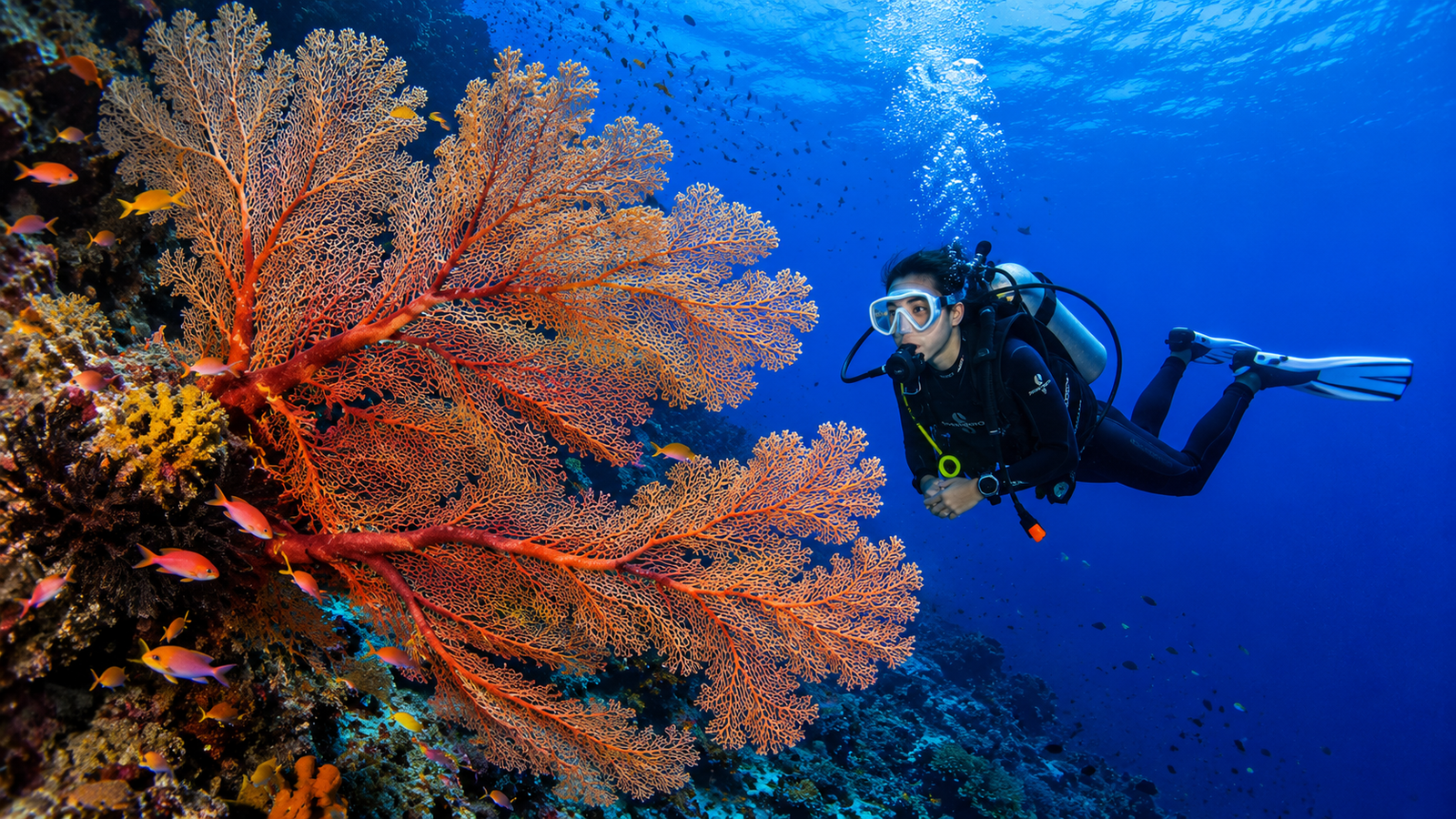
    Scuba diver alongside a massive gorgonian sea fan on the Apo Island wall dive — deep blue water background with vibrant coral Philippines
    The Apo Island wall dive — gorgonian sea fans, sheer coral walls, and visibility up to 40 meters on the best days. A bucket-list dive for any serious underwater photographer.

    Underwater Wildlife

    Marine Life You’ll See at Apo Island

    The clear waters and healthy coral cover, averaging 50–70%, support over 650 species of fish and more than 300 species of corals. Here’s what to look for:

    🐢
    Green Sea Turtle
    The star of the show. Permanent residents that feed on seagrass in the shallows. Virtually guaranteed on every visit.
    🐢
    Hawksbill Turtle
    Slightly smaller than green turtles, with a narrower head. Often seen at depth among the coral and sea fans.
    🐠
    Clownfish (Nemo)
    Found darting between sea anemones throughout the reef. One of the most photographed residents.
    🐡
    Parrotfish
    Brilliant blues, greens, and pinks. Constantly grazing on coral — their crunching sound fills the reef.
    🦈
    Reef Shark
    Occasional sighting around the deeper southern reef sections. Harmless to snorkelers and divers.
    🪸
    Brain & Staghorn Corals
    Massive formations visible from the surface. The staghorn thickets are a diver highlight at 15–18 m depth.
    🐙
    Frogfish & Nudibranchs
    Macro photographer heaven. Multiple frogfish species hide in the staghorn coral at 15–20 m.
    🐍
    Sea Snakes
    Banded sea snakes are common and curious. They are venomous but non-aggressive — do not handle them.
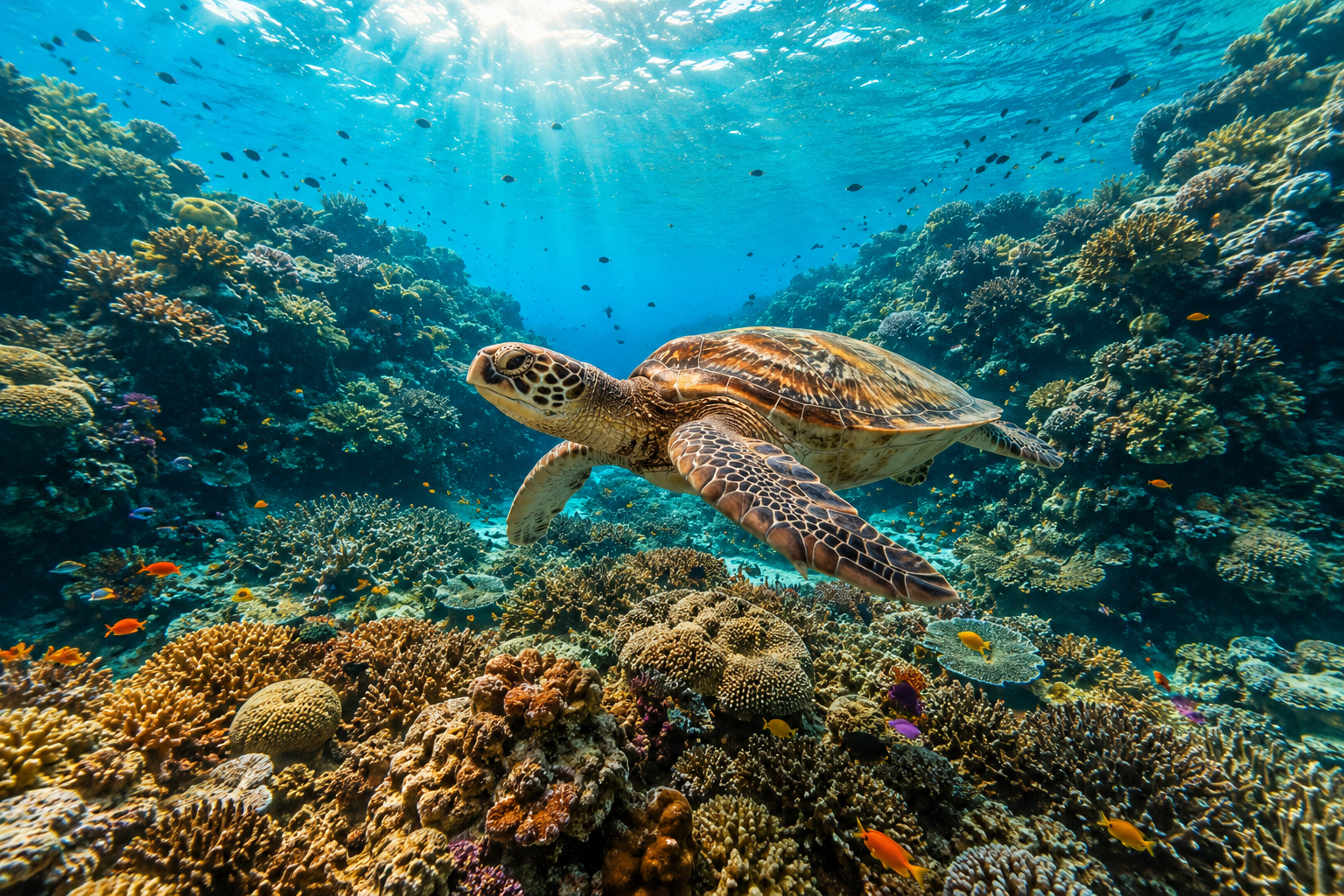
    Green sea turtle swimming through the Apo Island marine sanctuary Philippines — calm clear blue water with coral reef in the background
    A resident green sea turtle gliding through the Apo Island sanctuary. Both green and hawksbill turtles have called this reef home for generations.
    Conservation

    Rules & Conservation at Apo Island

    Apo Island’s marine sanctuary is the oldest continuously operating community-managed marine protected area in the Philippines, established in 1982. The locals are fully invested in the project, having seen fish stocks blossom and revenue from tourists dramatically increase. The rules are strictly enforced by local rangers and fellow visitors. Breaking them is not just illegal — it’s a genuine harm to an ecosystem that has taken 40 years to build.

    What is and isn’t allowed

    • Snorkeling and swimming outside the sanctuary boundary markers
    • Watching turtles from a respectful distance (at least 1–2 meters)
    • Underwater photography and videography
    • Hiring a local snorkeling guide (encouraged and often required)
    • Buying food and souvenirs from local vendors on the island
    • Touching, riding, or feeding sea turtles or any marine life
    • Standing on or touching coral — even dead coral
    • Collecting shells, coral, or any material from the reef
    • Using non-reef-safe sunscreen (chemical sunscreen damages coral)
    • Fishing of any kind within the sanctuary zone
    • Throwing trash anywhere on the island or in the water
    • Entering the inner sanctuary zone (inside the buoy markers)
    ☀️
    Use reef-safe sunscreen only

    Standard chemical sunscreens (containing oxybenzone and octinoxate) are proven to bleach coral and disrupt turtle endocrine systems. Use only reef-safe, mineral-based sunscreen (containing zinc oxide or titanium dioxide) before entering the water at Apo Island. Better yet, wear a UV-protective rash guard and avoid sunscreen in the water entirely. This is not just etiquette — it’s enforced.
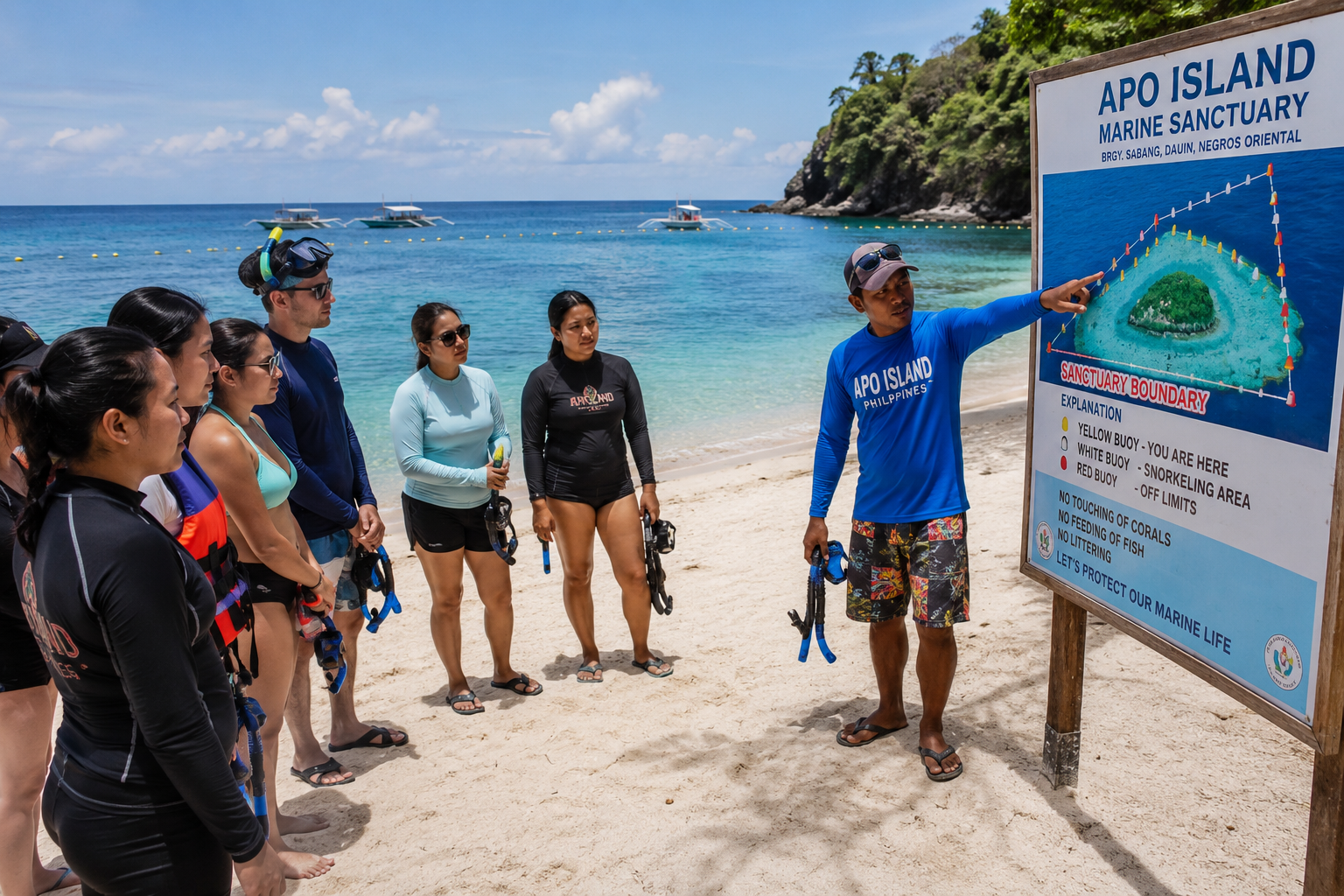
    Local snorkeling guide briefing visitors on Apo Island beach before entering the marine sanctuary — showing sanctuary boundary markers and conservation rules Philippines
    Every group gets a pre-snorkel briefing from a local guide on conservation rules — no touching turtles, no standing on coral, reef-safe sunscreen only.

    Eating on the Island

    What to Eat on Apo Island

    Apo Island has no restaurants in the commercial sense — just a handful of family-run eateries and food stalls operated by local residents. The food is simple, fresh, and exactly right for the setting.

    All fish served on the island is caught outside the sanctuary boundaries using sustainable line fishing — not from the protected reef. Expect grilled fish, kinilaw (raw fish ceviche in vinegar and coconut milk), garlic rice, and fresh buko (coconut water) straight from the tree. Budget ₱150–₱300 per person for a full meal.

    🥥
    Bring some snacks too

    Food options on the island are limited and sell out by early afternoon on busy days. Bring your own snacks and plenty of water — at least 1.5 liters per person. The crossing can be rough, snorkeling is physical, and the island has no convenience stores. Pack fruit, crackers, and electrolytes alongside your dry bag.
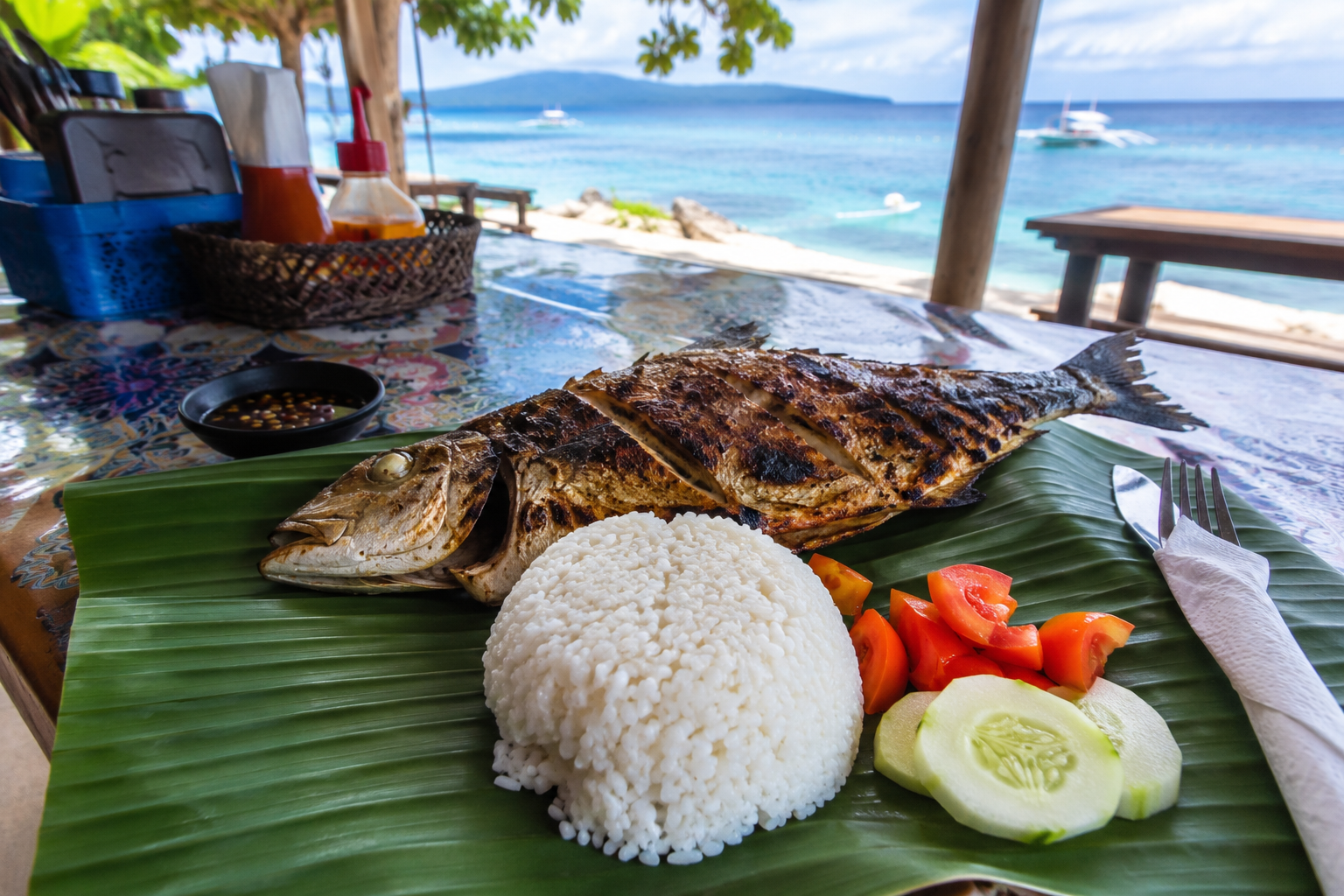
    Fresh grilled fish lunch served on a banana leaf at an Apo Island beachside eatery — sustainably caught outside the marine sanctuary Philippines
    Lunch on Apo Island — grilled fish caught sustainably outside the sanctuary, served with garlic rice and buko juice under the coconut palms. ₱150–₱300 per person.

    Planning

    Organized Tour vs DIY — Which is Better?

    DIY (independent)Organized tour
    Cost₱800–₱1,500/person₱1,500–₱3,500/person
    FlexibilityHigh — go at your own paceFixed schedule
    ConvenienceYou arrange everythingEverything handled for you
    Best forExperienced travelers, groupsFirst-timers, solo travelers, families
    LunchBuy on the islandUsually included
    GearRent on the islandUsually included
    Boat stressYou negotiate at the pierPre-arranged, stress-free
    💡
    Our recommendation

    First-timers and solo travelers: book an organized day tour. The price difference is small and the stress savings are significant — no pier negotiation, no transport figuring-out, gear included. Couples and small groups: DIY is worth it. Charter a private boat (₱2,000–₱3,500 total for up to 6 people), split the cost, and enjoy maximum flexibility on the island.


    When to Go

    Best Time to Visit Apo Island

    The best time to visit Apo Island is during the dry season from November to May. March and April offer the calmest seas and best visibility, with water temperatures around 82°F — perfect for extended snorkeling without a wetsuit. Water visibility on a good day reaches 30–40 meters.

    Avoid June to October when typhoons and the southwest monsoon bring rough seas. Boat trips can be cancelled with little notice during this period, and underwater visibility drops significantly.

    Within any day, arrive as early as possible — before 9 AM if you can. Turtles are most active feeding in the morning. By 11 AM, organized tour boats arrive and the snorkeling areas get crowded. The first hour of the day at Apo Island, with calm water and few other visitors, is an experience worth waking up for.

    MonthConditionsRecommendation
    Nov – JanDry, some northeast swell✅ Good — good visibility, fewer crowds
    Feb – AprDriest, calmest seas⭐ Best — peak conditions, peak visibility
    MayTransition, still mostly dry✅ Good — excellent before rains arrive
    Jun – OctRainy, rough seas, typhoon risk⚠️ Avoid — boats may cancel, poor visibility
    Calm turquoise water at Apo Island on a clear dry season morning — ideal snorkeling and diving conditions November to May Philippines
    Apo Island on a dry season morning — glassy water, 30-40 meter visibility, and turtles in the shallows. November to May is when conditions are at their best.

    Practical Advice

    Practical Tips for Your Apo Island Day Trip

    🎒
    What to bring

    Dry bag (essential for phone and valuables on the boat), reef-safe sunscreen, rash guard or wetsuit, water shoes for the pier wade-in, at least 1.5L of water, snacks, cash (₱2,000+ per person recommended), underwater camera or GoPro, prescription swim goggles if needed.

    💵
    Bring cash — no ATMs on the island

    There are no ATMs on Apo Island and no card payments accepted anywhere. Bring enough cash for boat fare (both ways), entrance fee, snorkel guide, gear rental, lunch, and a little extra for souvenirs. ₱2,000–₱3,000 per person covers most scenarios comfortably.

    👟
    Wear water shoes or old sandals

    Both at Malatapay pier and Apo Island beach, you’ll need to wade through shallow water to reach or leave the bangka boat. The seabed can be rocky. Water shoes or old sandals you don’t mind getting wet are highly recommended. Flip flops tend to come off in the surf.

    🌊
    Check sea conditions before you go

    The 30-minute boat crossing can be rough, especially from December to February when the northeast swell picks up. If you’re prone to motion sickness, take sea sickness medication 1 hour before departure. Ask locals at Malatapay pier about current conditions — they’ll tell you honestly if the crossing is too rough that day.


    FAQ

    Frequently Asked Questions About Apo Island

    How do you get to Apo Island from Dumaguete?
    Take a southbound jeepney from Dumaguete to Malatapay (45 min, ₱20). From Malatapay pier, take a bangka boat to Apo Island (30 min, ₱300–₱500 per person shared, or ₱2,000–₱3,500 for a private charter). Total journey is about 1.5 hours each way. Leave Dumaguete by 7:00–7:30 AM.
    How much is the entrance fee to Apo Island?
    The environmental fee is ₱100 for Filipino visitors and ₱300 for foreigners. A snorkeling guide fee of ₱200–₱300 (per group of up to 4) is also required for the sanctuary zone. Snorkel gear rental costs an additional ₱100–₱200 if you don’t bring your own.
    Will I definitely see sea turtles at Apo Island?
    Almost certainly, yes. Green sea turtles and hawksbill turtles are permanent residents of the sanctuary and feed daily in the shallow reef zone. Morning snorkelers (before 10 AM) virtually always spot multiple turtles within the first 15–20 minutes. A local guide will take you directly to where they feed.
    Is Apo Island good for non-divers?
    Absolutely. Snorkeling at Apo Island is world-class on its own. The turtles, coral gardens, and fish life are all accessible in 1–5 meters of water with a simple mask and fins. You do not need to be a diver to have an unforgettable experience here.
    What time should I leave Dumaguete?
    Leave Dumaguete by 7:00–7:30 AM at the latest. This gets you to Malatapay by 8:15 AM, on the water by 8:30 AM, and snorkeling before the organized tour boats arrive at 10–11 AM. The morning is the best time for turtle sightings and calm conditions.
    Can you stay overnight on Apo Island?
    Yes. Apo Island has a few basic accommodation options including Liberty’s Lodge and Apo Island Beach Resort. Overnight stays are recommended for divers who want to do multiple dives across different sites. Note that electricity is limited — the generator usually runs only until 10–11 PM.
    Is Apo Island near Siquijor?
    Yes — Apo Island is about 12 km northeast of Siquijor. Some Siquijor-based tour operators offer Apo Island day trips, but the most common and practical gateway is Dumaguete, which is closer and has more frequent boat departures from Malatapay.

    GC
    Giovanni Carlo Bagayas
    Filipino Travel Writer & Content Creator
    I was born in Cebu City and grew up in Dumaguete — Apo Island is practically in my backyard. I’ve been making the Malatapay crossing more times than I can count, and the turtle encounters never get old. This guide is written from first-hand experience, not aggregated travel writing. The turtles really are that close.

    Keep Exploring

    More Dumaguete & Negros Oriental Guides

  • How to Get to Siquijor from Cebu & Dumaguete (2026) — Ferry + New Flights

    How to Get to <a href="https://bestphilippinestravelguide.com/siquijor-delicacies/">Siquijor</a> from <a href="https://bestphilippinestravelguide.com/cebu-philippines/">Cebu</a> & Dumaguete (2026) — Ferry + New Flights
    🇵🇭 Siquijor Travel Guide Updated 2026

    How to Get to Siquijor from Cebu & Dumaguete (2026)

    Ferry from Dumaguete in 45 minutes, OceanJet from Cebu in 4–5 hours, or fly direct with the brand-new Sunlight Air flights launched December 2025. Every option — fully explained.

    🚢 Ferry routes ✈️ New direct flights 💰 Fares & schedules 🆕 Updated June 2026
    How to get to Siquijor Philippines — ferry from Dumaguete and the new Sunlight Air direct flights from Cebu launched December 2025
    ⚡ Quick answer

    The fastest and easiest way to get to Siquijor is by fast ferry from Dumaguete (45–60 minutes, from ₱260). From Cebu, you can take the OceanJet via Tagbilaran (4–5 hours, from ₱1,600) or fly direct with Sunlight Air (1 hour, from ₱1,988) — the first commercial airline to ever fly to Siquijor, launched December 15, 2025. Siquijor has no major airport accepting wide-body jets, and no road access — all arrivals are by sea or the new Sunlight Air flights.

    All Options

    All Ways to Get to Siquijor — At a Glance

    Siquijor is a small island in the Central Visayas that had, until December 2025, zero commercial flights. Getting there meant a ferry — full stop. That changed when Sunlight Air landed the first-ever commercial aircraft on the island on December 15, 2025, opening a direct air link from Cebu. Here is every option available as of 2026.

    🚢
    Ferry from Dumaguete
    The most popular route. Frequent departures from 5 AM to 7:30 PM daily. Multiple operators. No pre-booking needed for most trips.
    ⏱ 45–90 min ₱130–₱455 ⭐ Best for most travelers
    ✈️
    Fly: Sunlight Air from Cebu
    The new direct flight launched Dec 15, 2025. First-ever commercial flight to Siquijor. 4x weekly Mon/Wed/Fri/Sun. ATR 72 aircraft.
    ⏱ ~1 hour from ₱1,988 🆕 New Dec 2025
    🚢
    Ferry from Cebu (OceanJet)
    Direct ticket, stops in Tagbilaran (Bohol) — stay on the same boat. Twice daily departures from Cebu Pier 1. Air-conditioned fastcraft.
    ⏱ 4–5 hours ₱1,600–₱2,400
    🚢
    Ferry from Tagbilaran, Bohol
    OceanJet direct from Tagbilaran Port to Siquijor. Good option if you’re already in Bohol on a multi-island trip.
    ⏱ ~2 hours ₱500–₱700
    Siquijor island seen from the sea on approach — blue water in the foreground with the island's lush green hills on the horizon, Philippines
    Siquijor on approach from the sea — the view most visitors get from the ferry. The island’s compact size and green hills are visible from miles out.

    🆕 Brand New — December 2025

    Sunlight Air Direct Flights from Cebu to Siquijor

    ✈️
    Historic first — December 15, 2025

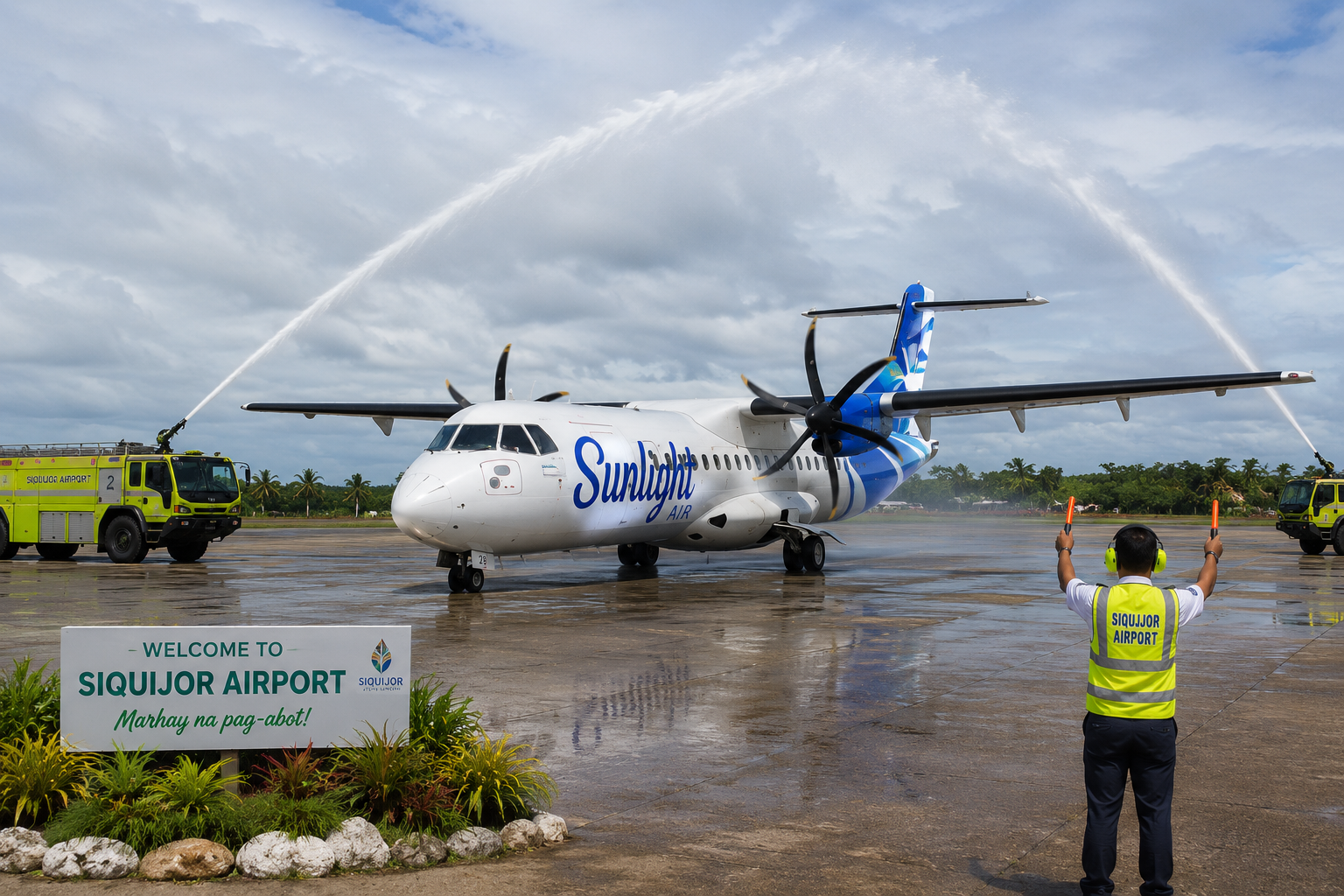
    On December 15, 2025, a Sunlight Air ATR 72-500 carrying 68 passengers touched down at Siquijor Airport — the first commercial aircraft ever to land on the island. It was greeted by a ceremonial water cannon salute. Siquijor, which had depended entirely on sea travel for all of its history, finally had an air connection to the rest of the Philippines.

    Sunlight Air ATR 72 aircraft on the tarmac at Siquijor Airport on December 15 2025 — the first-ever commercial flight to land on Siquijor island Philippines
    Sunlight Air’s inaugural flight at Siquijor Airport, December 15, 2025 — a historic moment marking the island’s first-ever commercial airline connection.

    Sunlight Air launched the Cebu–Siquijor route on December 15, 2025, making it the only commercial airline currently serving Siquijor Airport (IATA code: SQF). The route was developed in partnership with the Provincial Government of Siquijor, led by Governor Jake Villa, who spearheaded the airport upgrade and airline partnership over several years.

    Flight schedule (Cebu–Siquijor)

    FlightRouteDepartureArrivalDays
    2R875Cebu (CEB) → Siquijor (SQF)10:20 AM11:20 AMMon, Wed, Fri, Sun
    2R876Siquijor (SQF) → Cebu (CEB)11:40 AM12:40 PMMon, Wed, Fri, Sun

    Key facts about the Sunlight Air Siquijor route

    DetailInformation
    AircraftATR 72-500 / ATR 72-600 (turboprop, ~70 seats)
    Flight timeApproximately 1 hour
    Frequency4x weekly — Monday, Wednesday, Friday, Sunday
    Introductory fareFrom ₱1,988 one-way base fare (Cebu–Siquijor)
    Bookingres.sunlightair.ph or through travel agents
    ConnectionsManila and Clark via Cebu hub; also connecting to Siargao and Coron
    Launch dateDecember 15, 2025
    💡
    Is the flight worth it over the ferry?

    For travelers coming directly from Cebu, the Sunlight Air flight saves you 3–4 hours of sea travel and removes the uncertainty of rough seas during typhoon season. At ₱1,988+ base fare vs ₱1,600 for OceanJet, the price difference is small for the time you gain. Book early — the plane holds around 70 passengers and the route is gaining popularity fast.

    🔗
    Connections from Manila and other islands

    Travelers from Manila, Clark, or Siargao can connect to Siquijor via Cebu as a hub. Sunlight Air offers connecting flights on the same airline, which simplifies booking. From Manila, fly to Cebu with any carrier, then connect to the Sunlight Air Siquijor flight on the same day (the 10:20 AM departure gives you enough time from most morning Manila–Cebu flights).

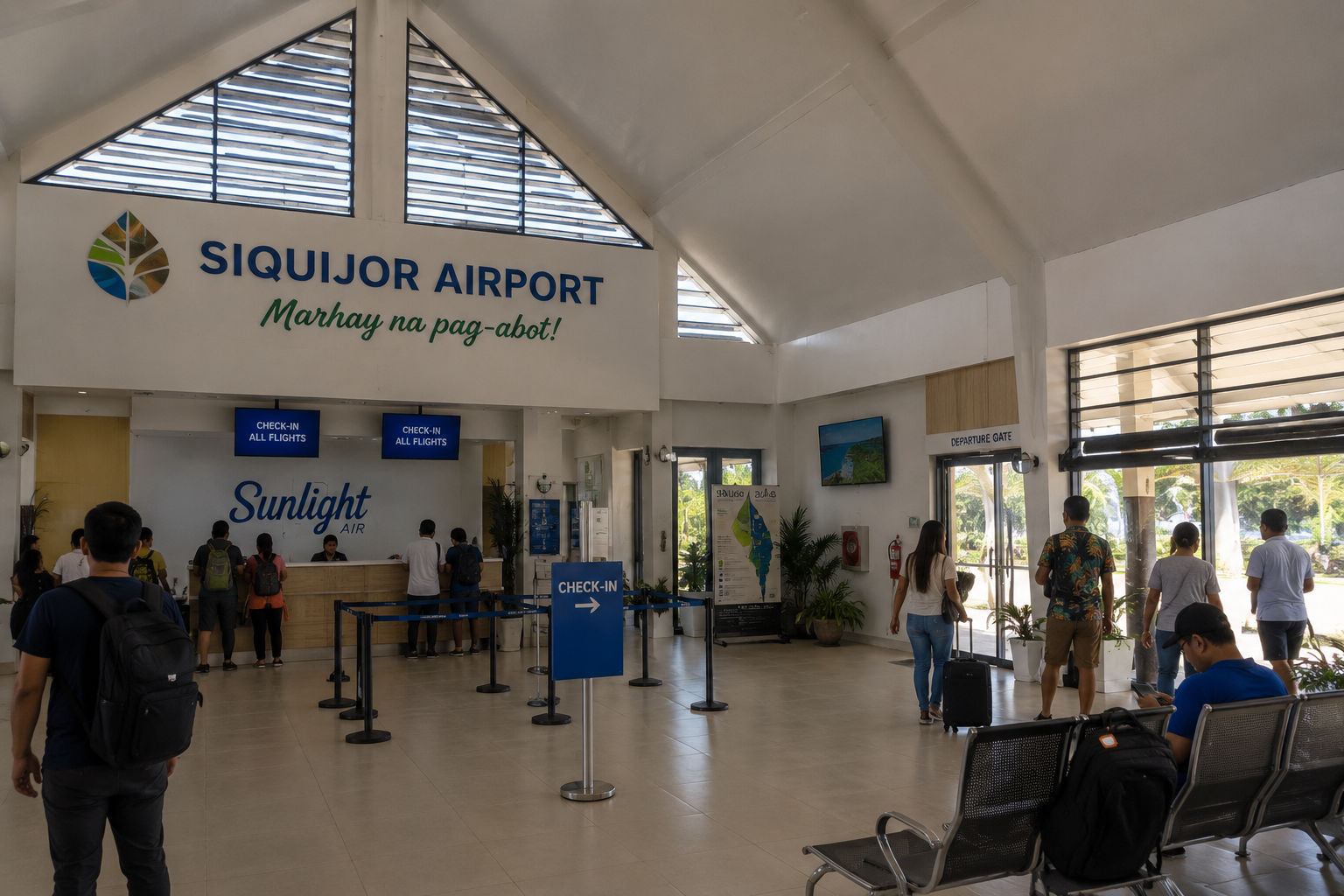
    Siquijor Airport terminal building — the small but modern domestic airport that opened for commercial flights in December 2025, serving Sunlight Air flights from Cebu
    Siquijor Airport’s newly upgraded terminal — modest, functional, and historic. Sunlight Air is the only commercial airline currently serving it.

    Most Popular Route

    Ferry from Dumaguete to Siquijor

    This is how the vast majority of travelers — both Filipino and international — reach Siquijor. It is fast, affordable, frequent, and stress-free. The port is central, departures run all day, and you don’t need to book in advance for most trips.

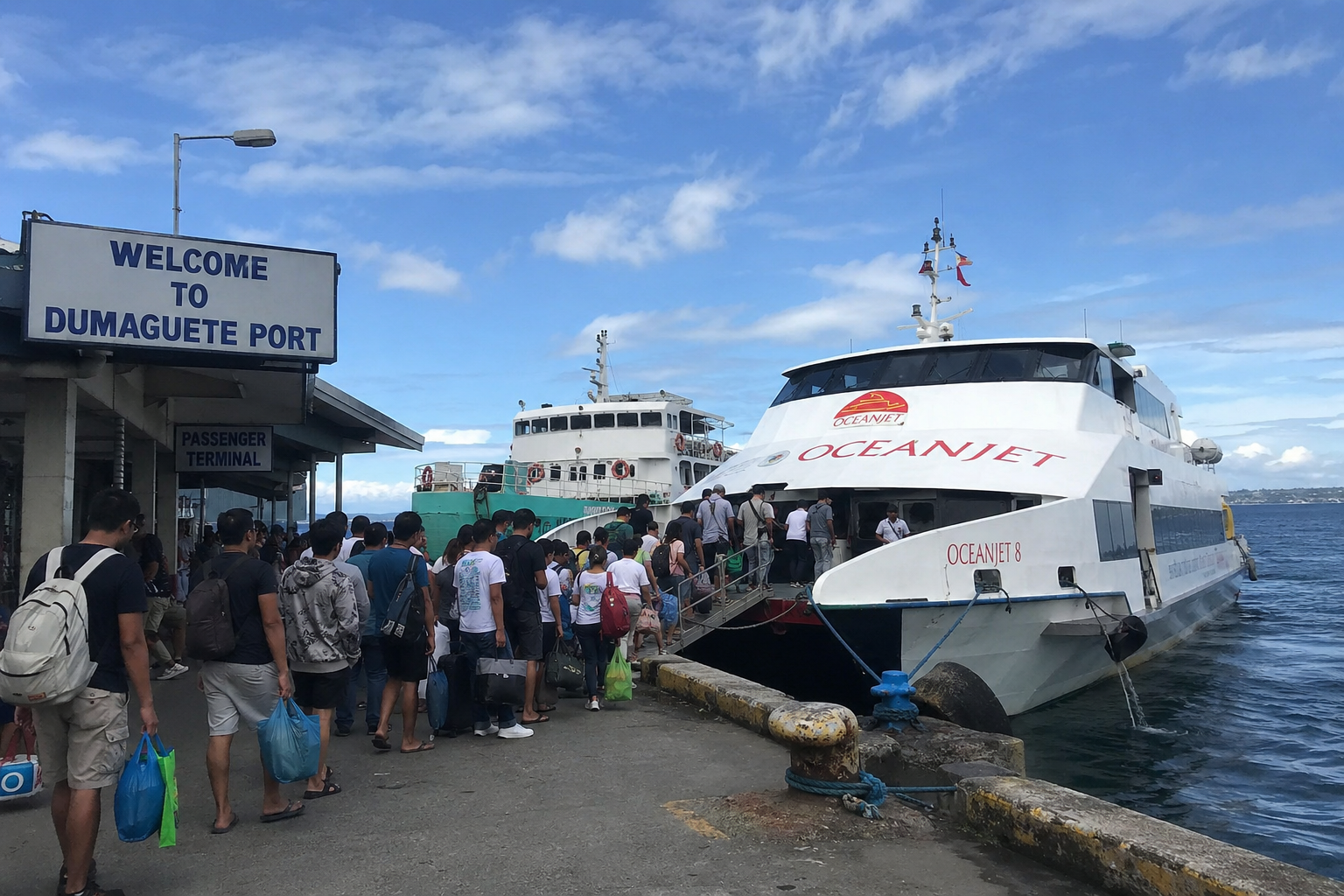
    Dumaguete port with passengers boarding a ferry to Siquijor — showing the pier, vessels, and ticket booths at the Dumaguete City ferry terminal Philippines
    Dumaguete port — the most popular jumping-off point for Siquijor, with ferries running from 5 AM to 7:30 PM daily across multiple operators.

    Step-by-step: Cebu → Dumaguete → Siquijor

    1
    Fly from Cebu to Dumaguete (DGT)

    Cebu Pacific, Philippine Airlines, and AirAsia all operate the Cebu–Dumaguete route. Flight time is 40–50 minutes. Fares range from ₱800–₱2,500 depending on how early you book. Daily flights available.

    2
    Transfer from Dumaguete Airport to the port

    Dumaguete Airport is small and the port is only 10–15 minutes away by tricycle or Grab. Tricycle costs ₱30–₱80. Grab is available and usually ₱60–₱150. No buses needed.

    3
    Buy your ferry ticket at the Dumaguete port

    Multiple operators have booths at the port: OceanJet, Montenegro Lines, Anika Star (HS Star Marine), and Aleson Shipping. No advance booking required for most departures — just show up, buy a ticket, and board. Bring cash.

    4
    Take the ferry to Siquijor (45–90 minutes)

    Fastcraft ferries (OceanJet, Anika Star) take 45–60 minutes. RORO ferries (Montenegro, Aleson) take 1.5–2 hours but are cheaper and can carry your vehicle. First departure is 5:00 AM, last is 7:30 PM.

    5
    Arrive at Siquijor Port — rent your scooter

    Scooter rental shops line the pier exit. Rent for ₱300–₱500/day. San Juan, the main tourist hub, is about 20–25 minutes west along the ring road.

    Dumaguete–Siquijor ferry options comparison

    OperatorTypeTravel timeFareVehicles?
    OceanJet FASTFastcraft45–50 min₱260–₱380No
    Anika Star (HS Star Marine)Fastcraft45–60 min₱260–₱300No
    Montenegro LinesRORO + Fastcraft1–1.5 hr₱130–₱455Yes (RORO)
    Aleson ShippingRORO1.5–2 hr₱130–₱200Yes
    🕐
    Departure schedule from Dumaguete

    Ferries depart Dumaguete from as early as 5:00 AM to 7:30 PM daily, with departures roughly every 1–2 hours depending on the operator. This frequency means you can arrive in Dumaguete at almost any time and catch a ferry within the hour. Always confirm current times at the port booth, as schedules shift slightly by season.

    🏍
    Bringing a motorcycle?

    If you want to bring your own motorcycle to Siquijor, use the Montenegro RORO service. The vehicle freight rate is approximately ₱570 for a motorcycle and ₱1,430 for a private 4-wheel vehicle, on top of the passenger fare. Travel time is about 1.5–2 hours on the RORO vessel.

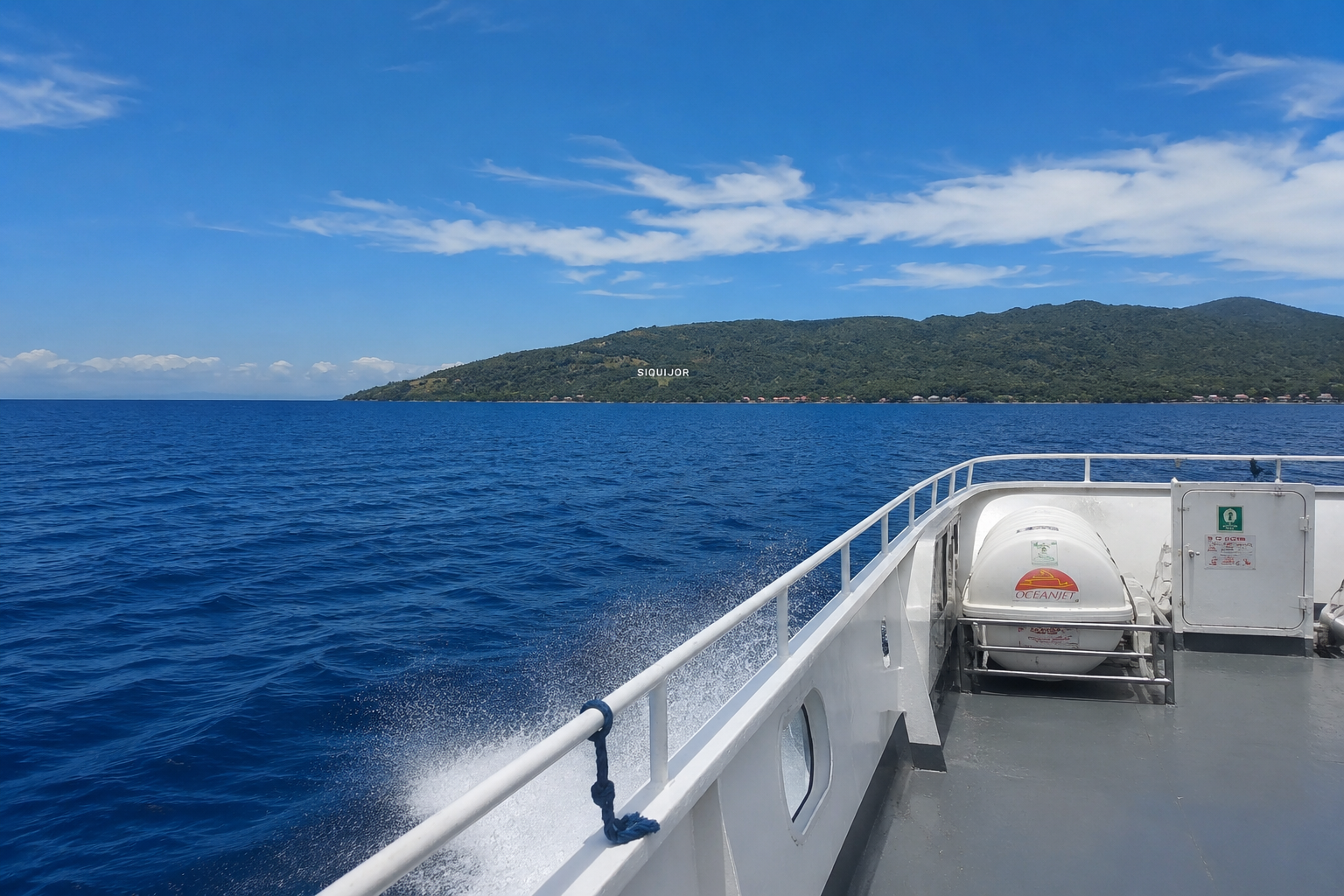
    View from the deck of a fastcraft ferry crossing to Siquijor — open blue water and clear sky with Siquijor island visible on the horizon, Philippines
    The view from the ferry deck on the Dumaguete–Siquijor crossing — 45 minutes of open water, blue sky, and the island ahead.

    From Cebu by Sea

    Ferry from Cebu to Siquijor (via Tagbilaran, Bohol)

    If you’re coming from Cebu and prefer the sea, OceanJet operates the best fast ferry option. There is no truly direct fast ferry from Cebu straight to Siquijor — the boat makes a stop in Tagbilaran, Bohol along the way, but you stay on the same vessel for the entire journey. You just don’t need to get off in Tagbilaran.

    OperatorTypeDeparture from CebuTravel timeFare
    OceanJet RECOMMENDEDFastcraft (via Tagbilaran)5:10 AM & 1:00 PM (Pier 1)4–4.5 hrs₱1,600–₱2,400
    Lite FerriesRORO (direct, overnight)Late evening~10 hrs₱605
    Starlite FerriesRORO (weekend service)Weekends, late night~10 hrs₱635
    💺
    OceanJet tip — you don’t get off in Bohol

    When you book OceanJet Cebu to Siquijor, the ferry stops in Tagbilaran for about 20 minutes to pick up and drop off passengers. You stay seated. No need to collect luggage, re-board, or buy a separate ticket. The stop is already calculated into the quoted travel time. Arrive at Cebu Pier 1 at least 45 minutes before departure for check-in.

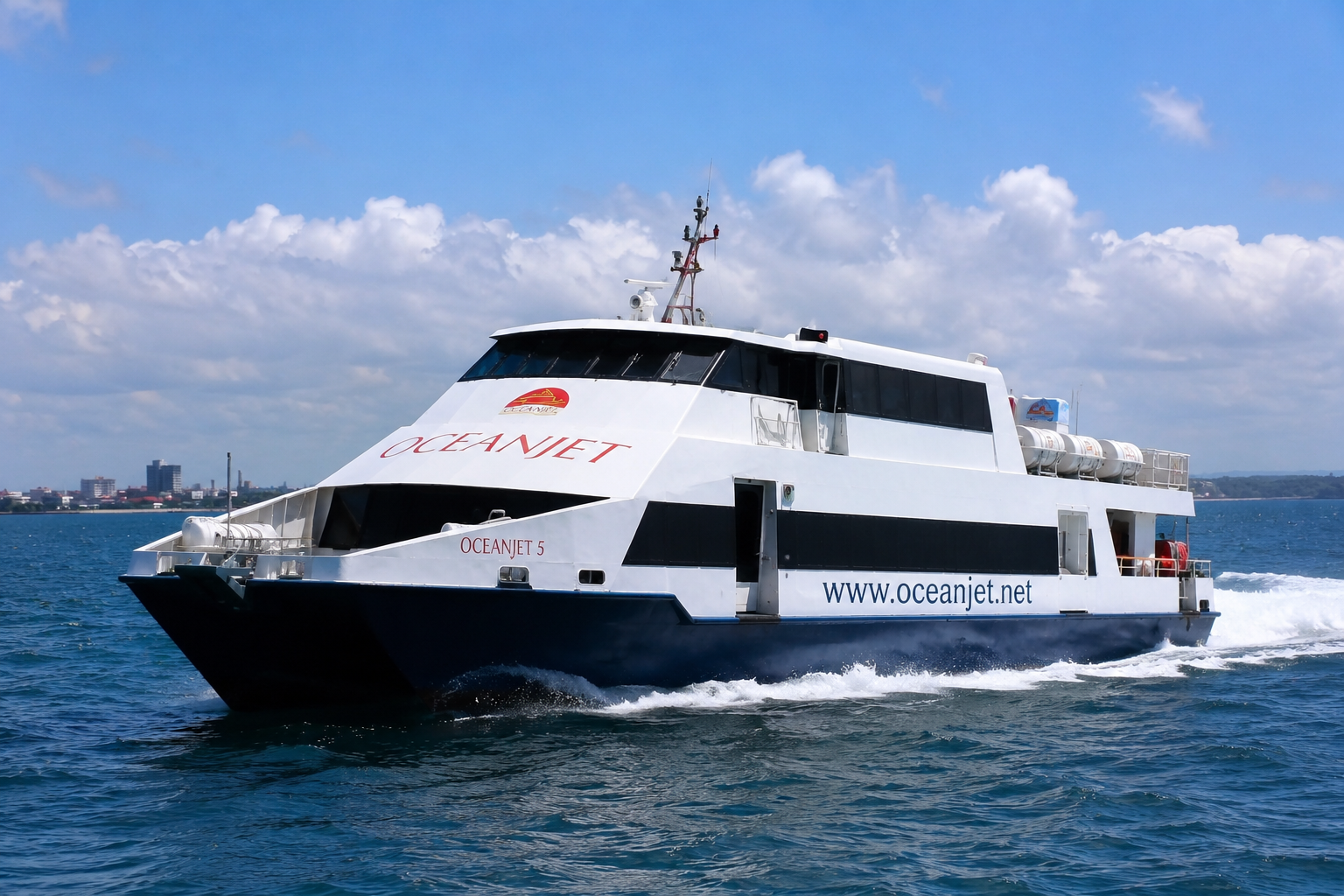
    OceanJet fastcraft vessel at sea on the Cebu to Siquijor route via Tagbilaran Bohol — air-conditioned fast ferry with assigned seating Philippines
    The OceanJet fastcraft serving the Cebu–Siquijor route — air-conditioned, assigned seating, and you stay on board through the Tagbilaran stop.

    From Bohol

    Ferry from Tagbilaran, Bohol to Siquijor

    If you’re island-hopping and already in Bohol, this is your most direct and logical route. OceanJet operates direct fast ferries from Tagbilaran Port to Siquijor. Travel time is approximately 2 hours. This combination — Cebu → Bohol → Siquijor — is one of the most popular Visayas multi-island itineraries.

    RouteOperatorTravel timeApprox. fare
    Tagbilaran → SiquijorOceanJet~2 hours₱500–₱700
    Siquijor → TagbilaranOceanJet~2 hours₱500–₱700
    🗺️
    Classic Visayas island-hopping route

    Manila/Cebu → Bohol (Tagbilaran) → Siquijor → Dumaguete → Cebu/Manila is one of the best island-hopping loops in the Philippines. You get Bohol’s tarsiers and Chocolate Hills, Siquijor’s waterfalls and beaches, and Dumaguete’s city charm and Apo Island diving — all in one logical circuit.


    From Manila

    Getting to Siquijor from Manila

    There is no direct flight from Manila to Siquijor. All routes require at least one connection. Here are the two most common approaches:

    RouteHowTotal timeBest for
    Manila → Cebu → Siquijor ✈️+✈️Fly Manila–Cebu, then Sunlight Air Cebu–Siquijor (Mon/Wed/Fri/Sun)3–5 hrs totalFastest option, best comfort
    Manila → Dumaguete → Siquijor ✈️+🚢Fly Manila–Dumaguete direct, then fast ferry 45 min3–4 hrs totalMost flexible, frequent ferry departures
    Manila → Cebu → Siquijor ✈️+🚢Fly Manila–Cebu, then OceanJet ferry via Tagbilaran6–8 hrs totalBudget option, no flight restrictions
    ✈️
    Recommended route from Manila in 2026

    The best combination is Manila → Dumaguete (direct flights by Cebu Pacific or Philippine Airlines, ~1.5 hrs) followed by the Dumaguete fast ferry (45 min, no booking needed). This gives you the most flexibility — you can take the next ferry within an hour of landing, at any time from 5 AM to 7:30 PM.


    Decision Guide

    Which Route is Best for You?

    The right route depends on where you’re coming from and what matters most to you. Here’s a clear breakdown:

    Route Recommender — Pick Your Situation
    🏠
    You’re based in Dumaguete or flying in there
    OceanJet or Anika Star fast ferry — 45 min, no booking needed, runs all day.
    Best route
    ✈️
    You’re in Cebu and hate long ferry rides
    Sunlight Air direct flight — 1 hour, Mon/Wed/Fri/Sun, from ₱1,988. Book ahead, fills up fast.
    New 2025 option
    🚢
    You’re in Cebu and the flight days don’t work
    OceanJet Cebu–Siquijor via Tagbilaran. 4–5 hrs, twice daily. Comfortable fastcraft, stay on the same boat through Bohol.
    Sea option
    🗺️
    You’re island-hopping through Bohol
    OceanJet Tagbilaran–Siquijor direct. ~2 hours. Fits naturally into the classic Visayas circuit.
    Logical route
    💰
    You’re on a tight budget and time isn’t urgent
    Lite Ferries or Montenegro RORO from Cebu — cheapest fares from ₱605, carries vehicles, but takes ~10 hours overnight.
    Budget pick
    🏍
    You want to bring your motorcycle
    Montenegro RORO from Dumaguete. ₱570 motorcycle freight + passenger fare. Takes 1.5–2 hours.
    Vehicle route

    On Arrival

    What to Do When You Arrive in Siquijor

    Arriving by ferry at Siquijor Port

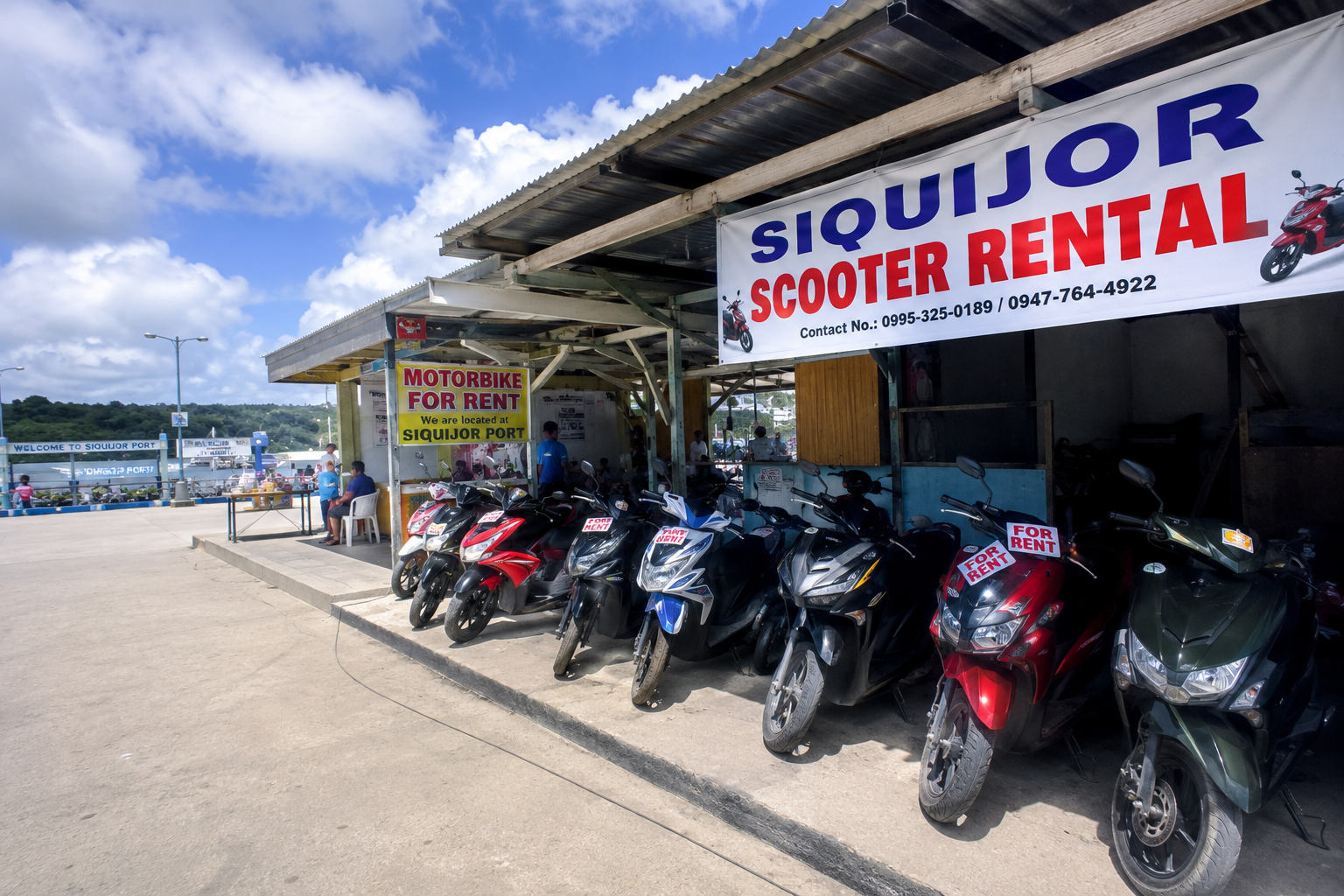
    Most ferries arrive at Siquijor Port in the town of Siquijor on the northwest coast. As you exit the terminal, scooter rental shops are right at the pier — this is the best time to rent. Rates are ₱300–₱500/day. Your guesthouse in San Juan is about a 20–25-minute ride west along the ring road.

    Some Montenegro RORO ferries also arrive at Larena Port on the northeast coast. From Larena, San Juan is about 35–40 minutes by scooter going west around the ring road.

    Scooter rental stalls right outside Siquijor Port on arrival — showing motorbikes available for hire at ₱300-500 per day at the pier exit Siquijor Philippines
    Scooter rentals right at the Siquijor pier exit — the first thing to do after stepping off the ferry. ₱300–₱500/day and you’re free to explore.

    Arriving by Sunlight Air at Siquijor Airport

    Siquijor Airport is located in the town of Siquijor, close to the port. The airport is small — expect a short walk to the terminal building. Tricycles and habal-habals (motorcycle taxis) are available outside arrivals. To San Juan: about 20–25 minutes by scooter, or arrange transport with your guesthouse in advance.

    💵
    Withdraw cash before arriving

    Siquijor has very few ATMs and they run out of cash regularly, especially during peak season. Withdraw in Dumaguete or Cebu before you travel. Most restaurants, market stalls, ferry booths, and accommodations are cash-only. Budget at least ₱3,000–₱5,000 in cash for a 3-day stay.


    Practical Advice

    Booking Tips & Things to Watch Out For

    📅
    Book OceanJet and Sunlight Air in advance during peak season

    During peak season (December–April), Holy Week, and long weekends, ferry seats and Sunlight Air flights sell out. Book OceanJet tickets at least 2–3 days ahead via their website or app. Book Sunlight Air as early as possible — the plane holds ~70 passengers and the route is popular. Walk-in tickets for Montenegro RORO are usually available without advance booking.

    ⛈️
    Ferries cancel in bad weather — have a buffer day

    If a typhoon signal is raised in the area, all ferry trips are automatically suspended by the Philippine Coast Guard. This can happen with little notice. Always build at least one buffer day into your departure plans — especially if you have a connecting flight to catch. Sunlight Air is less affected but can also be delayed in severe weather.

    🎫
    Where to buy ferry tickets

    OceanJet: book online at oceanjet.net or via the OceanJet app. Montenegro Lines: at the port counter or bustickets.ph. Anika Star / HS Star Marine: usually at the pier counter only. Sunlight Air: res.sunlightair.ph. Always bring your booking confirmation and a valid government-issued ID.

    Arrive at the port early

    For OceanJet, arrive at least 45–60 minutes before departure for check-in and security. During peak season, arrive 90 minutes early. For Montenegro RORO, 30–45 minutes is sufficient. For Sunlight Air, treat it like any domestic flight — arrive at the airport at least 1 hour before departure.

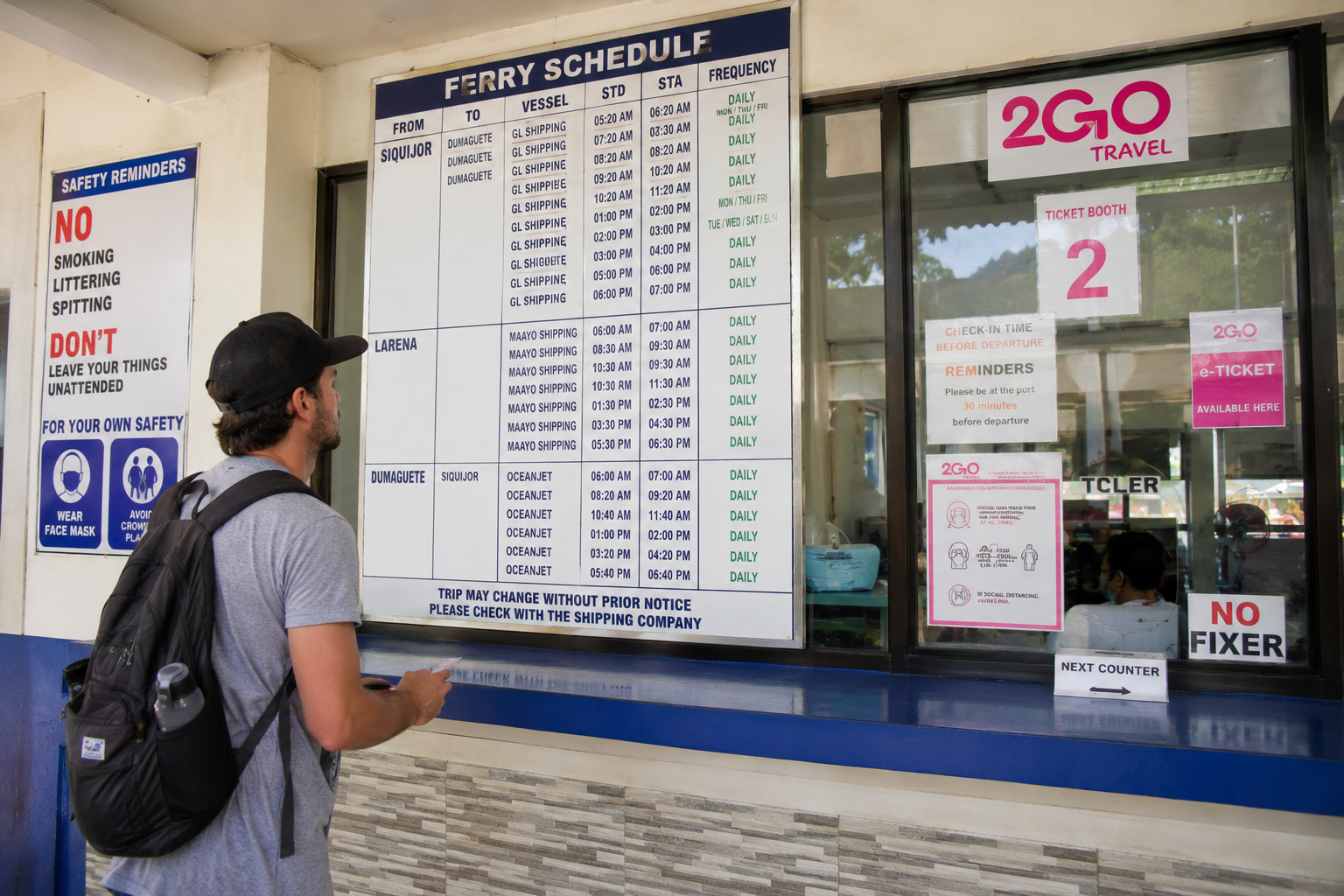
    Traveler buying a ferry ticket at the port counter for Siquijor Philippines — showing the ticket booth and booking process at a Philippine domestic ferry terminal
    Buying your ferry ticket at the port counter — for most operators outside peak season, walk-in tickets are available without advance booking.

    FAQ

    Frequently Asked Questions

    Is there a direct flight to Siquijor?
    Yes — as of December 15, 2025, Sunlight Air operates the first-ever commercial flights to Siquijor. Direct flights run from Cebu 4 times a week (Monday, Wednesday, Friday, Sunday), taking approximately 1 hour. Connecting flights from Manila and Clark are available via Cebu. No other airline currently serves Siquijor.
    How long is the ferry from Dumaguete to Siquijor?
    The fast ferry (fastcraft) takes 45–60 minutes. RORO ferries that carry vehicles take 1.5–2 hours. Multiple operators run the route from 5:00 AM to 7:30 PM daily. No advance booking is usually needed outside peak season.
    How long is the ferry from Cebu to Siquijor?
    OceanJet fastcraft takes 4–5 hours via a stop in Tagbilaran, Bohol (you stay on the same boat). Slower RORO ferries like Lite Ferries take about 10 hours. OceanJet is the recommended option for most travelers.
    What is the cheapest way to get to Siquijor?
    The cheapest option is the Montenegro or Aleson RORO ferry from Dumaguete, costing from ₱130. If coming from Cebu, Lite Ferries offers the cheapest sea route at ₱605, though it takes ~10 hours. For most travelers, flying to Dumaguete and taking the fast ferry is the best value combination.
    Does Siquijor have an airport?
    Yes. Siquijor Airport (IATA: SQF) was upgraded and officially opened for commercial flights on December 15, 2025. Sunlight Air is the only airline currently serving it, with direct flights from Cebu 4x weekly.
    Can I bring my car or motorcycle to Siquijor?
    Yes, via Montenegro or Aleson RORO ferries from Dumaguete. Motorcycle freight is approximately ₱570 and a private 4-wheel vehicle costs around ₱1,430, on top of the passenger fare. Travel time is 1.5–2 hours.
    How do I get from Siquijor Port to San Juan?
    Rent a scooter right at the pier (₱300–₱500/day) — this is the recommended and most convenient option. San Juan is about 20–25 minutes west along the ring road. Tricycles and habal-habals are also available if you prefer not to ride yourself.

    GC
    Giovanni Carlo Bagayas
    Filipino Travel Writer & Content Creator
    I grew up in Pagadian City, Mindanao, and have been traveling the Philippines for over 10 years. I’ve taken the Dumaguete ferry to Siquijor multiple times — it’s one of the smoothest ferry rides in the country. This guide is kept current with the latest schedules and the new Sunlight Air flights that changed how travelers reach the island in late 2025.
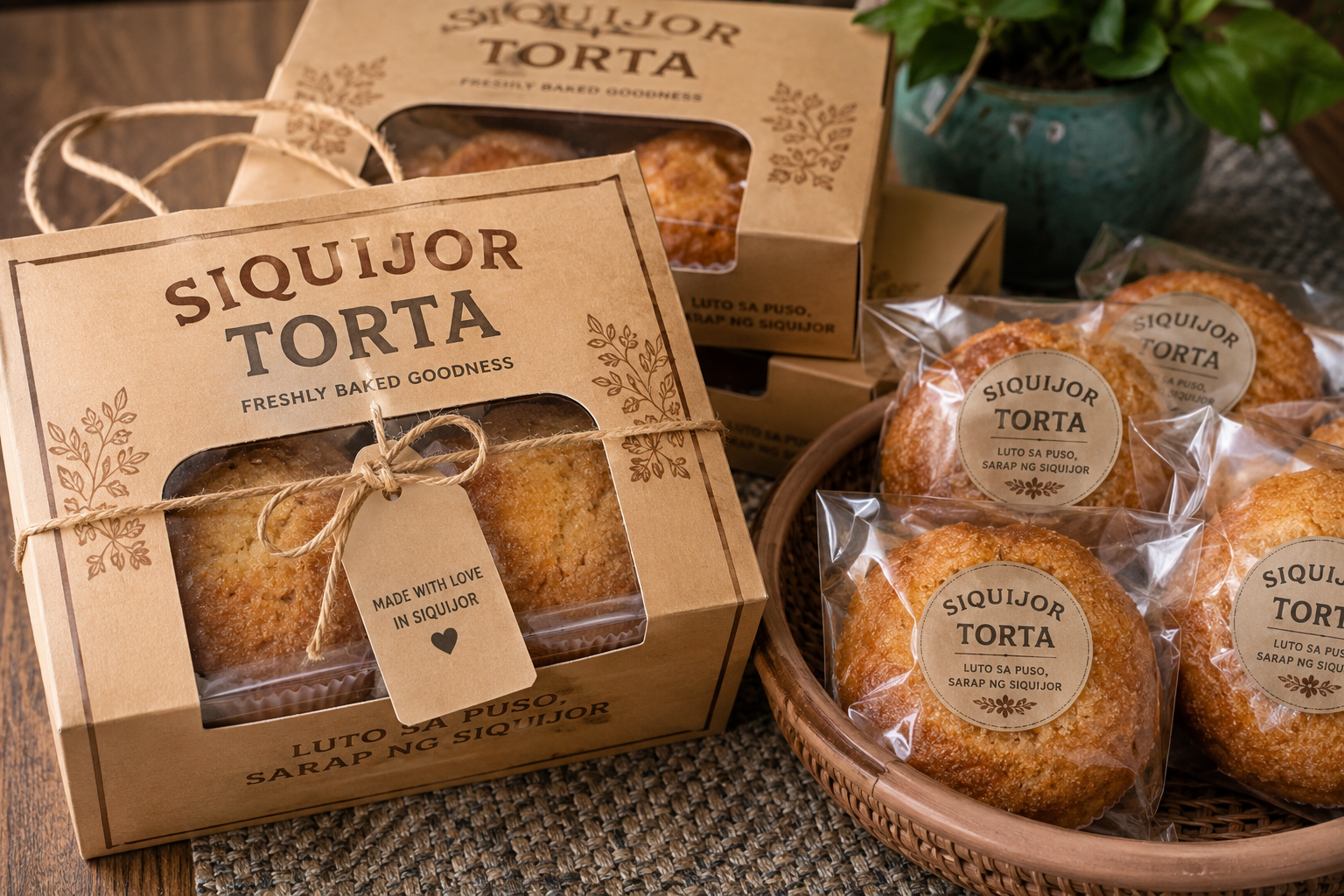
    Keep Exploring

    More Siquijor Travel Guides

  • 3-Day Siquijor Itinerary: Perfect for First-Timers (2026)

    3-Day <a href="https://bestphilippinestravelguide.com/siquijor-delicacies/">Siquijor</a> Itinerary: The Perfect Island Trip for First-Timers (2026)
    🇵🇭 Siquijor Travel Guide

    3-Day Siquijor Itinerary: The Perfect Island Trip for First-Timers

    Cambugahay Falls, Paliton Beach, the enchanted Balete Tree, cliff diving at Salagdoong — your complete day-by-day plan for the most magical island in the Philippines.

    📅 3 Days · 2 Nights 🛵 Scooter-friendly 💰 Budget & Mid-range 🆕 Updated June 2026
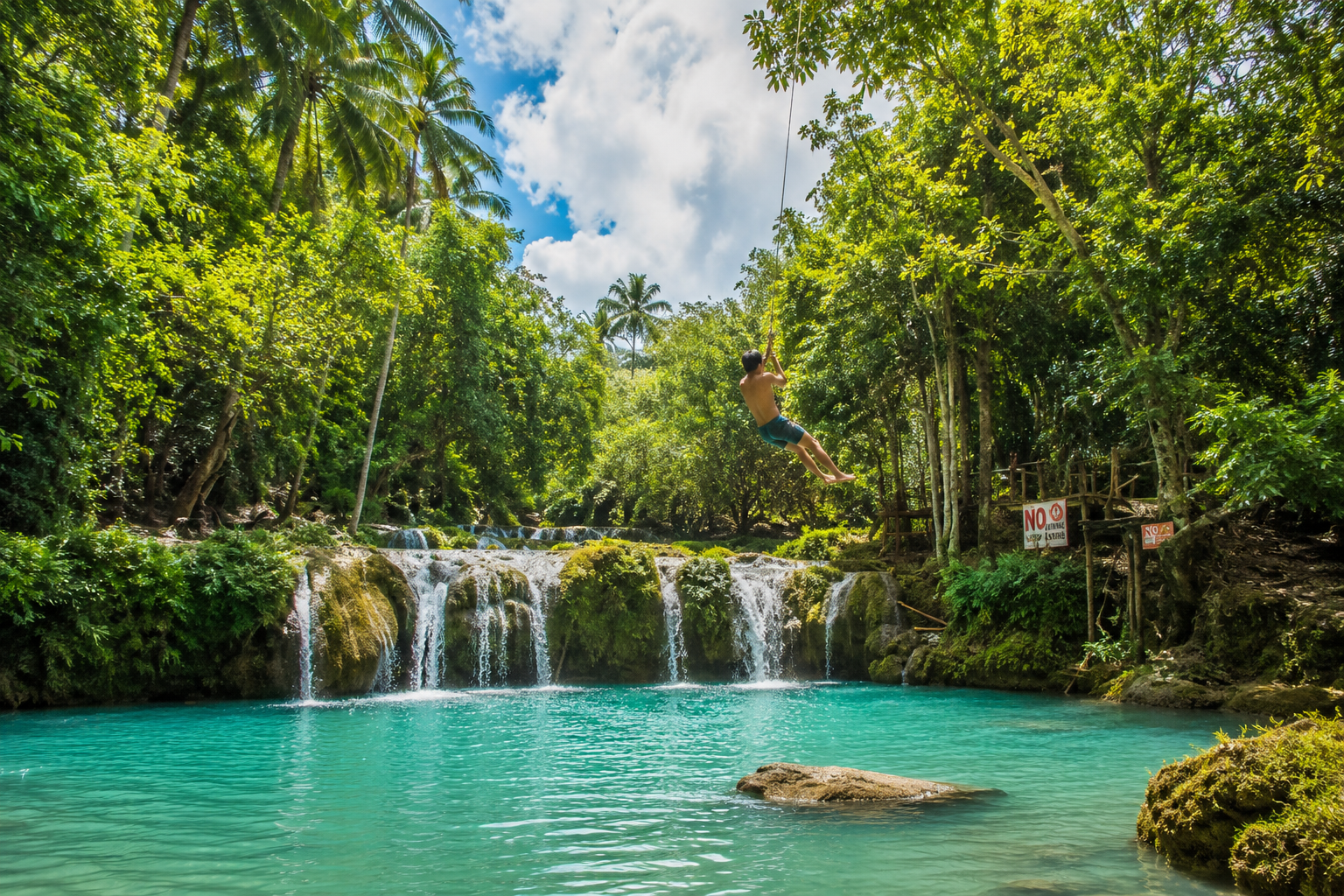
    Cambugahay Falls turquoise cascading pools with rope swing and bamboo raft — the highlight of any 3-day Siquijor itinerary in the Philippines
    ⚡ Quick answer

    3 days in Siquijor is the perfect amount of time for first-time visitors. Day 1 covers the north — Paliton Beach and Tubod Marine Sanctuary. Day 2 is the highlight reel — Cambugahay Falls, the Enchanted Balete Tree, and Lazi Church. Day 3 takes you around the south and east — Salagdoong Beach, Lugnason Falls, and a sunset send-off at San Juan. Base yourself in San Juan and rent a scooter (₱300–₱500/day) for maximum freedom.

    Overview

    Before You Go: What to Know About Siquijor

    Siquijor is a small island in the Central Visayas region of the Philippines, located just 45 minutes by fast ferry from Dumaguete. At only 343 square kilometers, it can be circumnavigated in a single day — but don’t be fooled by the size. This island packs in cascading waterfalls, pristine white-sand beaches, 400-year-old trees, Spanish colonial churches, marine sanctuaries, and a centuries-old mystical reputation that makes it unlike any other island in the archipelago.

    For international visitors, Siquijor is still genuinely off the beaten path compared to Boracay or Palawan. The crowds are smaller, the prices are lower, and the experience is more authentic. Three days here is enough to see the highlights at a relaxed pace — though many visitors wish they’d stayed longer.

    📅
    Best time to visit

    The dry season runs from November to May. February to April is peak — perfect weather, calm seas, and all waterfalls flowing. Avoid June to October when typhoons are possible and some waterfalls like Lugnason can dry up or flood.


    Arrival

    How to Get to Siquijor

    Siquijor has no commercial airport, so all visitors arrive by ferry. The most common and convenient gateway is Dumaguete City in Negros Oriental.

    FromFerry operatorTravel timeApprox. fare
    Dumaguete (most common)Lite Shipping, Montenegro45 min – 1 hr₱200–₱280
    Cebu CityOceanjet, Supercat3.5–4 hrs₱700–₱1,200
    Tagbilaran, BoholLite Shipping2–2.5 hrs₱500–₱700
    Plaridel, MindanaoLite Shipping1.5 hrs₱250–₱350
    🚢
    Pro tip — arriving from Dumaguete

    The Dumaguete–Siquijor route is the most popular and has the most departures (roughly every 1–2 hours from 6 AM to 5 PM). Ferries arrive at Siquijor port in the town proper. From there, scooter rental shops are right at the pier — grab your wheels immediately.

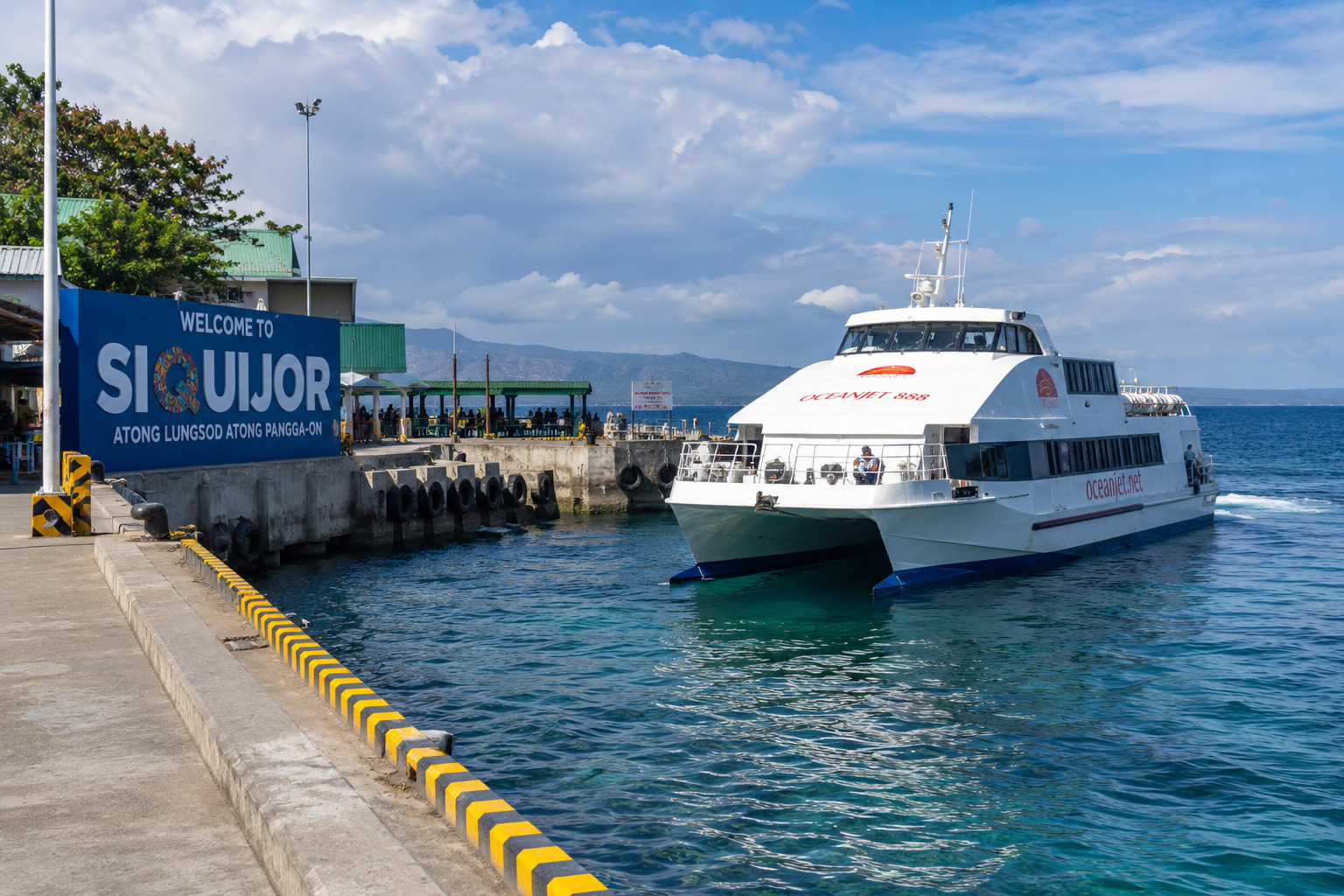
    Fast ferry arriving at Siquijor pier from Dumaguete — the most popular way to get to Siquijor island Philippines
    The fast ferry from Dumaguete arrives at Siquijor pier in 45 minutes — scooter rentals are available right at the dock.

    Transport

    Getting Around Siquijor

    Siquijor has one main ring road that circles the entire island — it is well-paved, scenic, and almost traffic-free. This makes it one of the best islands in the Philippines for self-guided exploration.

    🛵
    Scooter / Motorbike
    ₱300–₱500/day
    Best option. Maximum freedom, easy parking, available at the pier and all guesthouses.
    🚗
    Habal-habal (moto taxi)
    ₱150–₱300/trip
    Good for single trips if you don’t want to ride yourself. Negotiate price upfront.
    🛺
    Tricycle
    ₱100–₱200/trip
    Good for short distances within town. Too slow and expensive for full-day exploring.
    🚐
    Island Tour (guided)
    ₱2,500–₱4,000/day
    Private van with driver/guide. Best for groups or those who don’t want to ride a scooter.
    🛵
    First-time scooter riders

    Siquijor has arguably the best roads in the Philippines for beginner scooter riders. Traffic is light, the road is smooth, and the ring road is impossible to get lost on. If you’ve ever wanted to try riding a scooter, this is the place to do it. Always wear a helmet — it’s required by law and smart practice.

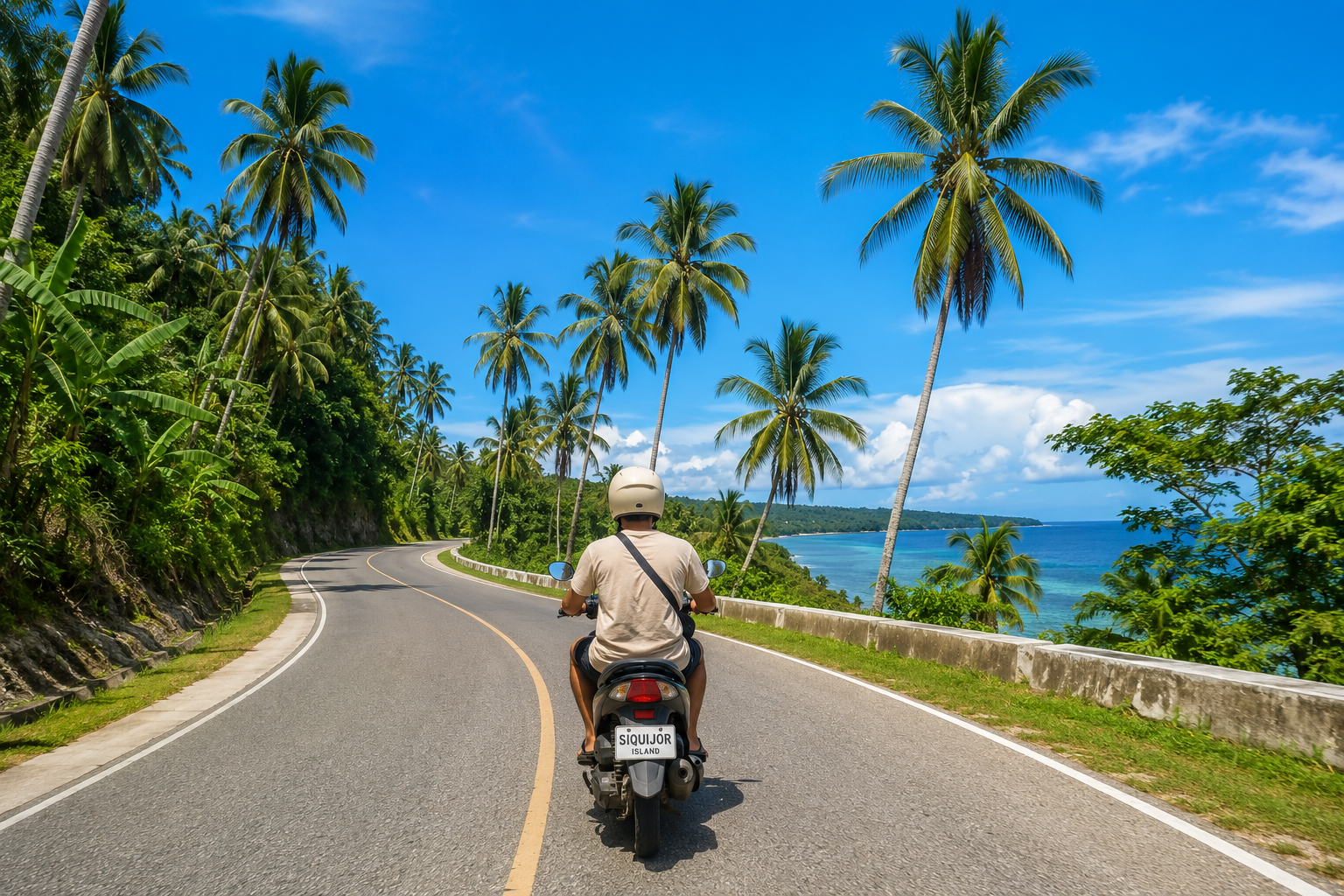
    Traveler riding a scooter on Siquijor's ring road lined with coconut trees and blue sky — the best way to explore Siquijor island Philippines
    Siquijor’s ring road is one of the best scooter routes in the Philippines — smooth, scenic, and almost traffic-free. ₱300–₱500/day rental.

    1
    Beaches, Snorkelling & the North Coast
    Paliton Beach · Tubod Marine Sanctuary · San Juan sunset · torta breakfast

    Your first day is all about easing into the island rhythm. Don’t rush. Siquijor rewards the slow traveler. Start early to beat the crowds at Paliton, spend the afternoon underwater at Tubod, and end the day watching the sun sink behind the mountains from the San Juan shoreline.

    7 AM
    🍰 Breakfast — torta & barako coffee

    Start your Siquijor trip the right way — with fresh torta from a roadside bakery near the town proper. The golden sponge cake leavened with tuba (coconut wine) is the island’s signature delicacy and costs ₱10–₱25 per piece. Pair it with a strong cup of local barako coffee. Bakeries open before dawn and sell out by mid-morning, so 7 AM is perfect timing.

    🍽 Must-eat ₱50–₱80 for breakfast
    8 AM
    🏖 Paliton Beach — the “Little Boracay” of Siquijor

    Paliton Beach in San Juan is Siquijor’s most photographed stretch of sand — white, powdery, fringed with coconut palms, and facing a spectacular sunset horizon. Arriving early (before 9 AM) means you may have it almost entirely to yourself. The water is calm and clear, perfect for a morning swim. By late morning tour groups arrive, so early arrival is key. No entrance fee.

    Free entrance 🕗 Arrive before 9 AM for empty beach
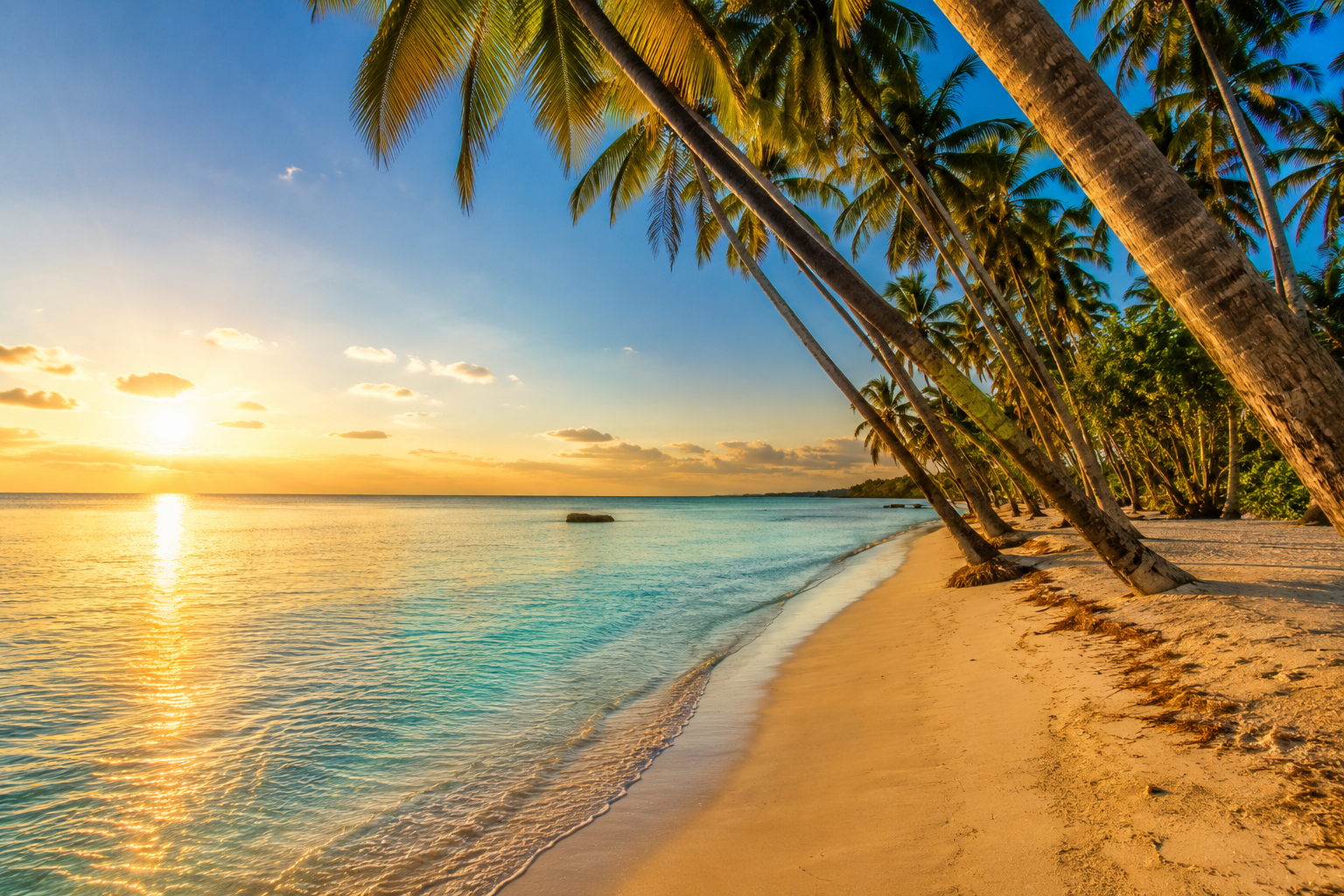
    Paliton Beach Siquijor at sunrise — white sand, calm turquoise water, and coconut palms with no crowds in the early morning
    Paliton Beach at sunrise — arrive before 9 AM and you may have this stretch of paradise almost entirely to yourself.
    10 AM
    🐠 Tubod Marine Sanctuary — snorkelling with sea turtles

    A short ride from Paliton, Tubod Marine Sanctuary is one of the best beginner snorkelling spots in Siquijor. The protected reef is home to sea turtles, parrotfish, clownfish, and a dense, healthy coral garden. Entrance is ₱50–₱100 and snorkel gear can be rented on site for around ₱100. The turtles are almost guaranteed — they feed near the surface most mornings.

    ₱50–₱100 entrance 🐢 Sea turtles most active in the morning
    Sea turtle gliding over coral reef at Tubod Marine Sanctuary Siquijor Philippines — one of the best snorkelling spots in the Visayas
    Sea turtles are a near-daily sighting at Tubod Marine Sanctuary — one of Siquijor’s most accessible and rewarding snorkelling spots.
    12 PM
    🍽 Lunch — fresh seafood in San Juan

    Head back to San Juan for lunch at one of the beachside restaurants along the strip. Fresh grilled fish, kinilaw (Filipino ceviche), and sutukil (a Visayan dining tradition of grilling, stewing, and eating raw seafood) are all staples here. Budget ₱150–₱300 per person for a full meal with rice and drinks.

    🍽 Try kinilaw & grilled pusit ₱150–₱300 per person
    2 PM
    🦋 Siquijor Butterfly Sanctuary (optional)

    A quiet, underrated stop — a small sanctuary in the hills of San Juan where dozens of native butterfly species flutter freely. Takes about 30–45 minutes. Small entrance fee of ₱30–₱50. Great for families or anyone who wants a gentle midday break away from the beach.

    ₱30–₱50 entrance 🦋 45 minutes is enough
    5 PM
    🌅 Sunset at Paliton Beach

    Return to Paliton for sunset — this is where it earns its reputation. The beach faces due west, making it one of the best sunset-watching spots in the Visayas. The sky turns orange, then pink, then deep purple behind the silhouetted coconut trees. Get there by 5 PM and stay until it’s dark. Locals bring coconuts and cold San Miguel. Do the same.

    🌅 Best sunsets in the Visayas Free
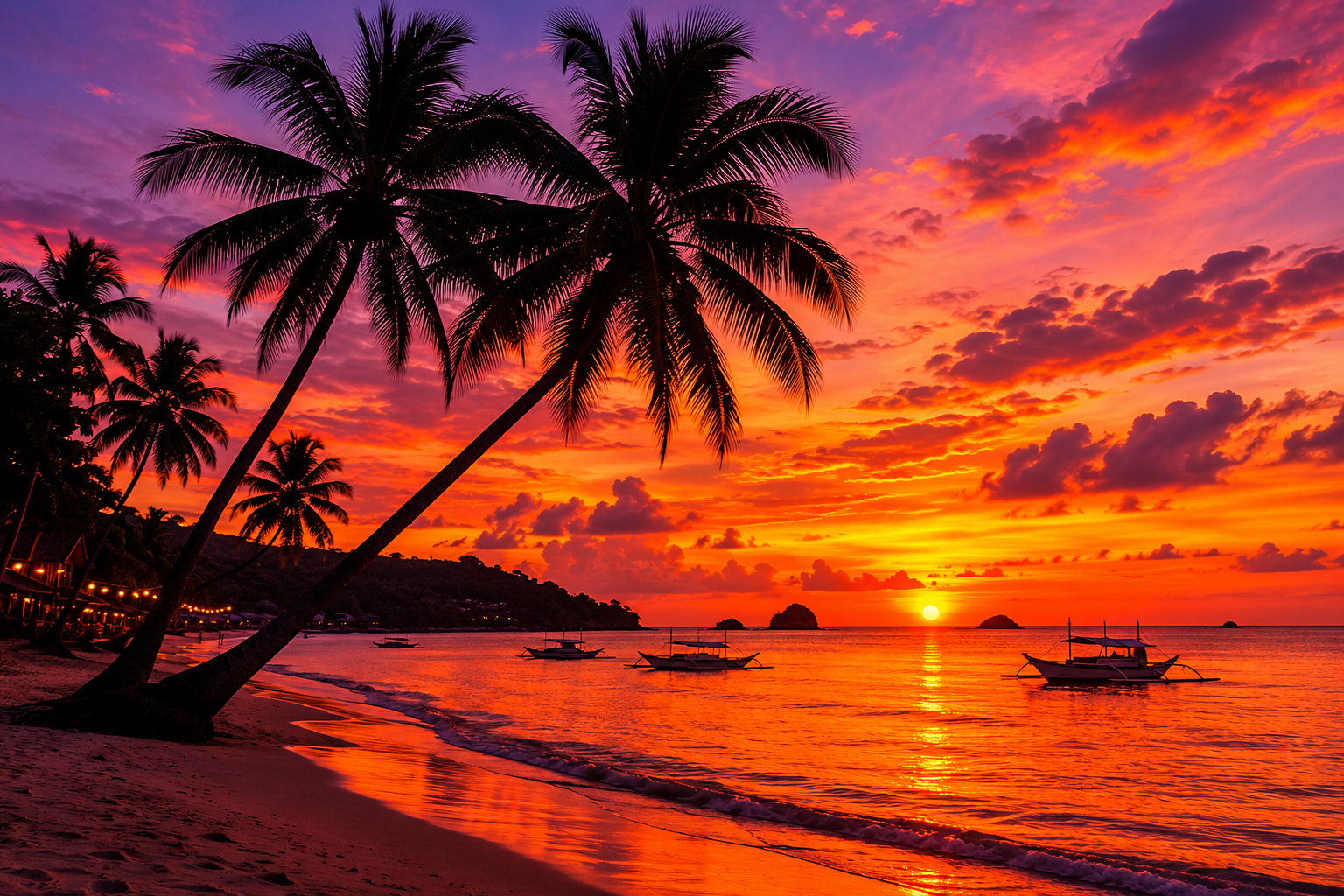
    Paliton Beach Siquijor sunset — silhouette of coconut palm trees against a dramatic orange and pink sky over the Visayas Sea
    Paliton Beach at sunset — one of the most dramatic skies in the Visayas. This is the view that makes people extend their stay.

    2
    Waterfalls, Witchcraft & the Mystical South
    Cambugahay Falls · Balete Tree · Lazi Church · Lagaan Falls

    Day 2 is the one everyone comes to Siquijor for. Cambugahay Falls alone is worth the entire trip. Combine it with the island’s most iconic cultural and mystical stops — the enchanted Balete Tree, Lazi’s 19th-century stone church — and you have a near-perfect day.

    7 AM
    🌊 Cambugahay Falls — the island’s crown jewel

    Go first thing in the morning. Seriously. Cambugahay Falls is Siquijor’s most visited attraction and for good reason — three tiers of turquoise cascading pools, rope swings, bamboo rafts, and some of the most photographed water in the Philippines. By 10 AM, tour buses start arriving. By 11 AM it’s crowded. Arriving at 7–7:30 AM means you’ll have the falls nearly to yourself for at least an hour.

    ₱50 entrance · ₱50 rope swing (unlimited) · ₱50 bamboo raft ⚠️ Wear water shoes — steps are slippery 📸 Bring small bills for the “human drones” (locals who take aerial photos)
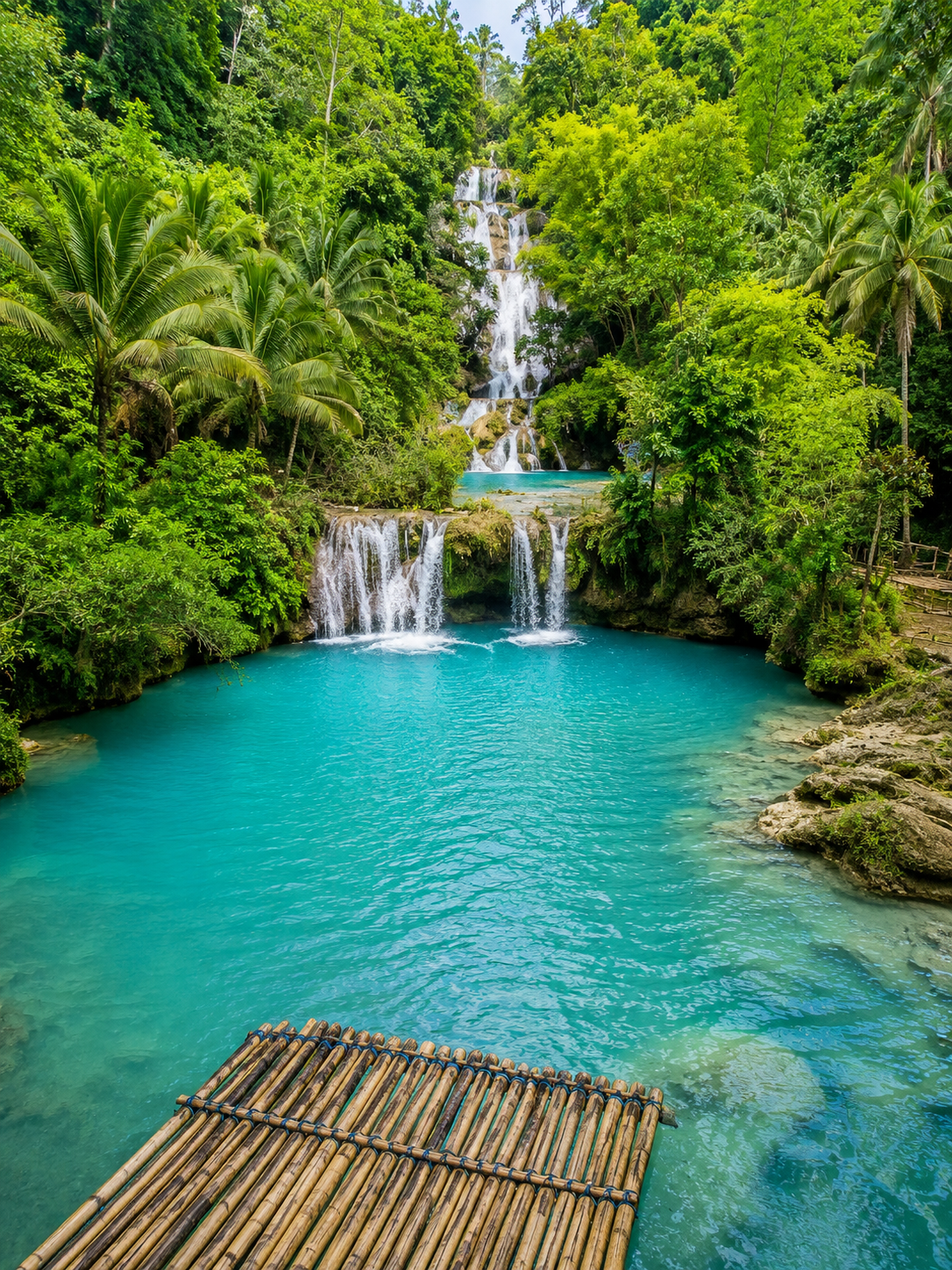
    Cambugahay Falls Siquijor full view — three tiers of turquoise cascading pools with bamboo raft in the foreground surrounded by lush jungle
    Cambugahay Falls in all its glory — three tiers of turquoise pools, rope swings, and bamboo rafts. Arrive before 8 AM to beat the crowds.
    9:30 AM
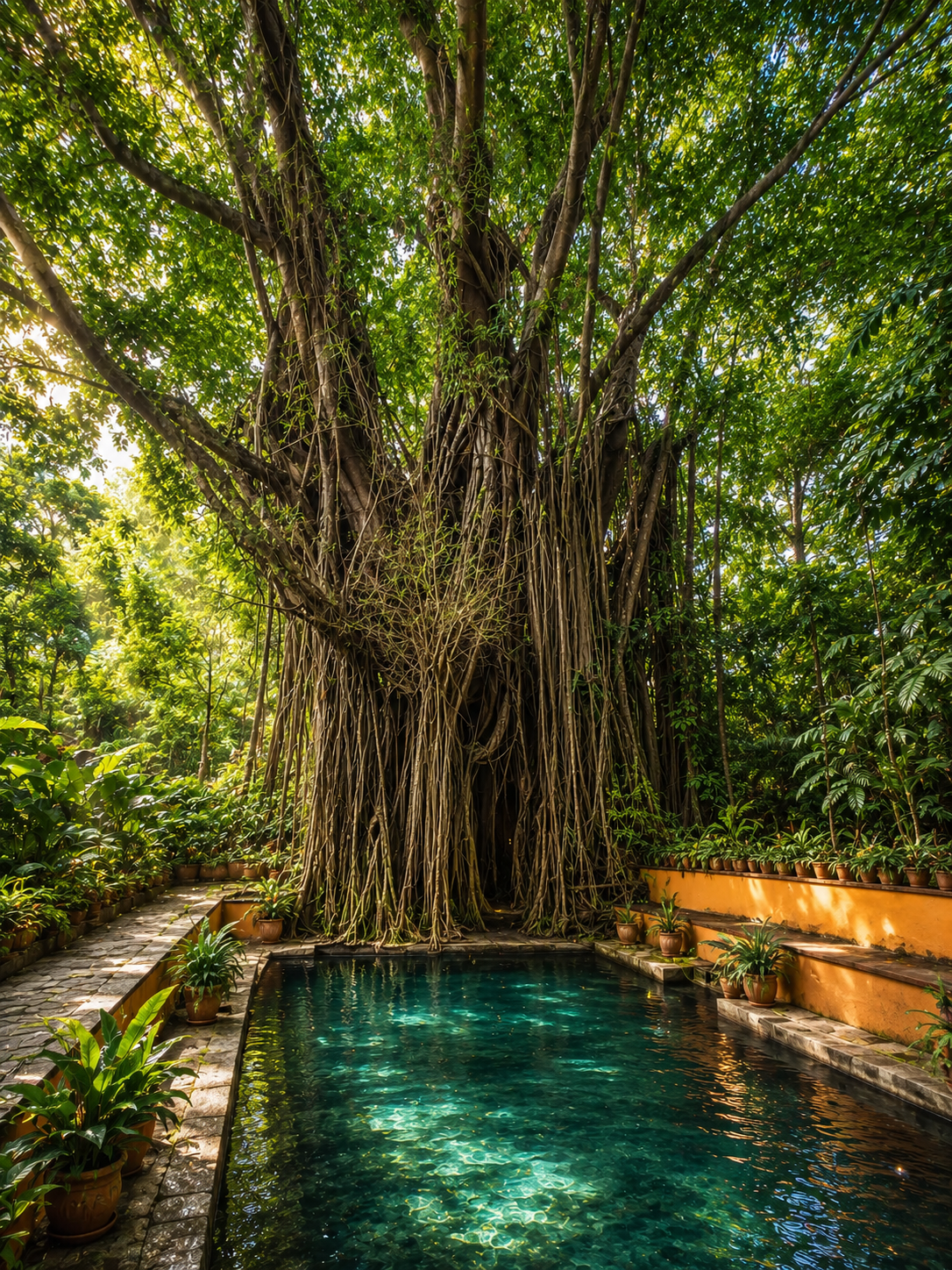
    🌳 Century-Old Enchanted Balete Tree

    Just 15–20 minutes from Cambugahay, the 400-year-old Balete Tree is one of Siquijor’s most iconic and eerie attractions. Enormous aerial roots cascade to the ground, forming a living curtain around a natural freshwater pool at its base — where fish will nibble the dead skin off your feet in a natural fish spa. Entrance is ₱10. The tree has deep spiritual significance; local shamans still use it for rituals during Holy Week.

    ₱10 entrance 🐟 Try the fish foot spa — it’s free
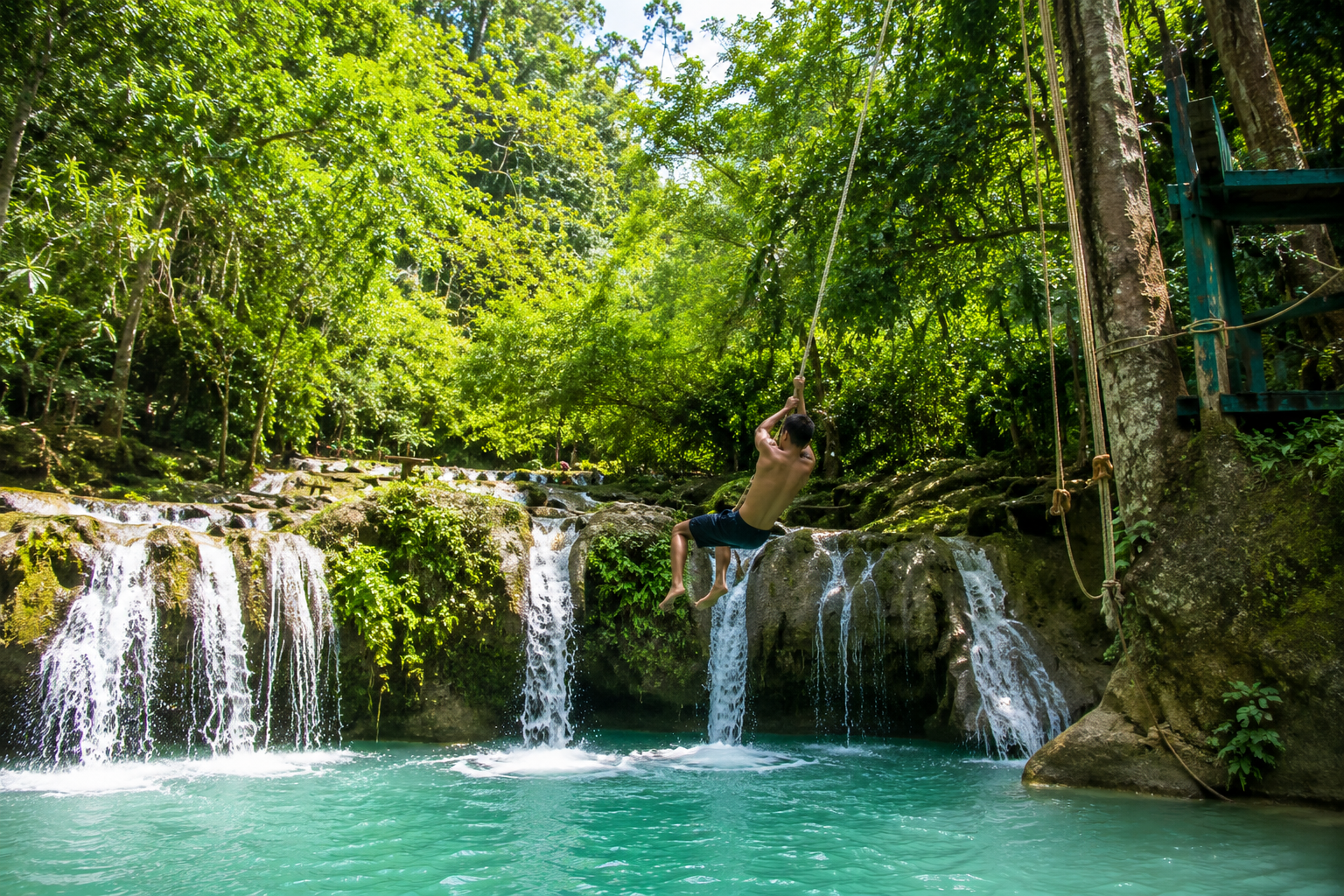
    Person on rope swing at Cambugahay Falls Siquijor mid-air above turquoise pool — the most thrilling activity on the island
    The Cambugahay rope swing — ₱50 for unlimited jumps. It’s more fun than it looks, and looks very fun.
    The 400-year-old Enchanted Balete Tree in Siquijor Philippines — massive trunk with hanging aerial roots and a natural freshwater fish spa at the base
    The 400-year-old Enchanted Balete Tree — one of Siquijor’s most atmospheric stops. The fish spa at the base is a genuine highlight.
    10:30 AM
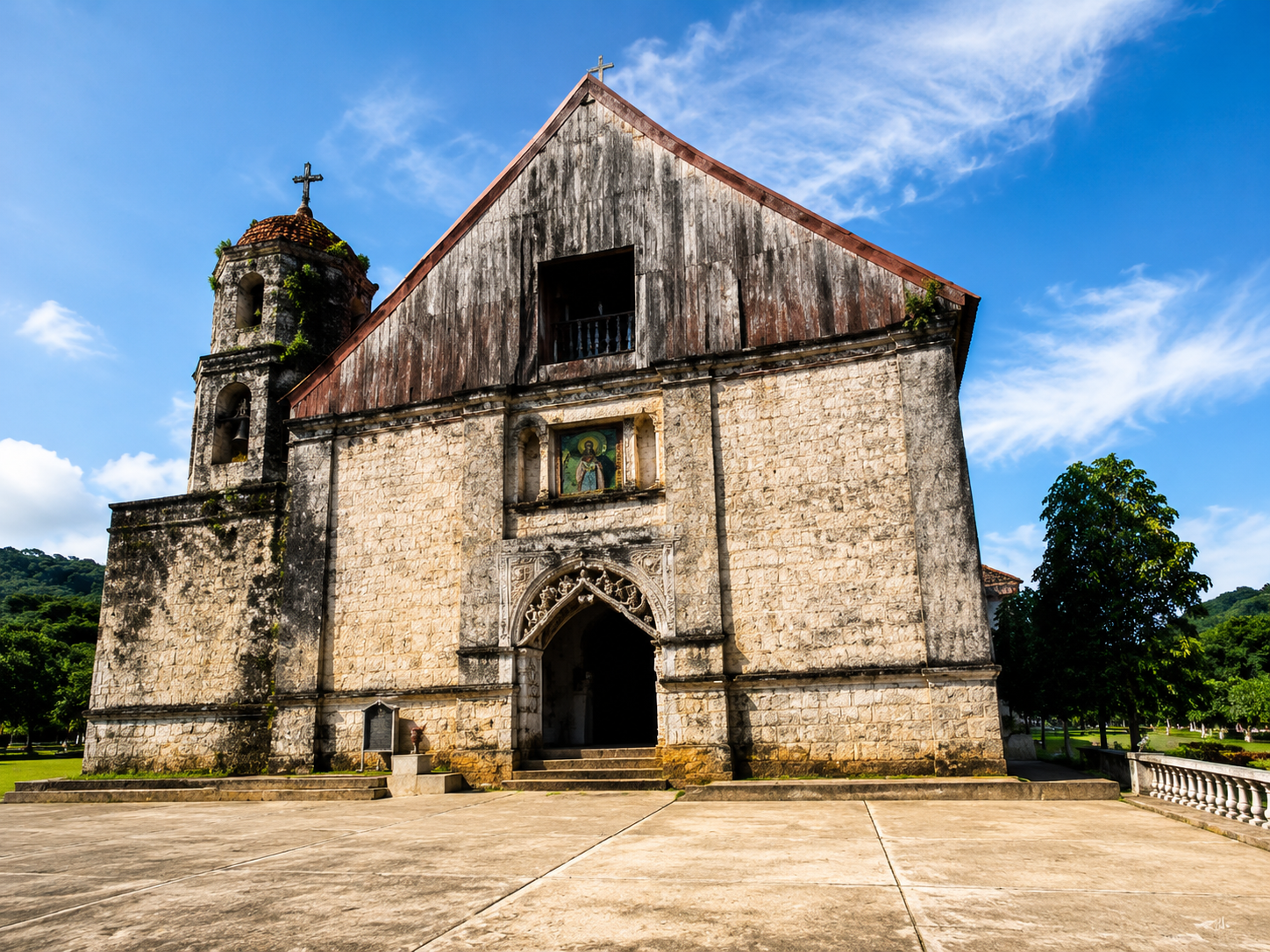
    ⛪ Lazi Church & Convent Museum

    The San Isidro Labrador Parish Church in Lazi is the oldest and largest stone church on Siquijor, completed in 1884. Built from coral stone and hardwood, its thick walls, bell tower, and centuries of weathering give it a profound, atmospheric weight. Next door, the old Lazi Convent functions as a small museum holding colonial-era artifacts, antiques, and religious items. Worth 30–45 minutes.

    ₱20 convent museum entrance 🏛 One of the most photographed churches in the Visayas
    Lazi Church facade in Siquijor Philippines — the oldest and largest Spanish colonial stone church on the island, completed in 1884 with its iconic bell tower
    The San Isidro Labrador Parish Church in Lazi — completed in 1884, built from coral stone, and one of the finest examples of colonial heritage in the Visayas.
    12 PM
    🍽 Lunch in Lazi

    Lazi has a small selection of local carenderias and restaurants near the church. Try fresh Visayan dishes — pinakbet, sinigang, or grilled fish with garlic rice. Budget ₱120–₱200 per person. Alternatively, pack a picnic from the San Juan market and eat at Lazi beach, which is quiet, local, and completely free of tourists.

    🍽 Simple local food, honest prices ₱120–₱200 per person
    2 PM
    💧 Lagaan Falls — the hidden waterfall

    Lagaan Falls is one of Siquijor’s most beautiful and least-crowded waterfalls, tucked into the forest near Lazi. The cascade drops dramatically into a deep, clear swimming hole. It requires a short hike (15–20 minutes) through the trees. Entrance fee is small and most visitors skip it entirely — which means you may have it to yourself. Best visited after Cambugahay so you can compare both.

    ₱30–₱50 entrance 🥾 Wear proper footwear for the hike
    4 PM
    🔮 Siquijor Town — healers & heritage walk

    Swing by Siquijor Town proper on your way back. The town square, the old church, and the heritage buildings along the waterfront give a quiet sense of the island’s Spanish colonial past. If you’re curious about Siquijor’s famous faith healers (mananambal), your guesthouse owner or a local guide can arrange a respectful visit — especially during Holy Week when healers gather to prepare their traditional potions.

    🌿 Ask your guesthouse about healer visits Free to walk around
    💡
    Cambugahay Falls insider tips

    Bring ₱200 in small bills — ₱50 entrance, ₱50 for the rope swing (unlimited jumps, worth every peso), ₱50 for a bamboo raft ride, and a little extra for the locals who will offer to take your photos from above. The lowest pool is the most photogenic. The middle pool has the best rope swing. The upper pool is quietest.


    3
    East Coast, Cliff Diving & Farewell
    Salagdoong Beach · Lugnason Falls · pasalubong shopping · San Juan send-off

    Your last full day takes you to the east side of the island — the wilder, quieter, less-touristed half. Salagdoong Beach is the main event: a stunning government-run beach with cliff diving platforms that will test your nerve. End the day with pasalubong shopping and a final sunset meal on San Juan’s beachfront.

    7:30 AM
    🌄 Mount Bandilaan — sunrise viewpoint (optional)

    Mount Bandilaan is the highest point on Siquijor and the island’s national park. An early morning drive to the summit rewards you with panoramic views of the entire island — and on clear days, glimpses of Negros, Cebu, and Bohol across the sea. The road up is paved but narrow. Entrance to the national park is minimal. Skip this if you’d rather sleep in and arrive at Salagdoong early instead.

    ₱20 national park entrance 🌄 Best view on the island at sunrise
    9 AM
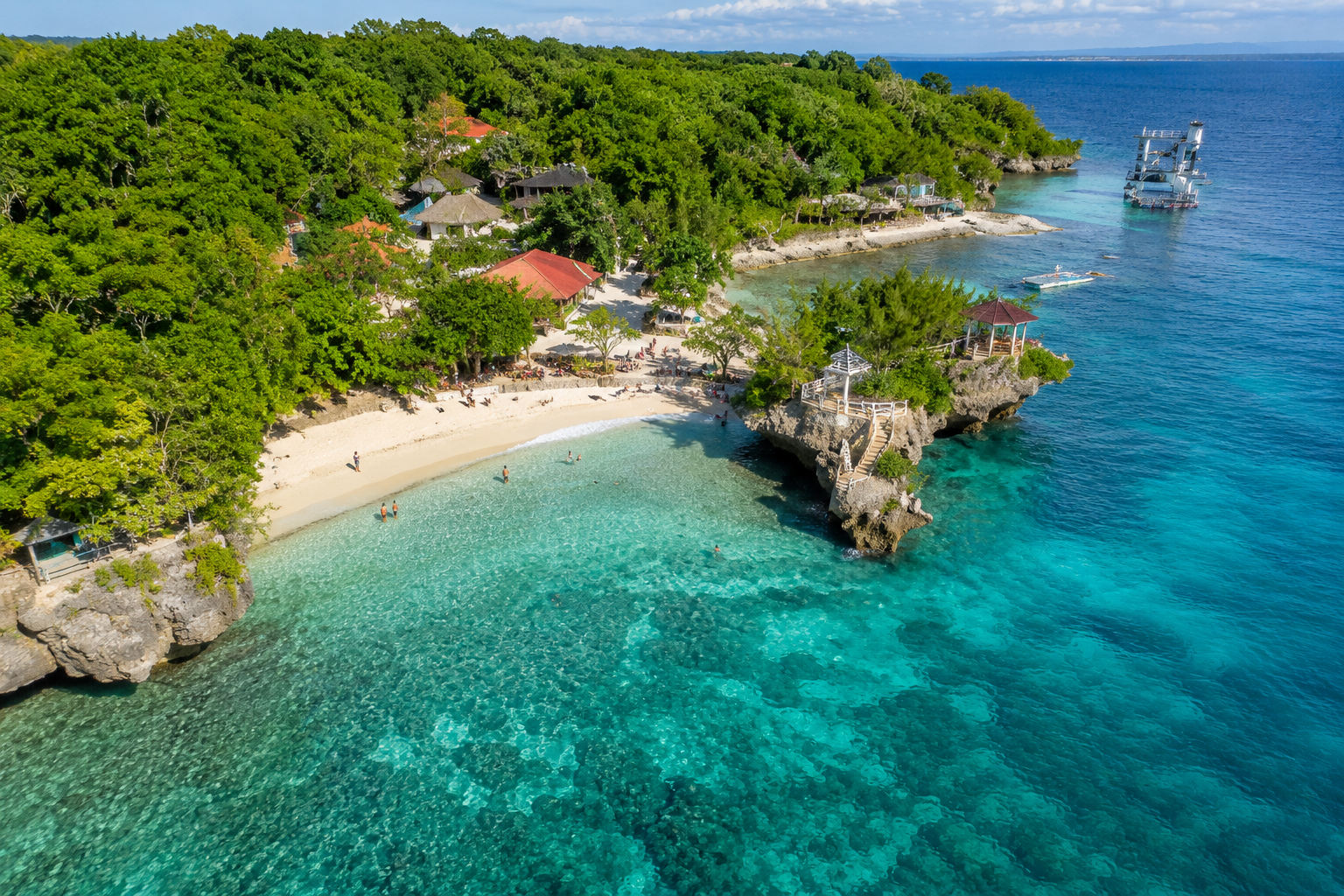
    🏝 Salagdoong Beach — cliff diving & crystal water

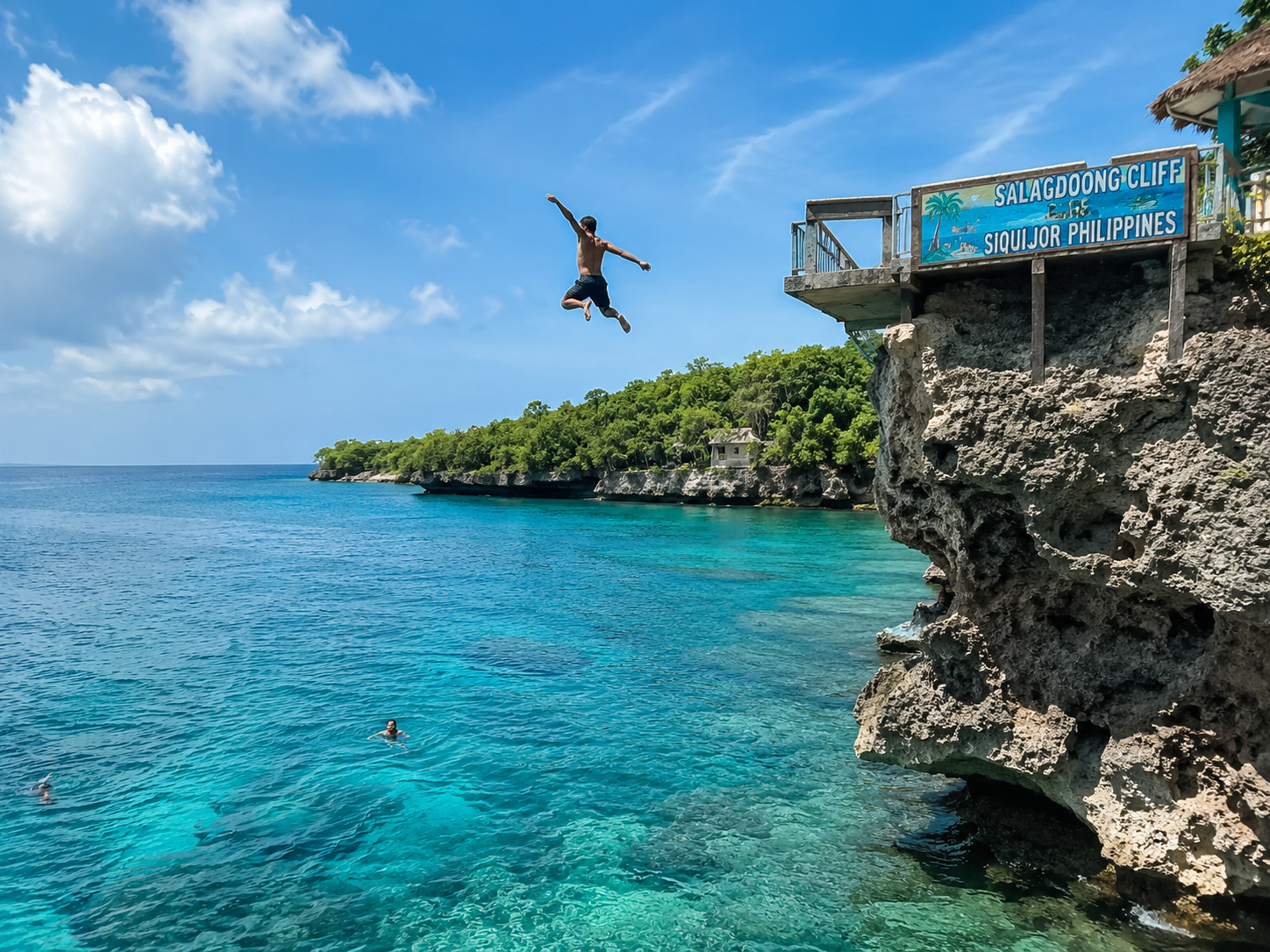
    Salagdoong Beach on the east coast is Siquijor’s most dramatic beach — two wooden diving platforms rise above a stunning turquoise cove enclosed by pine trees and volcanic rock. The lower platform is about 5 meters, the upper around 8. The water is deep, clear, and inviting. Even if you skip the cliff diving, the beach itself is beautiful, far less crowded than Paliton, and has clean facilities. Entrance is ₱50.

    ₱50 entrance ⚠️ Check water conditions before diving from the upper platform 🤿 Snorkelling here is also excellent
    Salagdoong Beach Siquijor wide view — turquoise cove enclosed by pine trees with the famous wooden cliff diving platform visible on the right
    Salagdoong Beach — Siquijor’s most dramatic cove, with pine trees, turquoise water, and the famous cliff diving platforms rising above it all.
    Cliff diving at Salagdoong Beach Siquijor Philippines — jumping from the wooden platform into the clear turquoise water below
    Taking the plunge at Salagdoong’s cliff diving platform — the lower platform is 5 meters, the upper is 8. The water is deep and clear.
    11:30 AM
    💧 Lugnason Falls (seasonal)

    Lugnason Falls is a spectacular waterfall near the south coast — tall, powerful, and set in a lush forested gorge. The catch: it only flows strongly during and just after the rainy season. In the dry season (February to April) it can be reduced to a trickle. If you’re visiting in the wetter months (October to January), this is unmissable. If not, you can skip it and spend more time at Salagdoong.

    ₱30 entrance ⚠️ Only visit in wet season — dries up Feb–April
    1 PM
    🍽 Lunch — back towards San Juan

    Head back along the ring road toward San Juan. Stop at any of the small beachside restaurants you pass — the east and south coasts have a handful of local spots with fresh catch, simple grilled food, and cold drinks. No rush. This is your last full afternoon on the island, so eat slowly and enjoy the view.

    🍽 Try Visayan grilled liempo ₱150–₱250 per person
    3 PM
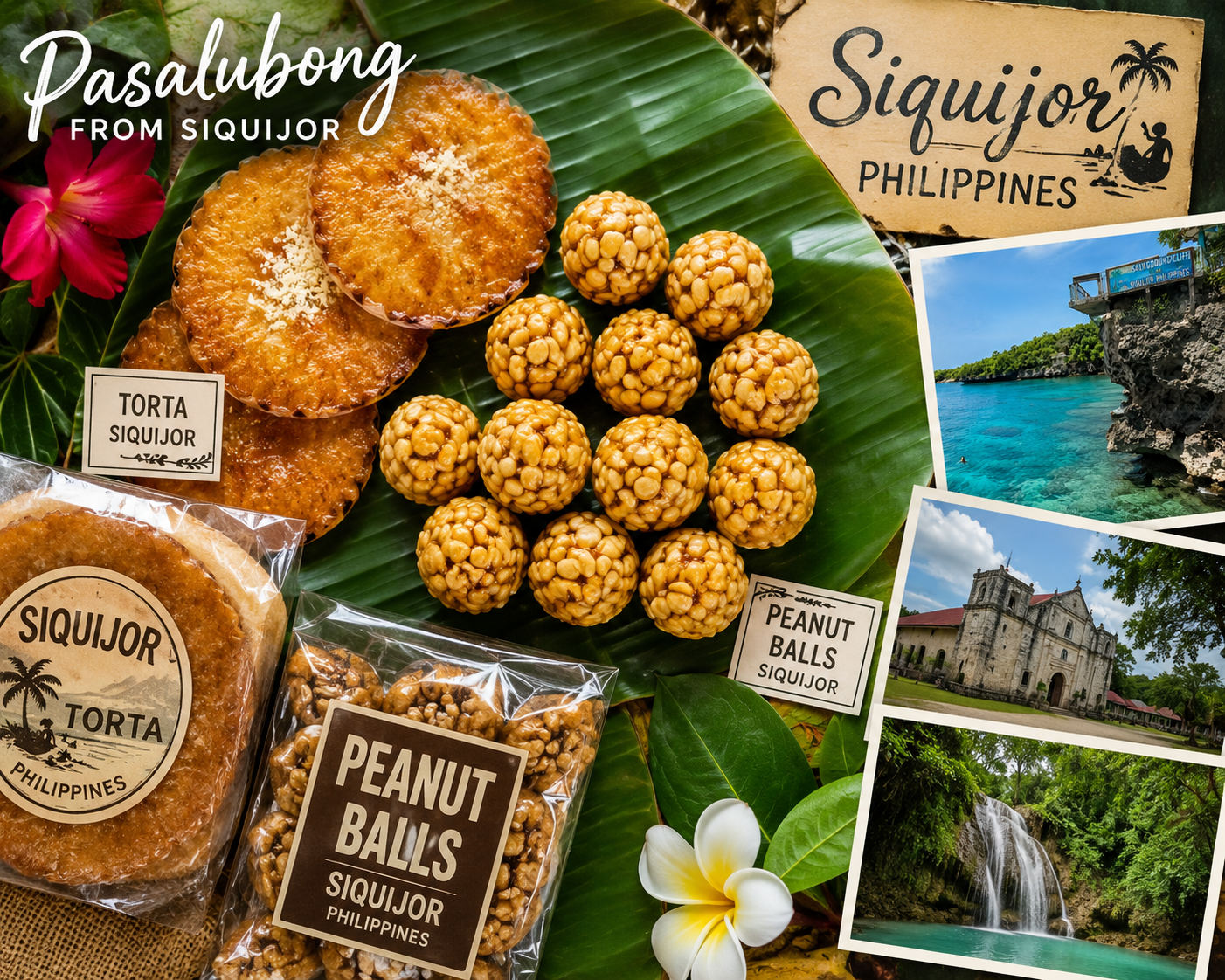
    🛍 Pasalubong shopping — torta, peanut balls & more

    Your last afternoon is for pasalubong. Head to the Siquijor town market or the bakeries near the town proper. Pick up: torta Siquijor (₱10–₱25/piece), peanut balls in chupa-chupa (sugar-coated, ₱5–₱10/piece), banana crackers, and tuba-based vinegar if you can find it. All pack well for travel and make genuinely local gifts that you won’t find anywhere else.

    🎁 Best pasalubong: torta + peanut balls Torta keeps 2–3 days at room temperature
    Siquijor pasalubong flat lay — torta siquijor, peanut balls, chupa-chupa, and banana crackers arranged on a banana leaf, the best local gifts from Siquijor island
    The best Siquijor pasalubong — torta, peanut balls, chupa-chupa, and banana crackers. All affordable, all genuinely local, all unavailable anywhere else.
    5:30 PM
    🌅 Final sunset dinner — San Juan beachfront

    End your Siquijor trip the way it deserves — at a beachfront table in San Juan, watching the sun drop behind the horizon with cold Pale Pilsen in hand and fresh seafood in front of you. Several restaurants along the San Juan strip are open until late and offer front-row sunset views. Budget ₱300–₱500 for a proper final dinner. Take your time. You’ll be back.

    🍺 Order: grilled tuna belly + garlic rice + cold beer ₱300–₱500 per person

    Accommodation

    Where to Stay in Siquijor

    San Juan is the best base for all visitors. It sits on the northwest coast, close to Paliton Beach, with good road access to every other attraction. Most accommodation is concentrated here, ranging from basic beach huts to comfortable mid-range resorts.

    🟢 Budget
    Guesthouses & hostels
    ₱500–₱1,200/night
    Simple fan rooms or dorm beds near San Juan beach. Look for: Miki’s Guesthouse, Nakabalo Guesthouse, AA Jungle Guesthouse. Basic but clean — all you need when you’re out exploring all day.
    🔵 Mid-range
    Beach resorts
    ₱1,800–₱4,000/night
    Air-con rooms, pools, and beachfront access. Top picks: Coco Grove Beach Resort (₱3,500+), Salamangka Resort, Aloha Seaside Resort, Infinity Sands. Great value compared to Boracay equivalents.
    🟡 Splurge
    Boutique & luxury
    ₱5,000–₱12,000/night
    Vida Homes is the most praised luxury option on the island — beachfront apartments with exceptional service. La Maison (₱4,000+) offers French-owned boutique charm. Limited availability — book well in advance.
    📌
    Booking tip

    Siquijor accommodation books up fast during peak season (February–April) and Holy Week. Book at least 4–6 weeks ahead for mid-range and above. Budget guesthouses are usually walk-in friendly outside peak season. Most properties allow scooter rental — ask your host to arrange it so you avoid deposits.


    Budget Planning

    3-Day Siquijor Budget Breakdown

    Siquijor is one of the most affordable island destinations in the Philippines. Here’s a realistic breakdown for a 3-day trip per person:

    ExpenseBudget travelerMid-range
    Accommodation (2 nights)₱1,000–₱2,400₱3,600–₱8,000
    Scooter rental (3 days)₱900–₱1,500₱1,200–₱1,500
    Food & drinks (all meals)₱1,200–₱1,800₱2,500–₱4,000
    Entrance fees (all attractions)₱300–₱500₱500–₱700
    Activities (rope swings, snorkel gear, etc.)₱200–₱500₱500–₱1,500
    Pasalubong & extras₱500–₱1,000₱1,000–₱3,000
    Ferry to/from Dumaguete₱400–₱560₱400–₱560
    TOTAL (per person)~₱4,500–₱8,000~₱9,700–₱19,000

    For international visitors, the budget range translates to roughly $80–$145 USD for 3 days — excluding flights to Dumaguete. By any measure, exceptional value for an island this beautiful.


    Where to Eat

    What to Eat in Siquijor

    Siquijor’s food scene is small but genuine. You’re not here for fine dining — you’re here for fresh seafood, local delicacies, and the kind of home cooking that only exists on small islands.

    🏆 Must-eat Siquijor foods

    • Torta Siquijor — golden sponge cake with tuba, the island’s signature delicacy. ₱10–₱25/piece at morning bakeries.
    • Peanut balls (chupa-chupa) — sugar-coated peanut clusters, crispy and addictive. ₱5–₱10/piece at market stalls.
    • Kinilaw — fresh raw fish cured in vinegar, coconut milk, ginger, and chili. Best eaten by the sea at lunchtime.
    • Sutukil — the Visayan tradition of choosing live seafood and having it grilled (su), stewed (tu), or eaten raw/cured (kil). San Juan beachfront restaurants do this well.
    • Grilled tuna belly — the Visayas is tuna country. Order it with garlic rice and calamansi for the definitive local meal.
    • Buko juice — cold coconut water straight from a young coconut. ₱30–₱50 from roadside vendors. Drink it everywhere.

    Practical Tips

    Essential Tips for Visiting Siquijor

    💵
    Cash is king

    Bring enough cash before arriving in Siquijor. There are a handful of ATMs in the town proper but they run out of cash frequently, especially during peak season. Most restaurants, guesthouses, and all market vendors are cash-only. Withdraw in Dumaguete before taking the ferry.

    📶
    SIM cards & connectivity

    Mobile signal in Siquijor is decent in San Juan and town proper but patchy in remote areas. Smart and Globe both have coverage. Buy a local SIM in Dumaguete or Manila before arriving — a 7-day data package costs ₱100–₱200. WiFi at guesthouses is available but slow.

    🌊
    Respect the marine sanctuaries

    Siquijor’s marine sanctuaries (Tubod, Tulapos) are protected by local law. Do not touch or step on coral, do not feed the fish, and do not use sunscreen that is not reef-safe before entering the water. These ecosystems are what keep the island’s underwater world thriving — treat them accordingly.

    🧘
    About the witchcraft reputation

    Siquijor’s reputation as the “island of witches” is rooted in centuries of indigenous healing traditions, not black magic or danger. Local healers (mananambal) practice herbal medicine, not curses. Visitors are welcome and safe. If you’re curious about the healing culture, approach it with genuine respect — not as a tourist attraction to mock or exploit.


    FAQ

    Frequently Asked Questions About Siquijor

    Is 3 days enough for Siquijor?
    Yes — 3 days is the sweet spot for first-time visitors. You can see all the main highlights without rushing. If you prefer a slower pace or want to add Apo Island as a day trip from Dumaguete, budget 4–5 days.
    What is the best way to get around Siquijor?
    Rent a scooter (₱300–₱500/day). Siquijor has the best roads for scooter riding in the Philippines — one smooth ring road, almost no traffic. Scooter rentals are available at the pier and at most guesthouses.
    What is the best area to stay in Siquijor?
    San Juan on the northwest coast is the best base. It has the most accommodation options, is closest to Paliton Beach, and is well-positioned for day trips to all other attractions. Budget guesthouses start from ₱500/night.
    When is the best time to visit Siquijor?
    The dry season (November–May) is best, with February to April being peak. The weather is stable, seas are calm, and all waterfalls flow well. Avoid June–October for typhoon risk.
    How much does a 3-day trip to Siquijor cost?
    Budget travelers can do 3 days for ₱4,500–₱8,000 per person (excluding flights). Mid-range travelers should budget ₱10,000–₱19,000. This covers accommodation, food, scooter rental, and all entrance fees.
    Is Siquijor safe for tourists?
    Yes. Siquijor is considered one of the safest islands in the Philippines. Crime rates are low, locals are friendly and accustomed to tourists, and the island has a calm, relaxed atmosphere. Exercise normal precautions — don’t leave valuables on the beach unattended.
    Can I do a day trip to Siquijor from Dumaguete?
    Technically yes — the fast ferry takes 45 minutes. But a day trip is not enough to do it justice. You’ll spend a lot of time in transit and only scratch the surface. At minimum, stay 2 nights. 3 nights is ideal.

    GC
    Giovanni Carlo Bagayas
    Filipino Travel Writer & Content Creator
    I grew up in Pagadian City, Mindanao, and have been exploring the Philippines for over 10 years. Siquijor holds a special place — I’ve visited multiple times, each revealing something the previous trip missed. This itinerary is built from real experience on the island, not from aggregated travel blogs. Everything here I’ve personally done.

    Keep Exploring

    More Siquijor & Visayas Guides

  • Torta Siquijor: The Golden Island Cake You Need to Try

    Torta Siquijor: What It Is, What It Tastes Like & Where to Buy It
    🇵🇭 Siquijor Delicacies

    Torta Siquijor: The Golden Island Cake You Need to Try

    Soft, mildly sweet, and leavened with tuba — this is not your ordinary sponge cake. Everything a visitor needs to know before arriving in Siquijor.

    ✍️ By Giovanni Carlo Bagayas 📅 Updated June 2026 ⏱ 8 min read
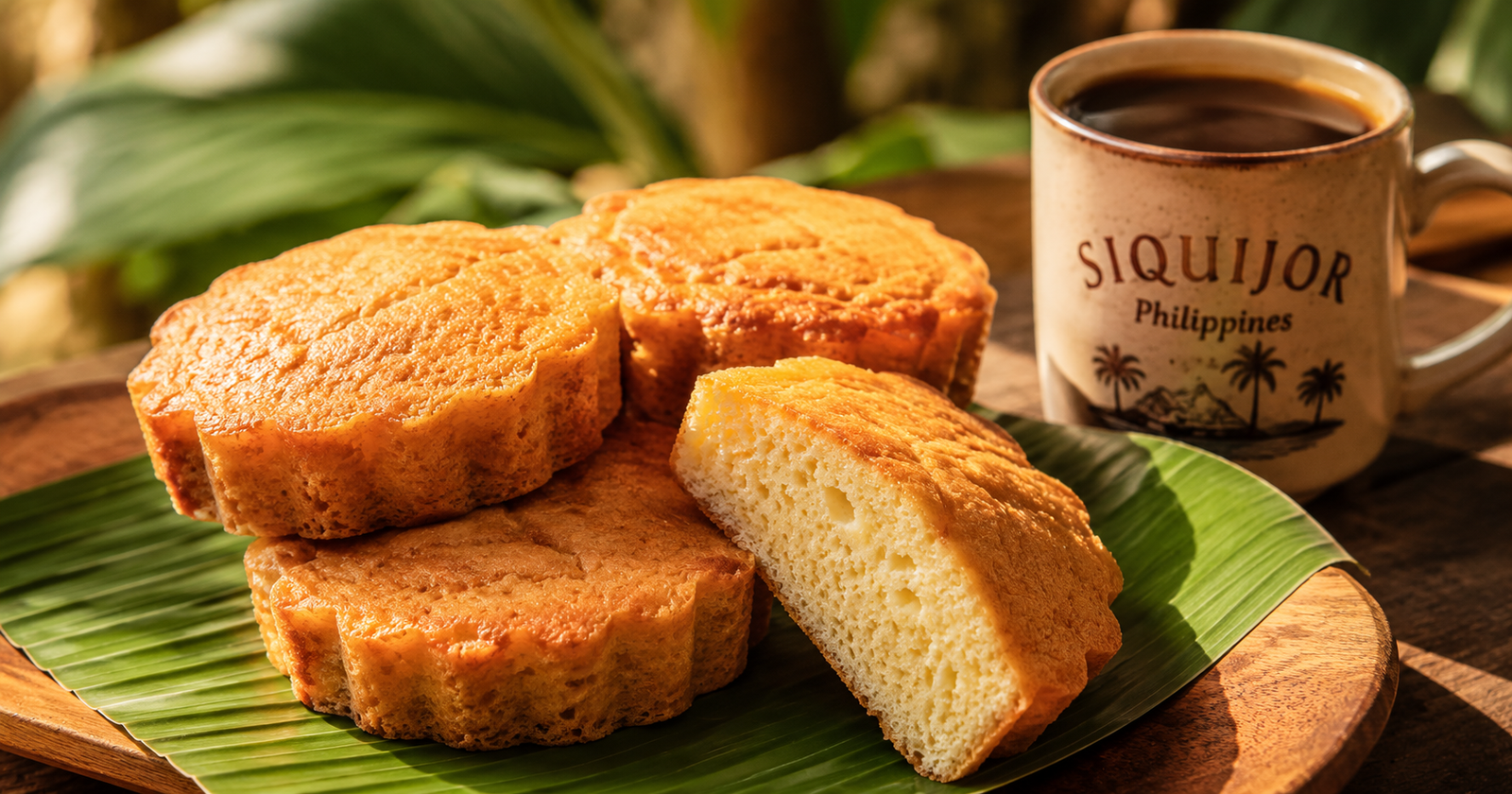
    Freshly baked Torta Siquijor on a wooden board with barako coffee — the most popular delicacy from Siquijor island, Philippines
    ⚡ Quick answer

    Torta Siquijor is a traditional Visayan sponge cake native to the island of Siquijor in the Philippines. Made from flour, sugar, eggs, milk, and tuba (freshly tapped coconut wine used as a natural leavening agent), it is soft, golden, and mildly sweet. Best eaten warm with a cup of barako coffee. It costs roughly ₱10–₱25 per piece at local roadside bakeries and is the most popular pasalubong from the island.

    Siquijor Delicacy

    What is Torta Siquijor?

    If you ask any local in Siquijor what to eat, torta will almost always be the first answer. It is the island’s signature baked delicacy — a sponge cake so deeply embedded in daily life that it serves as breakfast, afternoon merienda, and the most popular pasalubong visitors bring home.

    The torta belongs to the family of Visayan sponge cakes found across the Central Visayas region, closely related to the famous Torta Argao of Cebu. But Siquijor’s version carries its own identity: baked by small home bakeries and market vendors who have passed down their formulas through generations.

    What sets it apart from ordinary sponge cakes is the use of tuba — freshly tapped coconut wine — as the traditional leavening agent. This gives the torta not just its rise, but a subtle, complex flavor that no commercial yeast can replicate.

    🍰Sponge cakeType of delicacy
    🥥TubaKey leavening ingredient
    💰₱10–₱25Price per piece
    🕐Before 10 AMBest time to buy fresh
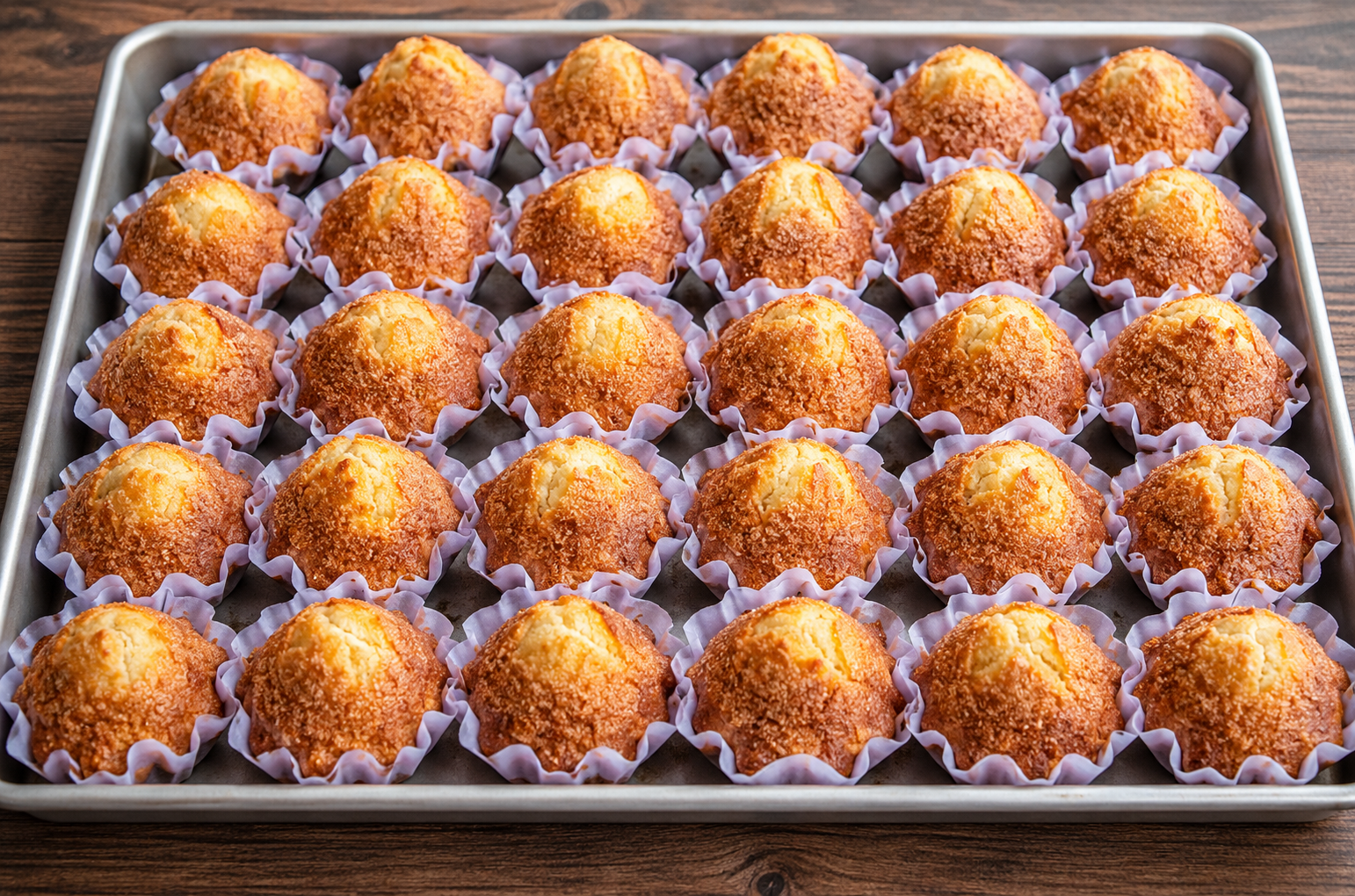
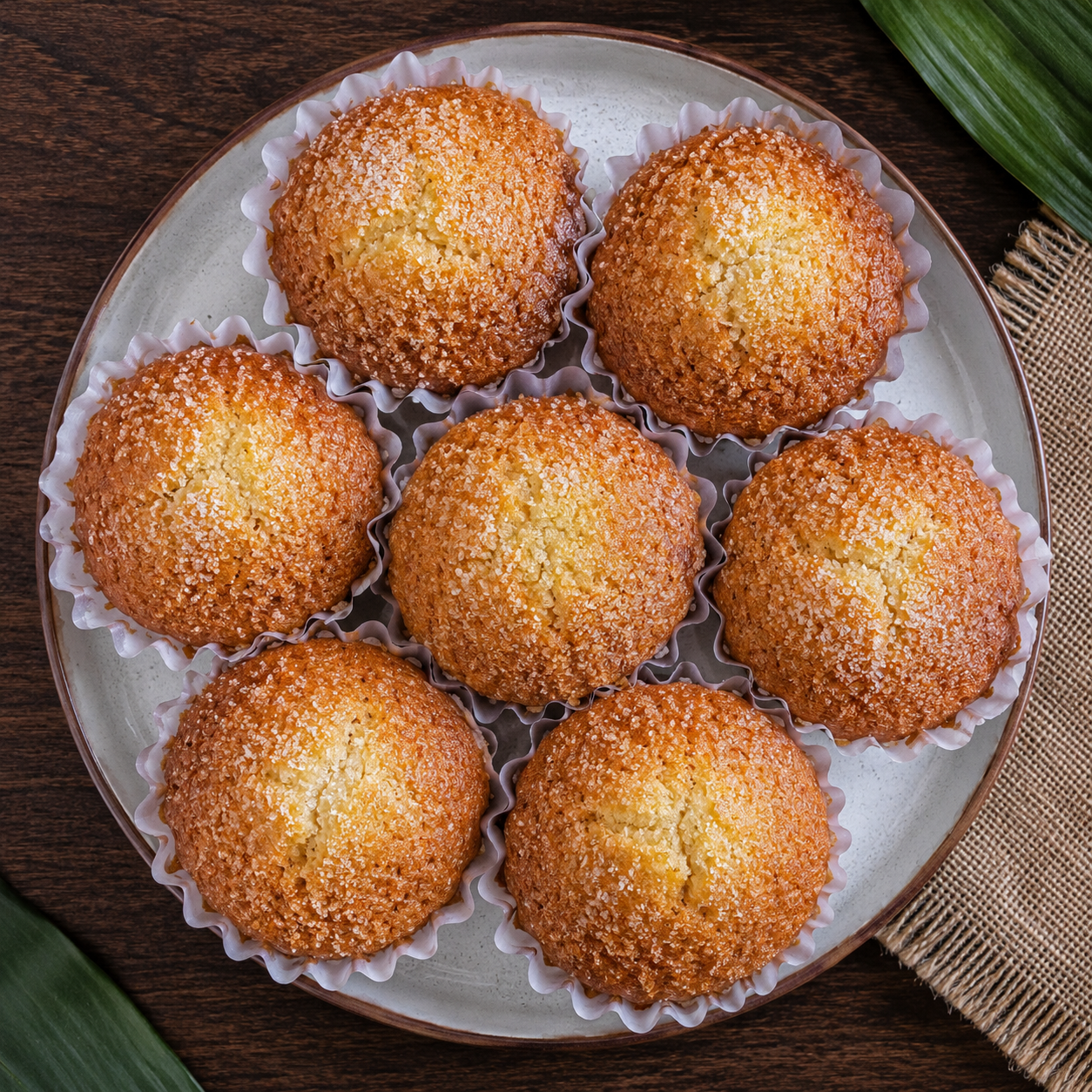
    Golden Torta Siquijor pieces arranged on a tray showing the sugar-dusted caramelized crust — a classic Siquijor delicacy
    Freshly baked torta Siquijor, golden and sugar-dusted straight from the oven — the signature look of this beloved island delicacy.

    Background

    History and Origins of Torta in Siquijor

    The torta’s roots in the Visayas trace back to Spanish colonial times, when the word torta entered the Filipino lexicon. While in northern Philippines the word came to mean a savory egg omelet, in the Visayas it evolved into something entirely different: a festive baked cake reserved for fiestas, weddings, and family celebrations.

    In Siquijor, the torta became a story of resourcefulness. Commercial yeast was historically scarce on a small, remote island. Local bakers turned to what the island had in abundance: coconut trees. From their sap came tuba — a freshly fermented coconut wine that triggers natural fermentation and gives the cake its distinctive rise and taste.

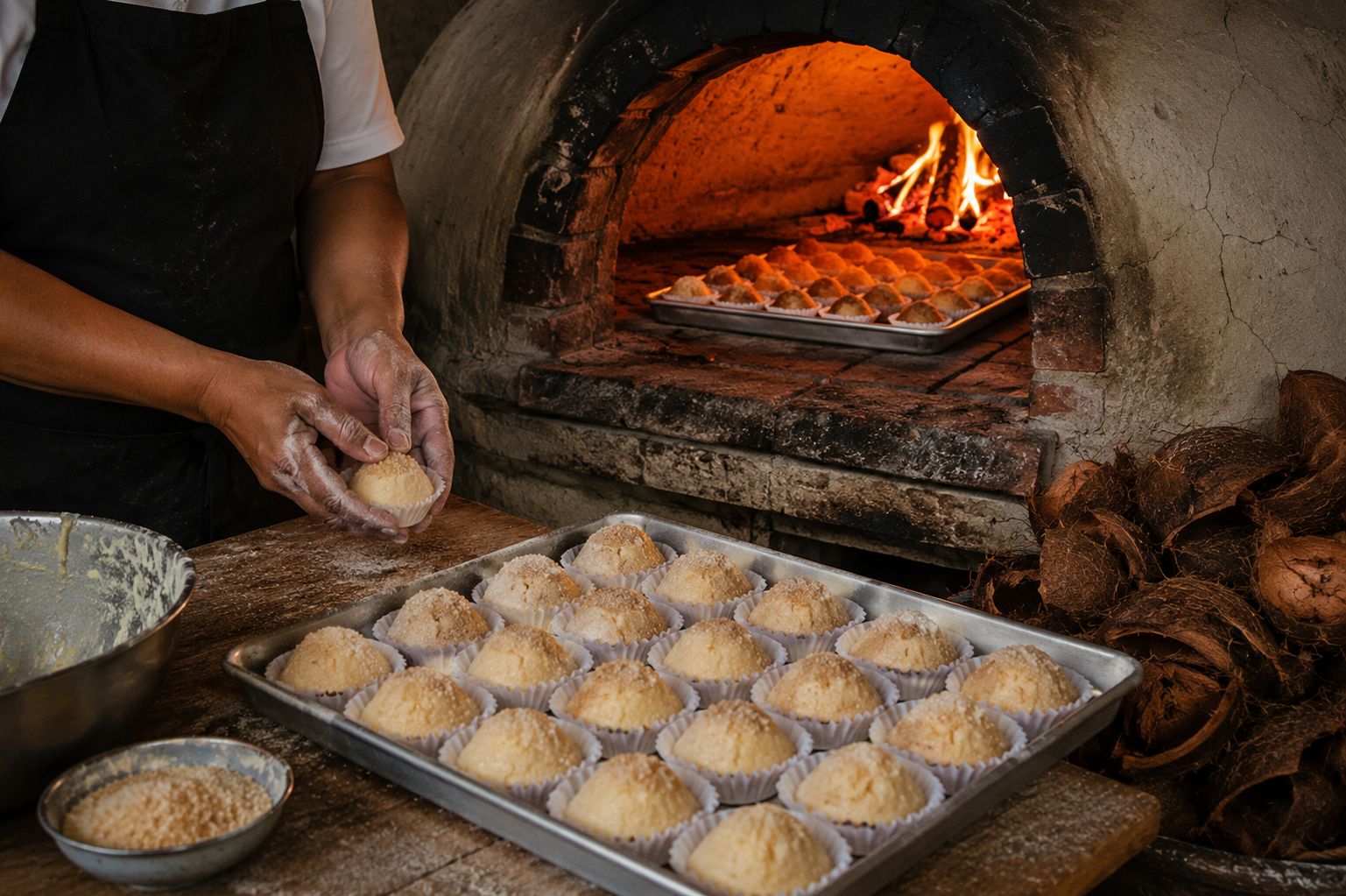
    The baking method is equally traditional. Many older bakeries in Siquijor still use a hurno or pugon — a clay or metal oven fired with dried coconut husks. The cakes absorb the faint smokiness of the burning coconut charcoal, adding a layer of flavor that a modern electric oven simply cannot produce.

    🌴
    Local knowledge

    The very best torta in Siquijor is baked by small home bakeries that mix their batter before dawn and pull the cakes out by mid-morning. If you arrive at the market before 10 AM, you’ll catch them while they’re still warm — the way they’re meant to be eaten.

    Traditional pugon native clay oven in Siquijor used for baking torta with dried coconut husks — a centuries-old baking tradition
    A traditional pugon (native clay oven) fired with dried coconut husks — the authentic way torta has been baked in Siquijor for generations.

    Flavor Profile

    What Does Torta Siquijor Taste Like?

    The first thing you notice is how different it is from a cupcake or muffin. Torta Siquijor is not sweet in the aggressive, frosting-laden way of Western pastries. It is mildly sweet — the kind of sweetness that lets the eggy richness and coconut undertones come through.

    The texture is soft and dense. Each piece has a tender, close crumb — slightly firmer than ordinary chiffon, with a barely golden exterior brushed with butter and dusted with white sugar while still hot. That buttery-sweet top crust is, for many visitors, the best part.

    The tuba leavening gives the cake a very faint tang — not sour, but alive. It’s a flavor you can’t quite name until you’re told what it is. It pairs beautifully with a strong cup of local Barako coffee or the sweetness of fresh buko juice.

    Best pairing

    Eat torta Siquijor with a hot cup of barako coffee — the bold, slightly bitter coffee cuts through the sweetness perfectly. It’s the classic Visayan afternoon merienda combination that locals swear by.

    Torta Siquijor broken in half showing soft moist crumb inside, served with a cup of hot barako coffee — the classic Filipino merienda pairing
    Torta Siquijor broken open to reveal its soft, dense crumb — best enjoyed with a cup of strong barako coffee in the afternoon.

    What’s Inside

    Key Ingredients in Torta Siquijor

    The ingredients are simple and humble — which is the point. No buttercream, no fondant, no ganache. Just honest pantry staples transformed by technique and tradition.

    Flat lay of Torta Siquijor ingredients — eggs, flour, sugar, condensed milk, evaporated milk, butter and oil on a wooden surface
    The humble ingredients behind Torta Siquijor — simple pantry staples that, with the right technique, produce something extraordinary.
    IngredientRole in the torta
    All-purpose flourThe structural base of the cake
    Egg yolks (many!)Richness, golden color, and tender crumb
    White sugarMild sweetness; also used as a crunchy topping
    Evaporated & condensed milkCreaminess and depth of flavor
    Vegetable oil & butterMoisture and richness
    Tuba (coconut wine)Traditional natural leavening — gives unique rise and flavor
    Vanilla extractSubtle aromatic sweetness
    Butter + sugar (topping)The golden, slightly caramelized finish brushed on while hot
    💡
    About tuba

    Tuba is freshly tapped coconut wine from Philippine coconut palms. In Siquijor, it is harvested each morning and used the same day in baking — a living leavening agent. If you’re making torta outside the Philippines, substitute with baking powder, though the unique flavor profile will differ slightly. The torta is not alcoholic — the alcohol fully cooks off during baking.

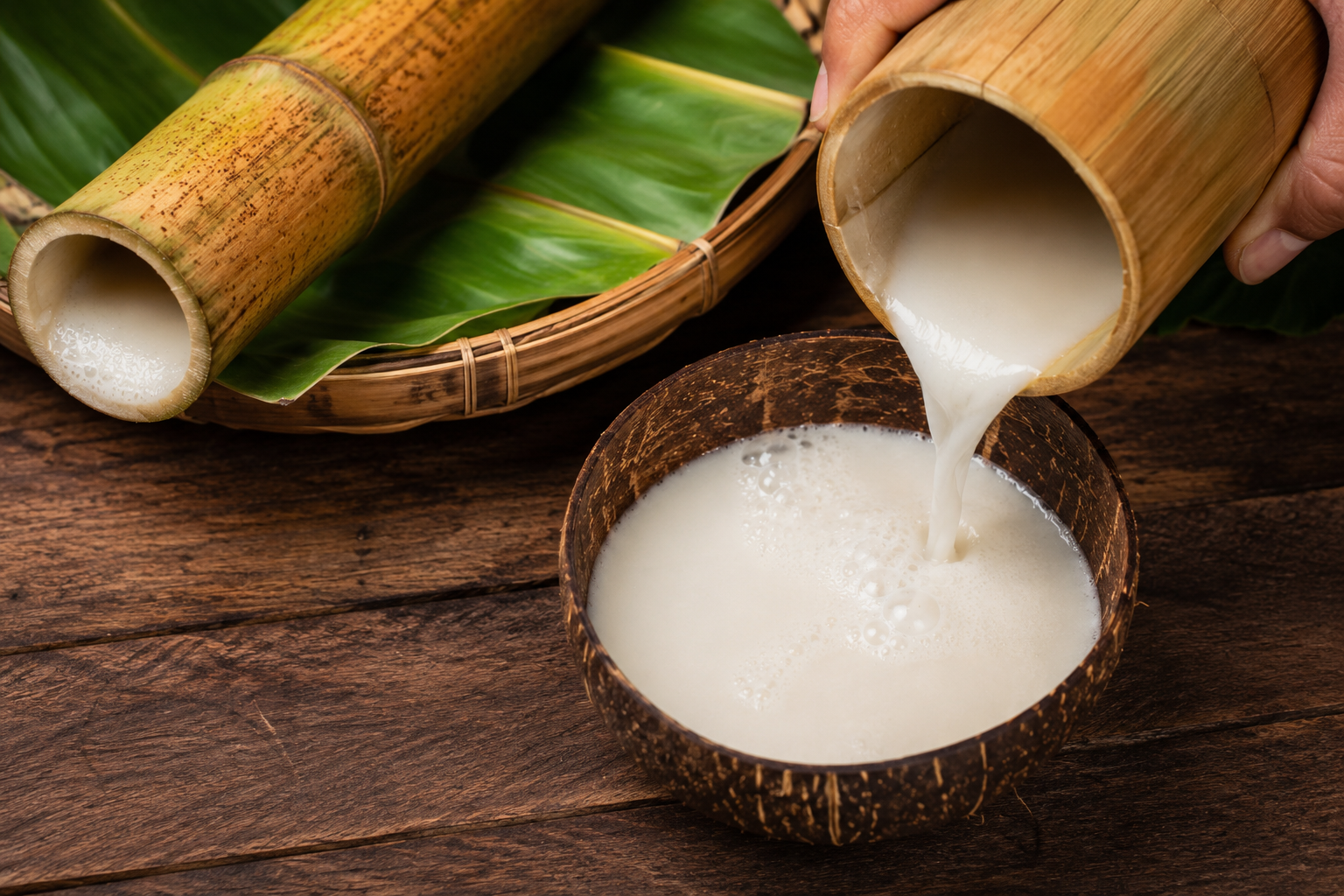
    Fresh tuba coconut wine in a bamboo container in Siquijor Philippines — the natural leavening agent used in traditional Torta Siquijor baking
    Freshly tapped tuba (coconut wine) from a Siquijor coconut palm — harvested each morning and used the same day as a natural leavening agent in torta.

    Home Recipe

    How to Make Torta Siquijor at Home

    This home version uses baking powder since tuba is not easy to find outside the Philippines. If you are in Siquijor, ask a local baker to show you the tuba version — it is worth the experience.

    Ingredients (makes 12 pieces)

    IngredientAmount
    All-purpose flour1¾ cups
    Baking powder1 tbsp
    Salt½ tsp
    White sugar1½ cups
    Egg yolks8 large
    Vegetable oil¾ cup
    Butter, melted¼ cup
    Evaporated milk½ cup
    Condensed milk½ cup
    Vanilla extract1 tsp
    Butter + white sugarfor topping

    Instructions

    1

    Preheat your oven to 350°F (175°C). Grease 12 torta molds, fluted ensaimada molds, or a muffin tin.

    2

    In a large bowl, whisk together the flour, baking powder, salt, and sugar until evenly combined.

    3

    In a separate bowl, whisk together the oil, melted butter, and egg yolks until smooth and slightly pale.

    4

    Add the evaporated milk, condensed milk, and vanilla to the wet mixture. Stir until fully incorporated.

    5

    Fold the wet mixture into the dry ingredients until the batter is smooth and flowing — not too thick, not watery.

    6

    Divide batter evenly among molds, filling each about ¾ full.

    7

    Bake for 25–30 minutes until tops are golden and a toothpick inserted in the center comes out clean.

    8

    While still hot, brush generously with butter and sprinkle white sugar over each piece. Let cool slightly before serving.

    🧑‍🍳
    Baker’s tip

    The secret to a moist torta is not overbaking. Pull the cakes out the moment the toothpick comes out clean — even two extra minutes will dry them out. The butter-and-sugar topping applied immediately after baking is non-negotiable: it creates the slightly caramelized crust that is the hallmark of a truly good torta.

    Finished homemade Torta Siquijor on a plate — top-down view showing the golden sugar-dusted surface of the traditional Filipino sponge cake
    Finished torta Siquijor — golden, sugar-dusted, and ready to eat. The caramelized top is the signature of a well-made torta.

    Comparison

    Torta Siquijor vs Torta Argao: What’s the Difference?

    If you’ve researched Philippine delicacies, you’ve likely encountered Torta Argao — the celebrated sponge cake from southern Cebu. The two are closely related, but not the same.

    FeatureTorta SiquijorTorta Argao (Cebu)
    LeaveningTuba or baking powderTuba — traditionally mandatory
    Fat usedVegetable oil + butterAged lard (pork fat)
    Baking methodModern or clay ovenClay oven + coconut husk fire
    TextureSoft, moist, lighterDenser, richer, longer shelf life
    SweetnessMild to mediumMild — lard reduces sweetness
    AvailabilityFresh daily at roadside stallsPackaged, nationally recognized

    The lard in Torta Argao gives it an unctuous richness that Siquijor’s lighter version doesn’t fully replicate. But Siquijor’s torta is often fresher and more accessible — you can find it still warm from the oven at local market stalls every morning.


    Where to Go

    Where to Buy Torta in Siquijor

    You won’t find torta inside a polished café. This is a street-level delicacy, and that’s exactly where the best versions live — at roadside bakeries, morning markets, and small kiosks run by local families.

    📍
    Roadside bakery near Siquijor Integrated School
    The most frequently mentioned spot by locals. A kiosk-style bakery that produces fresh torta daily, usually sold out by late morning. Also sells Pan Bisaya and other local baked goods.
    📍
    Lilibeth’s Bakery — Siquijor town
    A popular roadside bakery well-known locally for torta and Pan de Bisaya baked in a traditional native oven. Famous on social media for their authentic old-school baking method.
    📍
    Siquijor Town Public Market
    The best all-in-one stop. Find torta alongside peanut balls, chupa-chupa, and banana crackers — all in one stall-filled morning visit.
    📍
    San Juan market stalls
    San Juan is the main tourist hub. Several small vendors near the beachfront carry freshly baked torta, particularly during morning hours from 7–10 AM.
    🕐
    Best time to go

    Arrive between 7 AM and 10 AM. Most torta is baked before dawn and sells out by mid-morning. Going early means you get it still warm — the definitive way to eat it.

    Local roadside bakery stall in Siquijor Philippines displaying freshly baked torta and Pan Bisaya for sale at the market
    A typical roadside bakery stall in Siquijor — the kind of place where the best torta is found, usually sold out before noon.

    Cost

    How Much Does Torta Siquijor Cost?

    Torta Siquijor is one of the most affordable food experiences on the island.

    ₱10–₱25
    per piece at local bakeries

    A box of 12 pieces runs ₱120–₱280. For international visitors, that’s roughly $0.20–$0.45 USD per piece — one of the most authentic and affordable food experiences in the Philippines.


    Take-Home Gift

    Bringing Torta Home as Pasalubong

    Torta is the single most popular pasalubong (take-home gift) from Siquijor. Here’s what you need to know before packing it up:

    Torta keeps well at room temperature for 2–3 days without refrigeration, and up to a week in the fridge. Its shelf life is one of the reasons it became the traditional choice for pasalubong — even before refrigeration existed, torta survived the journey home.

    Most bakeries will wrap them in paper or cellophane. For larger quantities, ask the vendor for a box. Torta travels well in a carry-on bag — just keep them away from heavy items.

    ✈️
    Travel tip for international visitors

    Torta Siquijor passes through airport security without issues — it is a solid baked good, not a liquid or paste. Carry it in cabin luggage on domestic flights, or in checked luggage for international flights. Wrap in an extra layer of paper to keep fresh.

    Torta Siquijor wrapped and boxed as pasalubong ready to bring home — the most popular take-home gift from Siquijor island Philippines
    Torta Siquijor packed as pasalubong — the most popular take-home gift from the island, keeping fresh for 2–3 days at room temperature.

    FAQ

    Frequently Asked Questions About Torta Siquijor

    What is Torta Siquijor?
    Torta Siquijor is a traditional Visayan sponge cake from the island of Siquijor in the Philippines. Made from flour, eggs, sugar, milk, and tuba (coconut wine) as a natural leavening agent, it is soft, golden, and mildly sweet — one of the island’s most beloved local delicacies and pasalubong.
    Is Torta Siquijor the same as Torta Argao?
    They are closely related but not identical. Both are Visayan tuba-leavened sponge cakes. Torta Argao from Cebu uses aged lard for extra richness and is exclusively baked in clay ovens fired with coconut husks. Siquijor’s version uses oil and butter, is lighter, and is sold fresh daily at local roadside stalls.
    What does torta taste like?
    Soft, mildly sweet, slightly eggy and dense — with a buttery-sugary caramelized crust. The tuba leavening gives it a very faint pleasant tang. Best eaten warm, paired with barako coffee.
    Where is the best place to buy torta in Siquijor?
    The most recommended spot is the roadside bakery near Siquijor Integrated School in the town proper. Lilibeth’s Bakery is also well-known for baking in a traditional native oven. Arrive before 10 AM for the freshest batch.
    How much does Torta Siquijor cost?
    Typically ₱10 to ₱25 per piece. A box of 12 costs roughly ₱120–₱280 — about $0.20–$0.45 USD per piece, making it one of the most affordable authentic food experiences on the island.
    Can I bring Torta Siquijor on a plane?
    Yes. Torta passes through airport security without issues. It keeps at room temperature for 2–3 days and up to a week refrigerated. It’s an ideal pasalubong for both domestic and international travelers.
    Is the torta alcoholic because of the tuba?
    No. Tuba is a freshly tapped coconut wine, but the alcohol fully cooks off during baking. The torta is completely safe for everyone including children. Only the subtle flavor of the tuba remains.

    GC
    Giovanni Carlo Bagayas
    Filipino Travel Writer & Content Creator
    I grew up in Pagadian City, Mindanao, and have spent over 10 years exploring the Philippines. Siquijor is one of my favorite islands — I’ve eaten more torta here than I can count, and I know exactly which bakery to visit before 8 AM. This site is my way of sharing the Philippines honestly, through the eyes of someone who lives it every day.

    Keep Exploring

    More from Siquijor & Dumaguete

  • Why Travel to the Philippines in 2026: 12 Reasons to Visit

    🌏 Philippines Travel 2026

    Why Travel to the
    Philippines in 2026

    12 honest reasons why the Philippines should be your next destination — from world-class beaches and extraordinary value to visa-free entry for US and UK travelers and experiences you simply cannot find anywhere else in Asia.

    ✍️ Giovanni Carlo P. Bagayas (Gio) · Updated · 📖 10 min read
    🇺🇸
    US Citizens — No Visa Required
    30 days visa-free on arrival
    American passport holders enter visa-free for 30 days. Valid passport (6+ months), return ticket, proof of accommodation. Register free at etravel.gov.ph within 72 hrs before departure.
    🇬🇧
    UK Citizens — No Visa Required
    30 days visa-free on arrival
    British passport holders enter visa-free for 30 days. Valid passport (6+ months), return ticket, proof of accommodation. Register free at etravel.gov.ph within 72 hrs before departure.
    Quick answer

    Why should you travel to the Philippines?

    The Philippines offers something genuinely rare in travel: world-class natural beauty at an accessible price point, with no language barrier for English speakers and no visa required for US and UK citizens. Palawan has been ranked the world’s best island multiple times. Budget travelers can live well on USD 40–60 / GBP 32–48 per day. Filipinos are consistently ranked among the world’s most hospitable people. And with 7,641 islands, no two trips to the Philippines are ever the same.

    🏝️
    7,641
    Islands
    💵
    $40–60
    Budget/day USD
    💷
    £32–48
    Budget/day GBP
    🗣️
    #3
    English-speaking country
    ✈️
    30 days
    Visa-free US & UK
    🌤️
    Nov–Apr
    Best season
    The case for the Philippines

    12 Reasons to Visit the Philippines in 2026

    🏖️
    01
    The beaches are genuinely world-class
    Best in Asia
    Palawan has been named the world’s best island by Travel + Leisure, Condé Nast Traveler, and TripAdvisor — repeatedly. El Nido’s hidden lagoons, Boracay’s White Beach, and Coron’s crystal lakes are not overhyped. They are among the finest natural seascapes on earth. The Philippines doesn’t just have good beaches — it has the best beaches in Asia.
    💵
    02
    Extraordinary value for US & UK money
    Budget-friendly
    Your dollar and pound go incredibly far. A guesthouse in El Nido costs USD 15–25 per night. A full plate of rice and grilled fish costs USD 2–4. An all-day island hopping tour costs USD 17–26 per person. For the price of a week in the Maldives, you can spend a month in the Philippines — and arguably have a better time.
    Budget: USD 40–60 / GBP 32–48 per day
    🗣️
    03
    Everyone speaks English
    No language barrier
    The Philippines is the third-largest English-speaking country in the world. English is the language of education, business, government, and daily life. You will never need a phrase book, translation app, or hand signals to order food, book a tour, ask for directions, or have a real conversation with a local. This is the single biggest practical advantage the Philippines has over Thailand, Bali, Vietnam, or Japan for US and UK travelers.
    ✈️
    04
    No visa required for US & UK citizens
    30 days visa-free
    Zero paperwork. No pre-travel visa application. No appointment at an embassy. Americans and British passport holders simply arrive at the airport and receive 30 days on arrival — just like Thailand and Bali but with the added benefit of English being spoken at every immigration desk. The only pre-arrival step is registering free on etravel.gov.ph within 72 hours of your flight.
    🤿
    05
    Some of the world’s best diving & snorkelling
    World-class marine life
    The Philippines sits within the Coral Triangle — the global centre of marine biodiversity. Tubbataha Reef (Palawan) is a UNESCO World Heritage Site. Coron’s WWII Japanese wrecks are among the world’s top 10 wreck dives. Malapascua (Cebu) is the only place in the world where you can reliably dive with thresher sharks. Moalboal (Cebu) has a sardine run involving millions of fish. Apo Reef is the second-largest contiguous coral reef in the world.
    Fun dive from PHP 1,200 (~USD 21 / GBP 17)
    😊
    06
    The most hospitable people in Asia
    Filipino warmth
    This is not a travel cliché — it is consistently what US and UK travelers say surprised them most about the Philippines. Filipinos are genuinely warm, curious about visitors, and go out of their way to help. The concept of bayanihan (communal helping) and Filipino hospitality are not tourist-facing performances — they are cultural values lived daily. Many first-time visitors to the Philippines return specifically because of the people.
    🍜
    07
    A food culture that surprises and delights
    Underrated cuisine
    Filipino cuisine is Southeast Asia’s most underappreciated food culture — and it is having a global moment. Lechon (whole roasted pig) from Cebu is one of the finest roasted meats in the world. Sinigang (tamarind sour soup) is a revelation. Crispy pata, kare-kare, adobo, and fresh seafood grilled over charcoal at any coastal town are all extraordinary. The combination of Spanish, Chinese, Malay, and American culinary influences has created something genuinely distinctive.
    🎭
    08
    Rich culture unlike anywhere else in Asia
    Unique heritage
    The Philippines is the only Christian nation in Asia, the only Southeast Asian country with a Spanish colonial heritage, and home to 140+ ethnic groups each with distinct traditions, textiles, music, and folklore. The UNESCO rice terraces of Banaue are 2,000 years old. The Maranao people of Mindanao weave the world’s most intricate traditional textiles. The festivals — Sinulog, Ati-Atihan, Pahiyas — have no equivalent anywhere else in the region.
    🏄
    09
    World-class surfing and water sports
    Adventure capital
    Siargao’s Cloud 9 is a World Surf League venue — a perfect hollow reef break that barrels like a wave from a dream. But surfing is just the start. Canyoneering at Kawasan Falls, cliff jumping at Boracay, kitesurfing at Bulabog Beach, white water rafting in Cagayan de Oro, and volcano trekking at Mt. Apo (the Philippines’ highest peak) make this one of the most activity-dense destinations in Southeast Asia.
    🗺️
    10
    7,641 islands — infinite variety
    Never the same trip twice
    The Philippines’ sheer geographic variety means you can visit five times and never repeat an experience. A week in Palawan, a week in Cebu, a long weekend in Batanes, a Bohol countryside tour, and a Siargao surf trip are five entirely different trips — different food, different dialect, different culture, different landscape — all within one country. Most US and UK travelers who visit once plan a return trip before they leave.
    🌿
    11
    Incredible wildlife and biodiversity
    Mega-biodiversity hotspot
    The Philippines is one of 17 mega-diverse countries in the world. It is home to the Philippine eagle (world’s largest eagle by wingspan), the world’s smallest primate (Philippine tarsier in Bohol), whale sharks in Oslob and Donsol, dugongs in Palawan, and over 50,000 species of plants and animals — many found nowhere else on earth. For wildlife enthusiasts, the Philippines rivals Costa Rica and the Galapagos for endemic species density.
    📈
    12
    Tourism infrastructure is better than ever
    2026 is the right time
    New direct flight routes, upgraded airports (NAIA’s Terminal 1 renovation is complete, New Manila International Airport in Bulacan progressing), expanded domestic air coverage, and improved island ferry networks have made the Philippines significantly more accessible than five years ago. 2026 is genuinely one of the best years to visit — infrastructure is better, but the islands are not yet as crowded as Thailand or Bali at their peak.

    The honest comparison

    Philippines vs Thailand vs Bali — Which to Choose?

    This is the #1 decision US and UK travelers face when planning a Southeast Asia beach trip. Here’s the honest breakdown:

    FactorPhilippines 🇵🇭Thailand 🇹🇭Bali 🇮🇩
    Beach quality⭐ World’s best (Palawan)ExcellentGood
    English spoken⭐ EverywhereTourist areas onlyTourist areas only
    Visa (US/UK)⭐ 30 days free on arrival30 days free on arrival30 days free on arrival
    Daily budget USD$40–60$35–55⭐ $30–50
    Diving quality⭐ World-class (Coral Triangle)Very goodAverage
    Surfing⭐ World-class (Siargao)Good (Koh Samui area)Excellent (Uluwatu)
    Land transportIsland hopping required⭐ Excellent roads & trainsEasy (small island)
    Food culture⭐ Underrated & diverseWorld-famousExcellent (Indonesian)
    Crowds⭐ Less crowded than rivalsVery crowded at peaksVery crowded
    Cultural uniqueness⭐ Only Christian nation in AsiaBuddhist templesHindu culture
    Flight from USA14–16 hrs direct (LA/SF)~20 hrs (1 stop)~20 hrs (1 stop)
    Flight from UK13–14 hrs direct (LHR)~13 hrs direct~16 hrs (1 stop)

    “If you want the best beaches in Asia, go to the Philippines. If you want the easiest infrastructure, go to Thailand. If you want the most Instagrammable rice terraces, go to Bali. But if you want all three — and to be able to talk to everyone you meet — go to the Philippines.”


    ✦ Before You Go — Practical Tips for US & UK Travelers
    • Register on etravel.gov.ph within 72 hours before your flight — free, mandatory, takes 10 minutes. Get your QR code and show it at the Bureau of Quarantine counter on arrival.
    • Book domestic flights early — Cebu Pacific and AirAsia Philippines are the main budget carriers. Fares rise sharply in the last 2 weeks. Book 4–8 weeks ahead for best prices (USD 20–60 per flight).
    • Bring cash in Philippine pesos — many islands have unreliable ATMs. Exchange at the airport or SM Mall money changers in Manila or Cebu before island-hopping.
    • Get travel insurance with medical evacuation — medical evacuation from a remote island can cost USD 10,000+. Cover this from home before you fly.
    • Best season: November to April — avoid June to October for typhoon exposure especially on east-facing coasts. Palawan and Boracay are best November to May.
    • You can extend your 30-day stay — visit any Bureau of Immigration office. Extensions are issued in 29-day increments at around PHP 3,000 (~USD 52 / GBP 42) each.
    • Manila is a hub, not a destination — spend 1–2 days maximum in Manila (Intramuros, Binondo, food) then fly or ferry to the islands. Don’t judge the Philippines by Manila traffic.
    • Currency: Philippine peso (PHP) — USD is accepted at many tourist spots but get pesos for markets, local transport, and islands. Current rate: ~PHP 57–58 per USD, ~PHP 72–73 per GBP.

    Ready to Plan Your Philippines Trip?

    Start with the destinations, check the entry requirements, or dive straight into the food and culture guides — everything you need is here, free.

    Frequently Asked Questions

    Common questions from US and UK travelers deciding whether to visit the Philippines.

    Why should I visit the Philippines?+
    The Philippines offers world-class beaches (Palawan is ranked the world’s best island), no language barrier (English spoken everywhere), 30 days visa-free entry for US and UK citizens, extraordinary affordability (USD 40–60 / GBP 32–48 per day), world-class diving in the Coral Triangle, and the warmest hospitality you will find in Southeast Asia. The US is already the second-largest source of international visitors to the Philippines in 2026.
    Is the Philippines worth visiting in 2026?+
    Yes — absolutely. Tourism infrastructure has significantly improved, with upgraded airports and expanded domestic flight coverage. The Philippines offers world-class natural beauty at a fraction of the cost of the Maldives, Caribbean, or even Bali — with the added advantage that everyone speaks English and no visa is required for US and UK citizens.
    How does the Philippines compare to Thailand for US and UK travelers?+
    For beach quality — Philippines wins (Palawan consistently beats all Thai islands in world rankings). For English — Philippines wins by a significant margin. For land transport and infrastructure — Thailand wins. For diving — Philippines wins (Coral Triangle). For food fame — Thailand has the global reputation but Filipino cuisine is exceptional and underrated. Both offer 30-day visa-free entry for US and UK citizens.
    Is the Philippines cheap for Americans and British tourists?+
    Yes — very affordable. Budget travelers manage USD 40–60 / GBP 32–48 per day comfortably. Mid-range is USD 80–150 / GBP 65–120 per day. A guesthouse costs USD 15–25, a local meal USD 2–5, a full-day island hopping tour USD 17–26. The Philippines is significantly cheaper than the Maldives, Hawaii, the Caribbean, or any European beach destination with comparable scenery.
    Do Americans and British need a visa for the Philippines?+
    No — both US and UK citizens receive 30 days visa-free entry on arrival in 2026. The only pre-arrival requirement is registering free on etravel.gov.ph within 72 hours before your flight. Bring a valid passport (6+ months validity), a return/onward ticket, and proof of accommodation.
    Is the Philippines safe for US and UK tourists?+
    Yes for tourist destinations. Palawan, Boracay, Cebu, Bohol, Siargao, Banaue, Vigan, and Manila’s tourist areas are all safe for US and UK visitors. The US State Department (Level 2 overall) and UK FCDO advise against travel to specific parts of western Mindanao and the Sulu Archipelago only — areas tourists do not visit. Stick to the popular tourist circuit and take normal travel precautions.
    How long should I spend in the Philippines?+
    A minimum of 10–14 days is recommended to meaningfully explore the Philippines — ideally combining two destinations (e.g., Palawan + Cebu, or Cebu + Siargao). Three weeks lets you add Bohol, Batanes, or the Cordillera highlands. With 30 days visa-free, you have time to explore properly without rushing. Most US and UK travelers say they wish they had booked more time.
    Giovanni Carlo P. Bagayas — Gio
    Filipino travel writer & cultural guide

    Born in Cebu City, raised between Cebu and Dumaguete City, currently residing in Labangan, Zamboanga del Sur. As a Filipino who has traveled all three island groups — and spent years helping international visitors navigate the Philippines — I’ve written this guide specifically for US and UK travelers who want an honest, practical answer to the question: is the Philippines worth it? The answer, without reservation, is yes.

  • Best Places to Visit in the Philippines: Complete Guide (2026)

    🏝️ Philippines Travel Guide 2026

    Best Places to Visit
    in the Philippines (2026)

    From Palawan’s turquoise lagoons to Siargao’s surf breaks and Batanes’ dramatic cliffs — the definitive guide to the Philippines’ top destinations with costs in USD and GBP, visa info for US and UK travelers, and honest first-hand tips.

    ✍️ Giovanni Carlo P. Bagayas (Gio) · Updated · 📖 15 min read
    🇺🇸
    US Citizens — Visa Free
    30 days on arrival — no visa needed
    American passport holders enter the Philippines visa-free for up to 30 days. Bring a valid US passport (6+ months validity), a return/onward ticket, and proof of accommodation. Extensions available at any Bureau of Immigration office.
    🇬🇧
    UK Citizens — Visa Free
    30 days on arrival — no visa needed
    British passport holders enter the Philippines visa-free for up to 30 days. Bring a valid UK passport (6+ months validity), a return/onward ticket, and proof of accommodation. Extensions available at any Bureau of Immigration office.
    Quick answer

    What are the best places to visit in the Philippines?

    The best places to visit in the Philippines are Palawan (El Nido and Coron — world’s best island scenery), Boracay (White Beach — Asia’s finest sand), Cebu (history, whale sharks, waterfalls), Siargao (surfing and island vibes), Bohol (Chocolate Hills and tarsiers), Banaue/Ifugao (UNESCO rice terraces), Batanes (dramatic northern landscapes), Vigan (Spanish colonial heritage), Manila (history, food, culture), and Siquijor (mystical island). For first-time US and UK visitors, Palawan + Cebu is the ideal 10–14 day combination.

    🏝️
    7,641
    Islands
    💵
    $40–60
    Budget/day USD
    💷
    £32–48
    Budget/day GBP
    🌤️
    Nov–Apr
    Best time to visit
    ✈️
    14–16 hrs
    From USA (direct)
    ✈️
    13–14 hrs
    From UK (direct)
    No. 1 — The best in the Philippines

    Palawan — El Nido & Coron

    📍
    LocationWestern Philippines — Palawan province
    ⏱️
    Ideal stay5–7 days (El Nido) + 3–4 days (Coron)
    💵
    Budget/dayUSD 50–120 / GBP 40–95
    ✈️
    Fly intoEl Nido (ENI) or Puerto Princesa (PPS)

    Palawan is consistently ranked among the world’s best island destinations — and it earns the title. The province stretches 650 km from north to south and encompasses some of the most dramatic seascapes on earth. El Nido in the north features towering limestone karst islands, hidden lagoons, and white sand beaches accessible only by boat. Coron in the northeast offers world-class wreck diving, twin lagoons, and Kayangan Lake — often cited as the clearest lake in Asia. Puerto Princesa is the provincial capital and home to the UNESCO-listed Puerto Princesa Subterranean River, a navigable underground river through cathedral-like cave formations. For US and UK visitors, Palawan delivers the “paradise island” experience that the Philippines is famous for — often exceeding expectations.

    Top things to do
    • Island hopping Tour A, B, and C around El Nido — hidden lagoons, snorkelling, white sand beaches
    • Coron Island boat tour — Twin Lagoon, Kayangan Lake, Siete Pecados Marine Park
    • Puerto Princesa Subterranean River tour — UNESCO World Heritage Site, 8.2 km underground
    • Wreck diving in Coron Bay — WWII Japanese fleet, among the world’s best wreck dive sites
    • Nacpan Beach — 4 km of undeveloped white sand north of El Nido
    💡 US/UK tip: Fly Manila → El Nido direct (1.5 hrs, ~USD 60–100) or Manila → Puerto Princesa (1 hr, ~USD 40–80) then travel north by van. Book island hopping tours at your guesthouse — PHP 1,500–2,500 (~USD 26–43 / GBP 20–34) per person. Dry season only: November to May. El Nido shuts down during monsoon.
    No. 2 — Asia’s finest beach

    Boracay — White Beach

    📍
    LocationAklan, Western Visayas
    ⏱️
    Ideal stay3–5 days
    💵
    Budget/dayUSD 60–150 / GBP 48–120
    ✈️
    Fly intoCaticlan (MPH — 10 min to ferry) or Kalibo (KLO — 2 hrs, cheaper)

    Boracay’s 4 km White Beach is one of the most photographed beaches in Asia — powdery white sand so fine it squeaks under your feet, turquoise water, and a vibrant beachfront strip of restaurants, bars, and water sports operators. After a government-mandated closure and cleanup in 2018, Boracay returned cleaner and better managed than it had been for years. In 2026 it sits at the ideal sweet spot: world-class beach infrastructure with genuine tropical beauty intact. Best for first-time visitors, couples, and anyone who wants a beach holiday with excellent food, nightlife, and accessibility.

    Top things to do
    • White Beach sunset walk — 4 km of uninterrupted white sand, world-famous at golden hour
    • Paraw sailing — traditional Filipino outrigger boat sunset cruise
    • Helmet diving and snorkelling at Crocodile Island
    • Puka Shell Beach — quieter alternative north of the island
    • D’Talipapa market — buy fresh seafood, have it cooked at nearby restaurants for half the menu price
    💡 US/UK tip: Fly into Caticlan (MPH) for convenience — the airport is 10 minutes from the ferry. Kalibo (KLO) is 2 hours away but has more flight options and cheaper fares — worth checking both. Environmental fee PHP 300 (~USD 5 / GBP 4) paid on arrival at the port. Best months: November to May.
    No. 3 — History, beaches & whale sharks

    Cebu — The Queen City of the South

    📍
    LocationCentral Visayas
    ⏱️
    Ideal stay4–6 days
    💵
    Budget/dayUSD 40–100 / GBP 32–80
    ✈️
    Fly intoMactan-Cebu International Airport (CEB) — direct from UK/US via Manila

    Cebu is the Philippines’ most historically significant city and one of its most versatile destinations. Cebu City is home to Magellan’s Cross (1521), the Basilica Minore del Santo Niño (oldest Catholic church in the Philippines), and Fort San Pedro — plus excellent food, shopping, and nightlife. But Cebu province extends far beyond the city: Oslob in the south offers whale shark encounters (~3 hours from the city), Kawasan Falls is a stunning multi-tiered turquoise waterfall perfect for canyoneering, and Moalboal features sardine run diving and soft coral walls. Cebu is also the gateway to the nearby islands of Siquijor and Bohol.

    Top things to do
    • Magellan’s Cross and Basilica Minore del Santo Niño — oldest Catholic relics in the Philippines
    • Whale shark watching in Oslob — swim alongside the world’s largest fish (~USD 15 / GBP 12)
    • Kawasan Falls canyoneering — 3-hour descent through canyons and waterfalls from PHP 1,000 (~USD 17)
    • Temple of Leah — Roman-inspired hilltop memorial with panoramic city views
    • Lechon in Cebu — widely considered the best roasted pig in the Philippines
    💡 US/UK tip: Cebu has direct international connections — many US and UK visitors fly via Manila then connect (1.5 hrs, ~USD 40–80). Cebu makes an excellent hub for exploring the Visayas: Bohol is a 2-hour ferry, Siquijor is 3 hours, Dumaguete is 3 hours. Best time: November to May.
    No. 4 — Surfing capital of the Philippines

    Siargao — Cloud 9 & Island Life

    📍
    LocationSurigao del Norte, Mindanao
    ⏱️
    Ideal stay4–7 days
    💵
    Budget/dayUSD 40–90 / GBP 32–72
    ✈️
    Fly intoSiargao Airport (IAO) via Cebu or Manila

    Siargao has a mood that’s hard to describe without overselling it. The island is laid-back in a way that feels genuinely earned — not marketed. For surfers, Cloud 9 is a world-class hollow reef break that has hosted the World Surf League. For non-surfers, Siargao still delivers extraordinary island experiences: the Sugba Lagoon (a vast emerald lake in the mangroves), the Magpupungko rock pools, island hopping to Naked Island, Daku Island, and Guyam Island, and one of the Philippines’ best food and coffee scenes concentrated in General Luna. The island has developed rapidly since 2019 while still retaining its core character.

    Top things to do
    • Surf Cloud 9 — world-class hollow reef break, viewable from the famous boardwalk even for non-surfers
    • Sugba Lagoon day trip — 45-minute boat ride to an enormous emerald lagoon in the mangroves
    • Island hopping — Naked Island, Daku Island, Guyam Island (full day, PHP 800–1,200 / ~USD 14–21)
    • Magpupungko rock pools — natural tidal pools accessible at low tide, stunning at golden hour
    • Surf lessons in General Luna — PHP 500–800/session (~USD 9–14) for beginners
    💡 US/UK tip: Fly Manila or Cebu → Siargao (1–1.5 hrs, ~USD 40–80). Best surf: September to November. Best weather overall: October to April. Rent a motorbike in General Luna (~PHP 400/day / ~USD 7) for the best way to explore. Bring cash — ATMs are unreliable on the island.
    No. 5 — Chocolate Hills & tarsiers

    Bohol — Natural Wonders & Wildlife

    📍
    LocationCentral Visayas — 2 hrs from Cebu by ferry
    ⏱️
    Ideal stay3–4 days
    💵
    Budget/dayUSD 35–80 / GBP 28–64

    Bohol is most famous for two things that appear on every Philippines bucket list: the Chocolate Hills — over 1,200 perfectly conical limestone hills that turn brown (like chocolate) in the dry season — and the Philippine tarsier — one of the world’s smallest primates, with enormous eyes and a weight of just 80–160 grams. But Bohol offers much more: the Loboc River cruise through rainforest, the Panglao Island beaches (white sand, excellent diving), the centuries-old Baclayon Church, and the blood compact monument commemorating the peace treaty between Spanish explorer Miguel Lopez de Legazpi and Datu Sikatuna in 1565.

    Top things to do
    • Chocolate Hills viewpoint — best seen at sunrise before tour groups arrive, entrance PHP 100 (~USD 1.70)
    • Philippine Tarsier Sanctuary in Corella — ethical sanctuary for the world’s smallest primate
    • Loboc River Lunch Cruise — floating restaurant through jungle canopy, PHP 450 (~USD 7.80)
    • Panglao Island diving and snorkelling — Balicasag Island is one of the best dive sites in the Visayas
    • Baclayon Church — one of the oldest stone churches in the Philippines (1595)
    💡 US/UK tip: Combine Bohol with Cebu — fast ferry from Cebu City to Tagbilaran takes 2 hours (~USD 7). Most visitors do a full-day Bohol countryside tour covering Chocolate Hills, tarsiers, and the river cruise for PHP 1,500–2,500 (~USD 26–43 / GBP 20–34) per person.

    More unmissable destinations

    7 More Must-Visit Places

    🌾
    Banaue & Ifugao
    UNESCO rice terraces carved 2,000+ years ago. Most dramatic at sunrise in March–May. 8–9 hrs from Manila by night bus (~USD 15). Stay in Banaue town or trek to Batad village.
    🌿
    Batanes
    The Philippines’ northernmost province — dramatic cliffs, rolling hills, stone houses, and a pace of life unlike anywhere else. Fly from Manila (~USD 80–120 return). Best April–June.
    🏛️
    Vigan
    UNESCO-listed Spanish colonial city in Ilocos Sur. Cobblestone streets, centuries-old ancestral houses, and kalesa (horse-drawn carriage) rides. Best combined with Ilocos Norte highlights.
    🌋
    Tagaytay & Taal
    90 minutes from Manila — Taal Volcano on an island in a lake on an island. Cool highland climate, excellent bulalo (bone marrow soup), and dramatic volcanic views. Perfect day trip from Manila.
    🏙️
    Manila
    Often dismissed by tourists but genuinely worth 2 days. Intramuros (16th-century walled city), Binondo (oldest Chinatown in the world), the National Museum, and an extraordinary food scene.
    🌺
    Siquijor
    The Philippines’ most mystical island — white beaches, firefly watching, local folk healers, and no mass tourism. Take a ferry from Cebu City or Dumaguete. Stay at least 2 nights.
    🐬
    Davao
    Mindanao’s safest and most organized city — gateway to Mt. Apo (PH’s highest peak), the Philippine Eagle Center, and Samal Island beaches. Best base for exploring Mindanao safely.

    Find your perfect destination

    Best Places by Travel Style

    🏖️
    Best beaches
    Boracay White Beach, El Nido beaches, Nacpan Beach (Palawan), Alona Beach (Bohol), Puka Shell Beach (Boracay)
    🤿
    Best diving & snorkelling
    Tubbataha Reef (Palawan), Coron wrecks, Balicasag (Bohol), Moalboal sardine run (Cebu), Malapascua thresher sharks
    🧗
    Best for adventure
    Kawasan Falls canyoneering (Cebu), Mt. Apo trekking (Davao), Siargao surfing, Batanes hiking, Chocolate Hills cycling (Bohol)
    💑
    Best for couples
    El Nido private island tours, Batanes, Siquijor, Boracay sunset sailing, Coron island hopping
    👨‍👩‍👧
    Best for families
    Bohol (tarsiers + Chocolate Hills), Cebu City (history), Subic Bay, Puerto Princesa Underground River, Manila Ocean Park
    🎒
    Best on a budget
    Dumaguete, Siquijor, Pagadian, Cagayan de Oro, El Nido (dorm guesthouses from USD 10), Bohol countryside (day trip from Cebu)

    Philippines Travel Costs — USD & GBP (2026)
    ItemPHPUSD approx.GBP approx.
    Budget guesthouse/dorm (per night)PHP 500–1,200USD 9–21GBP 7–17
    Mid-range hotel (per night)PHP 2,500–5,000USD 43–87GBP 35–70
    Local meal (carinderia / turo-turo)PHP 80–150USD 1.40–2.60GBP 1.10–2.10
    Restaurant meal (mid-range)PHP 300–700USD 5–12GBP 4–10
    Domestic flight (Manila → Cebu)PHP 1,500–4,000USD 26–70GBP 21–56
    Island hopping tour (full day)PHP 1,000–2,500USD 17–43GBP 14–35
    Grab/taxi (city, per ride)PHP 100–300USD 1.70–5.20GBP 1.40–4.20
    Whale shark watching, OslobPHP 1,000USD 17GBP 14
    Scuba diving (1 fun dive)PHP 1,200–2,000USD 21–35GBP 17–28
    Airport transfer, Manila (Grab)PHP 400–700USD 7–12GBP 6–10

    💡 USD/GBP conversions approximate at May 2026 exchange rates. Exchange rate: ~PHP 57–58 per USD, ~PHP 72–73 per GBP.


    ✦ Essential Tips for US & UK Travelers
    • Register on etravel.gov.ph within 72 hours before your flight — it’s free, mandatory, and takes 10 minutes. You’ll get a QR code to show at the airport on arrival.
    • Bring cash in Philippine pesos — many islands (Siargao, Siquijor, El Nido) have unreliable ATMs. Exchange at the airport or a mall money changer in Manila or Cebu before heading to the islands.
    • Book domestic flights early — Cebu Pacific and AirAsia Philippines are the main budget carriers. Fares increase significantly in the last 2 weeks before travel. Book 4–8 weeks ahead for best prices.
    • Get comprehensive travel insurance that includes medical evacuation — hospital quality varies significantly outside major cities, and medical evacuation from remote islands can cost USD 10,000+.
    • Best time for most destinations: November to April (dry season). June to October is typhoon season — avoid east coast destinations especially. Palawan and Boracay are exposed during the southwest monsoon (June to October).
    • Don’t rely solely on Manila as your base — fly directly to Cebu or use Manila only as a connection hub. Cebu is better positioned for exploring the Visayas (Bohol, Siquijor, Siargao are all accessible by ferry or short flight).
    • eTravel is not a visa — it’s a health and travel declaration. US and UK citizens enter visa-free for 30 days. If you want to stay longer, visit a Bureau of Immigration office to extend in 29-day increments.
    • Tipping culture — service charge (10%) is often included in restaurant bills. If not, PHP 50–100 is appropriate for restaurant service. Tipping hotel staff PHP 100–200 per night is appreciated but not expected.
    • Safety overview — popular tourist destinations (Palawan, Boracay, Cebu, Bohol, Siargao) are safe for US and UK tourists. The US State Department (Level 2) and UK FCDO advise against travel to parts of western Mindanao and the Sulu Archipelago — not areas tourists visit. Stick to well-traveled tourist destinations and you’ll have no issues.
    Frequently Asked Questions

    Common questions from US and UK travelers planning a Philippines trip — answered directly.

    What are the best places to visit in the Philippines?+
    The best places to visit are Palawan (El Nido and Coron — world-class islands), Boracay (White Beach — Asia’s finest sand), Cebu (history, whale sharks, waterfalls), Siargao (surfing and island life), Bohol (Chocolate Hills and tarsiers), Banaue (UNESCO rice terraces), Batanes (dramatic northern landscapes), and Vigan (Spanish colonial heritage). For first-timers, Palawan + Cebu in 10–14 days is the ideal combination.
    Do US citizens need a visa to visit the Philippines in 2026?+
    No. US citizens receive 30 days visa-free entry to the Philippines on arrival in 2026. You need a valid US passport (6+ months validity), a confirmed return or onward ticket, and proof of accommodation. Register on etravel.gov.ph within 72 hours before your flight — this is mandatory but free and takes 10 minutes.
    Do UK citizens need a visa to visit the Philippines in 2026?+
    No. UK citizens receive 30 days visa-free entry to the Philippines on arrival in 2026. You need a valid UK passport (6+ months validity), a confirmed return or onward ticket, and proof of accommodation. Register on etravel.gov.ph within 72 hours before departure.
    What is the best time to visit the Philippines?+
    The best time to visit is November to April (dry season). December to February is coolest and most comfortable. March to May is hot and dry — ideal for beaches. Avoid June to October (typhoon season), especially for east coast destinations. Palawan and Boracay are best November to May. Siargao is best October to April for weather, but September to November for surf.
    How much does a trip to the Philippines cost?+
    Budget travelers can manage USD 40–60 / GBP 32–48 per day covering guesthouses (USD 15–25), local meals (USD 2–5), and basic activities. Mid-range travelers spend USD 80–150 / GBP 65–120 per day for comfortable hotels, restaurant meals, and guided tours. The Philippines is significantly more affordable than Thailand, Bali, or any European destination with comparable beaches.
    Is the Philippines safe for American and British tourists?+
    Yes for tourist destinations. Palawan, Boracay, Cebu, Bohol, Siargao, Banaue, Vigan, and Manila’s tourist areas are all safe for US and UK visitors. The US State Department (Level 2 overall) and UK FCDO advise against travel to parts of western Mindanao and the Sulu Archipelago only — these are not areas tourists visit. Stick to the major tourist destinations and exercise normal travel precautions.
    How do I get to the Philippines from the USA?+
    Philippine Airlines and United fly direct from Los Angeles (LAX) to Manila (MNL) — approximately 14–16 hours. Philippine Airlines also flies direct from San Francisco (SFO). From New York and other East Coast cities, expect 20–22 hours with one stop via a hub. Remember to register on etravel.gov.ph within 72 hours before departure.
    How do I get to the Philippines from the UK?+
    Philippine Airlines flies direct from London Heathrow (LHR) to Manila (MNL) — approximately 13–14 hours. British Airways and other carriers offer one-stop connections via the Middle East (Qatar, Emirates, Etihad) or Asian hubs (Singapore, Hong Kong). Cebu (CEB) also has direct connections from some UK airports via hub carriers. Register on etravel.gov.ph within 72 hours before departure.
    Giovanni Carlo P. Bagayas — Gio
    Filipino travel writer & Cebu native

    Born in Cebu City, raised between Cebu and Dumaguete City, currently residing in Labangan, Zamboanga del Sur. I’ve traveled across all three island groups — from the beaches of Palawan and Boracay to the highlands of Batanes and the surf breaks of Siargao. This guide is written from firsthand experience, specifically for US and UK travelers planning their first or return trip to the Philippines.

  • Baguio City Philippines: Complete Travel Guide (2026)

    🌲 Summer Capital of the Philippines

    Baguio City:
    Complete Travel Guide (2026)

    The Philippines’ coolest city — pine forests, strawberry farms, world-class art, flower festivals, and sweater weather year-round. Everything US and UK travelers need to know about visiting Baguio City in 2026.

    ✍️ Giovanni Carlo P. Bagayas (Gio) · Updated · 📖 10 min read
    Baguio City — At a Glance
    🌡️
    Temperature 12–22°C (54–72°F) Year-round cool highland climate
    ⛰️
    Elevation 1,540 meters above sea level City of Pines, Cordillera Region
    🚌
    From Manila 4–6 hours by bus PHP 400–1,500 (~USD 7–26)
    🌤️
    Best time November to May February for Panagbenga Festival
    ⏱️
    Ideal stay 2–3 days 3+ days with La Trinidad & Sagada
    💵
    Daily budget USD 30–60 / GBP 24–48 Most attractions free or under $2
    Quick answer

    What is Baguio City known for?

    Baguio City is the Summer Capital of the Philippines — a cool highland city in Benguet province at 1,540 meters elevation with year-round temperatures of 12–22°C (54–72°F). It is famous for its pine forests, strawberry farms in nearby La Trinidad, the Panagbenga Flower Festival in February, BenCab Museum, Camp John Hay, Session Road dining and nightlife, and Burnham Park. For international visitors it offers a uniquely un-tropical Philippine experience — sweater weather, misty mountains, and a vibrant arts and food scene unlike anywhere else in the country.

    What to see & do

    Top Things to Do in Baguio City

    Baguio is compact enough to explore most major attractions in 2–3 days. Here are the highlights — all with current 2026 entrance fees:

    Baguio’s central park — a beautiful urban green space with a man-made lake, rose garden, and open lawns. Rent a paddleboat (PHP 80–150) or bicycle (PHP 40–80/hr). Food stalls line the perimeter. Perfect starting point for any Baguio visit. Open 24 hours.
    📸 Best at sunrise — before the crowds arrive
    One of Baguio’s most iconic viewpoints — a panoramic overlook of the old Benguet mining town of Itogon below. Rent an Igorot costume for a photo (PHP 50). Surrounded by souvenir shops and strawberry products. Best visited early morning for clear views before the fog rolls in.
    ⏰ Go before 9 AM for best visibility
    The finest art museum in the Philippines — National Artist Benedicto Cabrera’s stunning collection of contemporary Filipino art and indigenous Cordillera artifacts, set in a lush hillside property with an eco-trail, organic farm, and Café Sabel (farm-to-table dining with mountain views). Open Tuesday–Sunday, 9AM–6PM.
    🎨 Don’t miss Café Sabel for lunch
    The former US military rest and recreation facility — now a sprawling 247-hectare highland resort with pine forests, a golf course, restaurants, cafes, and the Bell Amphitheater. Walk the forest trails, have coffee at one of the many cafes, or take the tree top adventure course. A pleasant half-day escape from the city proper.
    🌲 Best pine forest walks in Baguio
    Just 6 km north of Baguio in the valley of La Trinidad — rows of strawberry fields where you can pick your own berries (PHP 500–700/kg in season). Try the famous strawberry taho (warm silken tofu with strawberry syrup) sold by vendors along the road. Best visited November to May during strawberry season.
    🍓 Season: November to May only
    The pink twin-spired Our Lady of Atonement Cathedral atop Mount Mary Hill — climb 104 steps from Session Road for panoramic views of the city below. One of Baguio’s most photographed landmarks, especially at sunset when the pink facade glows in warm light. Open daily for prayer and tourism.
    📸 Sunset shots from the steps are stunning
    Wright Park’s Pool of Pines — a famous pine-lined reflecting pool — sits across from The Mansion, the Philippine President’s summer residence. Horse riding is popular here (PHP 200–300 per ride). The Mansion gates make a classic Baguio photo backdrop. Both easily combined in a 30-minute visit.
    🐴 Horse rides PHP 200–300 per person
    An authentic indigenous Cordillera village recreation — traditional Ifugao and Kalinga houses, indigenous art galleries, craft demonstrations, and panoramic mountain views. One of the most culturally immersive experiences in Baguio. Artists in residence, workshops available. Open daily.
    🎨 Best for cultural immersion
    Baguio’s main commercial street and social heartbeat — lined with cafes, restaurants, bookstores, and boutiques. The Night Market runs along Session Road every evening with street food, ukay-ukay (secondhand clothes), and local crafts. Closed to traffic on weekends for the famous Baguio Night Market and car-free days.
    🌙 Night Market: every evening from 8PM

    Baguio City Entrance Fees 2026
    AttractionPHPUSD approx.GBP approx.Hours
    Burnham ParkFREE24 hours
    Mines View ParkPHP 5~USD 0.09~GBP 0.076AM–9PM
    BenCab MuseumPHP 200~USD 3.50~GBP 2.75Tue–Sun 9AM–6PM
    Camp John HayFREE entry24 hours
    Botanical GardenPHP 100~USD 1.75~GBP 1.387AM–6PM
    La Trinidad Strawberry FarmFREE entry6AM–6PM
    Baguio CathedralFREE5AM–9PM
    Wright ParkFREE24 hours
    Tam-Awan VillagePHP 50~USD 0.87~GBP 0.698AM–6PM
    Mirador Heritage & Eco ParkPHP 100~USD 1.75~GBP 1.388AM–6PM
    Bell Church (La Trinidad)Minimal / free8AM–5PM
    Horseback riding (Wright Park)PHP 200–300~USD 3.50–5.20~GBP 2.75–4.108AM–5PM

    💡 Baguio is extremely affordable — most major attractions are free. Your biggest expenses will be accommodation and food.


    Getting there

    How to Get to Baguio from Manila

    There is no commercial airport in Baguio City — Loakan Airport exists but has no regular commercial services. All travelers reach Baguio by land from Manila or other Luzon cities.

    🚌
    Bus from Manila
    PHP 400–1,500 (~USD 7–26 / GBP 6–21)
    The most popular option. Victory Liner (Pasay and Cubao terminals), Genesis, and Partas operate frequent services daily — including overnight buses. Regular class PHP 400–800, First Class PHP 1,200, Royal Class PHP 1,500. Journey: 4–6 hours depending on traffic. Book online or at the terminal. First Class recommended — air-conditioned with reclining seats.
    🚗
    Drive / Car Rental
    ~5–7 hrs from Metro Manila
    Drive NLEX → TPLEX → Marcos Highway to Baguio (approximately 250 km). Kennon Road is an alternative route — more scenic but narrower and closed during heavy rain. Avoid driving during Holy Week and long weekends when traffic can turn the journey into 8–10 hours. Park-and-ride facilities available at the city entrance during peak season.
    🚐
    UV Express / Van for Hire
    PHP 250–400 (~USD 4.30–6.90)
    Shared van services operate from various Manila terminals to Baguio. Faster than buses (3.5–5 hours) but less comfortable. Good option for solo travelers wanting to save money without the full bus experience.
    🏙️
    Getting Around Baguio
    PHP 12–50 per jeepney ride
    Inside Baguio, jeepneys cover most routes from Burnham Park hub (PHP 12–25). Taxis and Grab are available (PHP 50–200 per trip). Walking is practical in the central Session Road area. Tricycles are not commonly used for longer distances — jeepney is the local standard.

    What to eat

    Baguio Food — What to Try

    Baguio has one of the best food scenes in the Philippines outside Metro Manila — a unique combination of Cordillera indigenous food, highland-grown produce, excellent coffee culture, and a thriving cafe and restaurant scene on and around Session Road.

    🍓
    Strawberry taho
    Warm silken tofu with strawberry syrup instead of the usual brown sugar — unique to Baguio and La Trinidad. Sold by street vendors for PHP 30–50. The quintessential Baguio food experience.
    🫘
    Baguio strawberry jam
    The most popular pasalubong from Baguio — fresh strawberry jam from La Trinidad. Available in all souvenir shops and the Public Market. Prices: PHP 50–150 per jar (~USD 1–3).
    🐔
    Pinikpikan
    The traditional Cordillera chicken dish — beaten chicken slow-cooked with etag (smoked cured pork) and vegetables. A cultural dish with deep indigenous significance. Available at local Igorot eateries.
    Baguio coffee culture
    Baguio has more specialty coffee shops per capita than almost any city in the Philippines. The cool climate is perfect for lingering over a cup. Session Road and the SM City area have dozens of options — from PHP 80–200 per cup.
    🌻
    Baguio Public Market
    The best market in the Cordillera — fresh highland vegetables, fruits, strawberries, ube (purple yam), peas, carrots, and flowers unavailable in lowland markets. Ground floor for produce, upper floors for souvenirs and ukay-ukay.
    🥘
    Good Shepherd products
    The Good Shepherd Convent near Mines View Park is famous for its ube jam, strawberry jam, peanut brittle, and polvoron (shortbread cookies) — all made by the nuns. Long queues are normal — worth the wait. Most popular Baguio pasalubong.

    February festival

    Panagbenga Flower Festival — February 2026

    The Panagbenga Festival (meaning “a season of blooming” in Kankana-ey) is Baguio’s most spectacular annual event — a month-long celebration of the city’s famous highland flowers held throughout February. The festival began in 1996 to revive the city after the devastating 1990 Luzon earthquake and has grown into one of the Philippines’ largest and most beautiful festivals.

    The two main parade events draw the biggest crowds: the Street Dancing Parade (first Saturday of February) and the Grand Float Parade (last Sunday of February) — enormous floats covered entirely in fresh flowers moving down Session Road. Both are free to watch from the street, though ticketed grandstand seats offer better views.

    “During Panagbenga, Baguio transforms into the most beautiful city in the Philippines — a million flowers, cool mountain air, and a city celebrating its own resilience.”

    Practical tips for Panagbenga: Book hotels 2–3 months in advance — the city fills completely during festival weekends. Arrive the day before the parade to secure a good street viewing spot. Expect heavy traffic on approach roads — consider the bus rather than driving. The flower market near Burnham Park runs throughout February with cut flowers, potted plants, and ornamental displays.


    Beyond Baguio

    Day Trips from Baguio

    Baguio is an excellent base for exploring the Cordillera highlands. These destinations are within easy reach:

    🏘️
    Sagada, Mountain Province
    ~3.5–4 hrs from Baguio
    The Philippines’ most famous highland escape — hanging coffins in Echo Valley, Sumaguing Cave spelunking, Kiltepan Peak sunrise, Bomod-ok Falls, and the most peaceful small-town atmosphere in the country. Strongly recommended for 1–2 nights.
    🌾
    Banaue & Batad Rice Terraces
    ~8–9 hrs from Baguio
    The UNESCO-listed rice terraces of Ifugao province — better done as an overnight trip from Baguio rather than a day trip. Take the Banaue bus from Baguio terminal for around PHP 400–600. Stay overnight in Banaue and trek to Batad village the next morning.
    🌸
    Atok (Northern Blossom)
    ~2 hrs from Baguio
    The highland flower farms of Atok, Benguet — fields of ranunculus, hydrangeas, roses, and sunflowers. A growing alternative to Baguio’s popular flower spots, with fewer crowds and stunning mountain backdrops. Best January to March during peak bloom.
    🦅
    Kabayan Mummy Caves, Benguet
    ~3 hrs from Baguio
    The ancient Ibaloi fire mummies of Kabayan — among the oldest preserved mummies in Asia, some over 500 years old. A fascinating UNESCO-nominated heritage site combining history, trekking, and the extraordinary cultural traditions of the Ibaloi people of Benguet.

    ✦ Essential Tips for US & UK Visitors
    • Pack warm clothing — even if you’re coming from a tropical destination. At 12–22°C, Baguio is significantly cooler than anywhere else in the Philippines. A light jacket or sweater is essential, especially for evenings and early mornings.
    • Avoid Holy Week and long weekends — Baguio is the most popular domestic destination for Manila residents during long weekends. Traffic on Kennon Road and NLEX can turn a 5-hour trip into 10+ hours. If possible, visit on a weekday.
    • For Panagbenga Festival in February — book your hotel 2–3 months in advance. Session Road hotels sell out completely. Consider staying in La Trinidad (6 km away) for better availability.
    • Visit Good Shepherd Convent early — the famous ube jam, strawberry jam, and polvoron sell out quickly. Arrive by 8–9 AM to avoid finding empty shelves. Queue is normal but moves fast.
    • Explore beyond Session Road — most tourists stay within the Session Road–Burnham Park corridor. BenCab Museum, Tam-Awan Village, and Camp John Hay are all worth the jeepney ride and offer a more spacious experience.
    • Altitude can affect some visitors — at 1,540m, a small number of visitors experience mild altitude-related fatigue or headaches on the first day. Rest, drink water, and avoid overexertion on arrival day.
    • Baguio’s weather changes fast — fog and light rain can appear suddenly even on clear days. Always carry a light rain jacket especially if trekking or visiting hilltop attractions.
    • Best pasalubong to bring home: Good Shepherd ube jam, strawberry jam, fresh strawberries (in season), Baguio peanut brittle, and woven Cordillera handicrafts from the Public Market.
    Frequently Asked Questions

    Common questions about visiting Baguio City, Philippines.

    What is Baguio City known for?+
    Baguio is known as the Summer Capital of the Philippines — a cool highland city at 1,540 meters elevation with year-round temperatures of 12–22°C. Famous for pine forests, strawberry farms, the Panagbenga Flower Festival (February), BenCab Museum, Session Road dining and nightlife, Camp John Hay, and Burnham Park. It offers a uniquely non-tropical Philippines experience.
    How do I get to Baguio from Manila?+
    By bus — Victory Liner, Genesis, and Partas operate frequent daily services from Manila (PITX, Pasay, Cubao terminals). Journey: 4–6 hours. Tickets: PHP 400–1,500 (~USD 7–26). There is no commercial airport in Baguio — all travelers arrive by land. Driving takes 5–7 hours from Metro Manila via NLEX and Marcos Highway.
    What is the best time to visit Baguio?+
    The best time is November to May (dry season). February is especially worth visiting for the Panagbenga Flower Festival. December to February is the coolest and most comfortable. Avoid Holy Week and long weekends due to extreme traffic. June to October is rainy season — roads can flood and fog reduces visibility.
    How much does it cost to visit Baguio?+
    Baguio is very affordable. Most major attractions are free — Burnham Park, Camp John Hay, Wright Park, Baguio Cathedral. BenCab Museum costs PHP 200 (~USD 3.50). Mines View Park costs PHP 5. A budget hotel or guesthouse costs PHP 800–2,000 (~USD 14–35) per night. Daily budget: USD 30–60 / GBP 24–48 covering accommodation, food, and activities.
    Is Baguio City safe for tourists?+
    Yes — Baguio is one of the safest cities in the Philippines. Well-governed, with visible police presence. Normal precautions apply: watch belongings at the Public Market and Night Market, avoid leaving valuables in cars. The city is family-friendly and significantly safer than Metro Manila.
    What is the temperature in Baguio City?+
    Baguio averages 12–22°C (54–72°F) year-round due to its 1,540m elevation. Coldest months: December to February (12–18°C / 54–64°F) — a jacket is essential. Warmest: April to May (18–22°C / 64–72°F). Even at its warmest, Baguio is 10–15°C cooler than Manila — making it an ideal highland escape.
    When is the Panagbenga Flower Festival?+
    Panagbenga runs throughout February in Baguio City. The main events are the Street Dancing Parade (first Saturday of February) and the Grand Float Parade (last Sunday of February) — both free to watch from the street along Session Road. Book hotels 2–3 months in advance as the city fills completely.
    Giovanni Carlo P. Bagayas — Gio
    Filipino travel writer & guide

    Born in Cebu City, raised between Cebu and Dumaguete City, currently residing in Labangan, Zamboanga del Sur. I have visited Baguio multiple times across different seasons — for the Panagbenga Festival, for strawberry season, and for the quiet off-peak months when the fog settles over Session Road. This guide is written from personal experience and verified 2026 research for US and UK travelers seeking a cool highland escape in the Philippines.

  • Philippine Mythical Creatures: Aswang, Tikbalang & More — Complete Guide (2026)

    👻 Filipino Folklore

    Philippine Mythical Creatures:
    The Complete Guide (2026)

    Aswang, Tikbalang, Manananggal, Kapre, Duwende, Sirena, White Lady and more — the definitive guide to creatures from Philippine folklore, with their origins, regional variations, and what they reveal about Filipino culture.

    ✍️ Giovanni Carlo P. Bagayas (Gio) · Updated · 📖 14 min read
    Quick answer

    What are Philippine mythical creatures?

    Philippine mythical creatures are supernatural beings from the folklore of the Philippines’ 140+ ethnic groups. The most famous are the Aswang (shape-shifting vampire-ghoul), Manananggal (detachable flying creature), Tikbalang (half-horse trickster), Kapre (giant tree smoker), Duwende (earth dwarf), Sirena (mermaid), Diwata (nature spirit), Tiyanak (demonic infant), and the White Lady (vengeful ghost). These creatures reflect Filipino beliefs about nature, death, the afterlife, and the spiritual world — shaped by Malay, Hindu, Chinese, Spanish, and indigenous influences over thousands of years.

    Philippine Mythical Creatures — Quick Reference
    CreatureTypeOrigin regionKey trait
    AswangEvilVisayas (Capiz, Iloilo)Shape-shifting vampire-ghoul
    ManananggalEvilVisayasDetaches upper body, preys on pregnant women
    TikbalangNeutralNationwideHalf-horse trickster of the forest
    KapreNeutralNationwideGiant tree-dwelling smoker
    DuwendeNeutralNationwideEarth dwarf of anthills and old trees
    SirenaNeutralCoastal PhilippinesFilipino mermaid
    DiwataBenignMindanao, VisayasNature fairy-spirit
    TiyanakEvilNationwideDemonic infant lures victims
    White LadyEvilLuzon (Balete Drive)Vengeful female ghost
    EngkantoNeutralNationwideEnchanted beings; can bless or curse
    SigbinEvilVisayasInvisible weredog that drains blood
    MultoSpiritNationwideGeneral term for Filipino ghost
    Nuno sa PunsoNeutralNationwideElderly anthill dwarf; must be respected
    SiyokoyEvilCoastal PhilippinesScaly sea creature; male counterpart of Sirena

    The most feared

    The Aswang — Shape-Shifting Vampire Ghoul

    📍
    Most prevalentCapiz, Iloilo, Antique (Visayas)
    ⚠️
    TypeShape-shifting vampire / ghoul / witch
    🌙
    ActiveNighttime only

    The Aswang is the most feared creature in Philippine folklore and the umbrella term for an entire family of shape-shifting supernatural monsters. By day, the Aswang appears as a perfectly ordinary person — usually a woman, often described as shy, quiet, and avoiding eye contact. At night, it transforms into one of several monstrous forms to prey on humans.

    The province of Capiz in the Western Visayas is considered the capital of Aswang folklore — so strongly associated that Capiz has become synonymous with supernatural horror in Filipino culture. During the Marcos dictatorship, psychological operations units reportedly spread Aswang myths to control rural populations in Visayas — a documented use of folklore as political propaganda.

    The Aswang manifests in multiple forms: as a blood-sucking vampire (mandurugo), a viscera-sucking creature (manananggal), a man-eating weredog (sigbin), a carrion-eating ghoul, or an evil-eye witch. Each regional variation reflects the specific fears and beliefs of its originating community.

    Key facts
    • Aswang is not a single creature — it is a category covering dozens of shape-shifting monsters across Philippine regional folklore
    • Most prevalent in the Visayas, particularly Capiz province — known locally as the “Aswang capital of the Philippines”
    • Distinguishing signs: avoids garlic and vinegar, reflected upside-down in eyes, unusually long tongue, can imitate voices of loved ones
    • Preferred targets: pregnant women, sick people, and children — especially newborns
    • Protection: garlic, vinegar, salt, bawang (garlic) hung at doorways, and religious imagery
    🧄 Folklore protection: Hang garlic and salt at doorways and windows. Place a bolo (knife) or scissors open under your pillow. The Aswang is said to be repelled by the smell of vinegar and the sight of a buntot pagi (stingray tail whip).
    The most disturbing

    The Manananggal — Detachable Flying Vampire

    📍
    RegionVisayas, nationwide
    ⚠️
    Special abilityDetaches upper body; grows bat wings
    🎯
    Primary targetPregnant women and unborn babies

    The Manananggal is arguably the most distinctively Filipino of all mythical creatures — nothing quite like it exists in Western or Asian mythology. The name comes from the Tagalog word tanggal, meaning “to remove” or “to separate.” Its defining characteristic is its ability to sever its upper body from its lower half at the torso, sprouting enormous bat-like wings and flying off to hunt while the lower body remains standing on the ground.

    It targets pregnant women, hovering above houses and inserting its long, proboscis-like tongue through the roof to reach the womb and consume the heart or blood of unborn babies. It is said to be attracted to the smell of bagoong (fermented shrimp paste) and patis (fish sauce) — staples of Filipino cooking.

    Key facts
    • Name comes from Tagalog “tanggal” — to separate or remove
    • Appears as a beautiful woman by day; transforms at night by applying a special oil
    • The lower half is its vulnerability — if the two halves cannot rejoin before sunrise, it dies
    • Attracted to the smell of bagoong and patis — Filipino fermented condiments
    • Featured in multiple Filipino films, TV series, and the 2023 horror film “Manananggal” which revived international interest
    🧂 Folklore protection: Find the lower half of the Manananggal before sunrise and pour salt, ash, garlic, or vinegar on the open wound. This prevents the halves from rejoining — killing it permanently.
    The forest trickster

    The Tikbalang — Half-Horse Guardian of the Forest

    🌲
    HabitatForests, mountains, remote trails
    📐
    AppearanceTall humanoid, horse head and hooves, long limbs
    PowerMakes travelers walk in circles indefinitely

    The Tikbalang (also spelled Tigbalang or Tigbalan) is one of the most visually striking creatures in Philippine folklore. It appears as a tall, bony humanoid with the head and hooves of a horse and disproportionately long limbs — its knees reach above its head when it squats. It lurks in rainforests, mountains, and remote trails across the Philippine archipelago.

    Unlike the Aswang, the Tikbalang is not primarily evil — it is a trickster. Its favorite prank is making travelers lose their way by causing them to walk in endless circles, returning to the same spot no matter which direction they take. Filipino travelers in the forest who find themselves going in circles will say — only half-jokingly — “May Tikbalang dito” (There’s a Tikbalang here). The cure is to turn your shirt or jacket inside out — this allegedly breaks the Tikbalang’s disorientation spell.

    Some folklore says that catching a Tikbalang and yanking out the longest golden hair from its mane will make it your loyal servant for life — though the creature will fight ferociously to prevent this.

    Key facts
    • Name possibly derived from the Sanskrit “vetala” (a spirit that possesses corpses) through Indian cultural influence
    • Some scholars link the Tikbalang’s horse-headed form to the Hindu deity Hayagriva, whose imagery spread through Southeast Asia
    • The “Tikbalang wedding” — a rain shower on a sunny day — is a common Filipino weather expression
    • Featured prominently in Filipino comics, the graphic novel The Mythology Class, and multiple Philippine horror films
    • Considered a guardian of the forest — not necessarily hostile, just territorial and mischievous
    👕 Folklore cure: If you’re lost in the forest due to a Tikbalang’s tricks, turn your shirt or jacket inside out. Say a prayer, or ask the Tikbalang’s permission (“Tabi tabi po”) to pass through its territory.
    The gentle giant

    The Kapre — Tree-Dwelling Giant

    🌳
    HomeBalete, acacia, mango, bamboo trees
    📏
    Height7–9 feet tall; dark, hairy body
    🚬
    Signature traitPermanently smoking a giant tobacco pipe

    The Kapre is one of the most recognisable Filipino mythical creatures — a massive, dark-skinned, hairy giant who lives in large old trees, especially the balete (strangler fig), which is considered the most supernaturally charged tree in Philippine folklore. The Kapre is always depicted with a giant tobacco pipe emitting thick smoke that smells throughout the area — the smell of tobacco near an old tree at night is considered a sign of the Kapre’s presence.

    Unlike the Aswang, the Kapre is not inherently malevolent. It is mischievous rather than murderous — known for playing pranks, causing people to become disoriented, hiding things, and watching humans with curiosity. Some folklore says a Kapre can fall in love with a human woman and become her protector, appearing to her as a handsome man. The gifts of a Kapre — stones, leaves — are said to turn to gold.

    Key facts
    • The word “Kapre” may derive from the Arabic “kafir” (non-believer) — introduced through contact with Muslim traders before Spanish colonisation
    • Associated specifically with the balete tree — the most feared tree in Filipino superstition
    • The smell of unexplained tobacco smoke near trees at night is considered the Kapre’s calling card
    • Generally harmless unless its tree is cut down — then it may take revenge on the household responsible
    • Offering tobacco or sweets is said to appease a Kapre and prevent its pranks
    The earth spirit

    The Duwende — Dwarf Spirit of the Earth

    🏡
    HomeAnthills, old trees, under the earth
    🎨
    TypesWhite (good) / Black (mischievous)

    The Duwende (from Spanish duende — goblin) is a small supernatural being in Filipino folklore who lives in anthills, old trees, abandoned houses, and beneath the earth. The most well-known type is the Nuno sa Punso (Old Man of the Anthill) — described as a tiny, ancient, bearded man who inhabits termite mounds and must be respected and asked permission before approaching. Accidentally kicking or sitting on an anthill without saying “Tabi tabi po” (excuse me) is said to invite the Nuno’s wrath — illness, skin conditions, or unexplained pain.

    Duwendes come in two types: white Duwendes who bring good fortune and blessing to households they favour, and black Duwendes who bring mischief, illness, and bad luck. Their goodwill can be earned with offerings of food, especially rice and sweets left near anthills or old trees.

    Key facts
    • “Tabi tabi po” — the respectful Tagalog phrase said when passing anthills, old trees, or areas where Duwende may live
    • Accidental disturbance of an anthill is traditionally considered the cause of unexplained skin rashes, joint pain, or illness
    • Traditional healers (albularyo) are called to perform rituals to appease the Nuno when a person falls ill after disturbing an anthill
    • White Duwende bring luck and may help households; black Duwende steal food and cause mischief

    More creatures from Filipino folklore

    Other Notable Philippine Mythical Creatures

    The Philippines has hundreds of mythical creatures across its 140+ ethnic groups. Here are the most well-known beyond the major five:

    🧜
    Sirena
    Neutral — sea
    The Filipino mermaid — human upper body, fish tail. Found in rivers, lakes, and the sea. Can be benevolent or vengeful. The male counterpart is the Siyokoy — a scaly, frog-like sea creature.
    🧚
    Diwata
    Benign — nature
    Fairy-like nature spirits from Mindanao and Visayan folklore — beautiful women who inhabit ancient trees, mountains, and bodies of water. They protect nature and punish those who harm it. Similar to the Greek nymph.
    👶
    Tiyanak
    Evil
    A demonic creature disguised as a crying infant in the forest. When a compassionate traveler picks it up, it reveals its true form — sharp claws, red eyes, fangs — and attacks. Based on the souls of unbaptised children.
    👻
    White Lady
    Evil — ghost
    The Philippines’ most famous urban ghost — a pale woman in white appearing to motorists on Balete Drive, Quezon City, late at night. Said to be the ghost of a woman killed during WWII. Seen in rear-view mirrors.
    🌿
    Engkanto
    Neutral
    Broad category of enchanted beings — appear as impossibly beautiful, flower-scented humans with no philtrum (groove above the lip). They can bestow gifts or cast curses. “Inengkanto” means to be spirited away by one.
    🐕
    Sigbin
    Evil
    An invisible weredog-like creature from Visayan folklore that stalks and drains the blood of victims at night. Believed to be kept as a familiar by Aswang families — hidden in jars and fed on children’s hearts.
    👴
    Multo
    Spirit
    The general Filipino word for “ghost” — the spirit of a deceased person that returns due to unfinished business, a violent death, or improper burial rites. Multo can be benign or malevolent depending on their story.
    🐍
    Bakunawa
    Evil — cosmic
    A giant sea serpent from Visayan mythology that swallows the moon — explaining lunar eclipses. The Bakunawa is one of the most important cosmic creatures in pre-colonial Filipino mythology. Noise-making rituals were performed to make it spit the moon back out.
    🦅
    Sarimanok
    Benign — sacred
    A legendary bird from Maranao mythology in Mindanao — a brightly coloured rooster carrying a fish in its beak, a symbol of good fortune and is the official symbol of the Maranao people. Widely used in Filipino arts and crafts.
    🌊
    Siyokoy
    Evil — sea
    The male sea creature counterpart of the Sirena — a scaly, greenish humanoid with webbed hands, fin-like appendages, and sea creature features. Drowns fishermen and drags victims to the sea floor.
    🕯️
    Bangungot
    Evil — nightmare
    A creature said to sit on a sleeping person’s chest and cause sudden death during sleep. The Filipino word for “nightmare” — also the name of a medically recognised phenomenon (Sudden Unexplained Nocturnal Death Syndrome) that occurs at unusually high rates in Filipino men.
    🧛
    Mandurugo
    Evil
    A blood-sucking type of Aswang that appears as a beautiful woman by day. She marries men and drains their blood gradually at night using a long hollow tongue — a Filipino vampire archetype made famous by the 1973 film “Shake, Rattle & Roll.”

    Why these creatures matter

    What Philippine Mythical Creatures Reveal About Filipino Culture

    Philippine mythical creatures are not simply monsters — they are windows into Filipino values, fears, and social structures. Understanding them reveals what pre-colonial and colonial-era Filipinos believed about the natural world, community, death, and the supernatural.

    Nature as sacred and sentient. The Kapre, Diwata, and Engkanto all inhabit natural spaces — trees, mountains, rivers. Their existence reflects a pre-colonial Filipino worldview in which nature is not a resource to be exploited, but a living community of spirits who must be respected. The practice of saying “Tabi tabi po” before entering a forest or passing an anthill is a linguistic remnant of this belief system that persists in modern Filipino culture.

    Fear as social control. Many Philippine mythical creatures specifically target people who violate social norms — pregnant women venturing alone at night (Manananggal), travelers who disrespect the forest (Tikbalang), or children who don’t obey their parents. Folklore served as an effective parenting and community compliance tool in communities without written law.

    The Aswang as gendered threat. The Aswang’s most common form — a woman by day, monster by night — reflects anxieties about female power and sexuality that were reinforced by Spanish Catholic colonisation. Scholars have noted that Aswang legends were more aggressively promoted in the Visayas during periods when Spanish and later American authorities wanted to suppress local folk beliefs and healers (babaylan), many of whom were women.

    Syncretism of influences. Philippine mythical creatures carry traces of every culture that passed through the archipelago — Malay animism (Diwata, Engkanto), Hindu mythology (Tikbalang’s horse-headed form linked to Hayagriva), Chinese folk belief (Aswang’s shape-shifting forms), Spanish Catholicism (Tiyanak’s unbaptised child origin), and indigenous traditions specific to each of the 140+ ethnic groups.


    Frequently Asked Questions

    Common questions about Philippine mythical creatures — answered directly.

    What are the most famous mythical creatures in the Philippines?+
    The most famous are the Aswang (shape-shifting vampire-ghoul), Manananggal (detachable flying creature), Tikbalang (half-horse trickster), Kapre (tree-dwelling giant), Duwende (earth dwarf), Sirena (mermaid), Diwata (nature fairy), Tiyanak (demonic infant), and the White Lady of Balete Drive (vengeful ghost). The Philippines has hundreds of mythical creatures drawn from 140+ ethnic group traditions.
    What is an Aswang in Filipino folklore?+
    The Aswang is the umbrella term for shape-shifting supernatural monsters in Philippine folklore. By day it appears as a normal person; by night it transforms to prey on humans. It manifests as a blood-sucking vampire, viscera-sucking creature, man-eating weredog, or carrion ghoul. Most prevalent in Capiz, Iloilo, and Antique in the Visayas — the region considered the “Aswang capital” of the Philippines.
    What is the difference between Aswang and Manananggal?+
    The Manananggal is a specific type of Aswang. While Aswang is a broad category, the Manananggal specifically detaches its upper body from its lower half at night, grows bat wings, and flies to prey on pregnant women using a proboscis-like tongue. Its vulnerability is its lower half — pouring salt or garlic on it before sunrise prevents the halves from rejoining, killing it.
    What is a Tikbalang?+
    The Tikbalang is a tall, bony humanoid with the head and hooves of a horse that lurks in Philippine forests. It is a trickster — not primarily evil — known for making travelers walk in circles indefinitely. The cure is turning your shirt inside out. Catching one and pulling its golden mane hair allegedly makes it your servant. Its form may be linked to the Hindu deity Hayagriva through ancient Southeast Asian cultural exchange.
    What is a Duwende in Filipino culture?+
    A Duwende is a small supernatural being — similar to a gnome or goblin — that lives in anthills, old trees, and beneath the earth. The Nuno sa Punso (Old Man of the Anthill) is the most well-known. Saying “tabi tabi po” (excuse me) before passing an anthill respects the Duwende and avoids its curse. White Duwendes bring blessings; black Duwendes bring illness and mischief.
    Is the Kapre evil?+
    No — the Kapre is mischievous rather than evil. It is a giant, dark, hairy humanoid who smokes a tobacco pipe in old trees (especially balete trees). It causes people to become disoriented and plays pranks, but generally doesn’t harm humans. It may even fall in love with a human woman and become her protector. Offering tobacco near its tree is said to keep it friendly.
    What is the White Lady of Balete Drive?+
    The White Lady of Balete Drive in Quezon City is the Philippines’ most famous urban ghost legend. She appears as a pale woman in a white dress in taxi rear-view mirrors late at night. According to legend, she is the ghost of a woman killed on that road during the Japanese occupation of WWII. Balete Drive is considered the most haunted road in the Philippines.
    Giovanni Carlo P. Bagayas — Gio
    Filipino travel writer & cultural guide

    Born in Cebu City and raised between Cebu and Dumaguete — deep in the Visayas, the heartland of Aswang and Manananggal folklore. Growing up hearing these stories from grandparents, neighbors, and tricycle drivers at night gave me a firsthand appreciation for how alive Philippine folklore remains. This guide combines childhood memory, academic research, and a genuine love for Filipino mythological tradition.

  • e travel philippines

    ✈️ Travel Requirements

    eTravel Philippines:
    Step-by-Step Guide (2026)

    Everything you need to register at etravel.gov.ph — requirements, step-by-step instructions, QR code tips, and what to do at the airport. Free, official, and takes under 10 minutes.

    ✍️ Giovanni Carlo Bagayas (Gio) · Updated · ⏱ 7 min read
    Quick answer

    What is eTravel Philippines?

    eTravel Philippines is the free, official online registration system at etravel.gov.ph required for all travelers entering the Philippines — foreigners and Filipino citizens alike. It replaced the old paper eArrival Card and the One Health Pass. You register within 72 hours before your flight, receive a QR code, and show it at the airport on arrival. Registration is completely free and takes 5–10 minutes.

    🌐
    etravel.gov.ph
    Official website only
    72 hrs
    Before your flight
    💰
    FREE
    No payment required
    5–10 min
    To complete
    📱
    QR Code
    Show on phone or print
    Before you start

    What You Need to Register

    You do not need to upload any documents. All information is entered manually in the online form. Prepare these four things before you begin:

    01
    Valid Passport
    Must be valid for at least 6 months beyond your planned stay. All details must match exactly what you enter in the form.
    02
    Flight Details
    Airline name, flight number, departure city, and your scheduled arrival date in the Philippines.
    03
    Accommodation Address
    Full hotel name and street address, or your host’s home address. This is the most commonly missed requirement — have it ready before you start.
    04
    Active Email Address
    You will receive a 6-digit OTP to verify your account, and your QR code will be sent here after registration.
    How to Register — Step by Step

    Complete these steps within 72 hours before your scheduled arrival. Recommended: register 48 hours before your flight to leave time for troubleshooting.

    1
    Go to the official eTravel website ⚠️ Official only
    Open etravel.gov.ph on any device — phone, tablet, or desktop. Confirm the URL shows .gov.ph in your browser’s address bar. You can also download the official eTravel app from Google Play Store or the Apple App Store.
    💡 Never use a search ad to reach eTravel — always type etravel.gov.ph directly into your browser.
    2
    Create your account Free
    Click Sign In then Create an Account. Enter your email address and tap Continue. The eTravel website will send a 6-digit OTP to your email — check your inbox (and spam folder if needed). Enter the OTP, then create a password of at least 8 characters. Submit your personal details: full name, sex, date of birth, citizenship, phone number, country of birth, passport number, and home address.
    3
    Fill in your personal details
    Enter your personal information exactly as it appears on your passport — full name, date of birth, sex, nationality, passport number, and expiry date. Any mismatch between your eTravel details and your passport can cause delays at immigration. Double-check before submitting.
    💡 Registering with family? One account can register multiple travelers on the same flight. Look for the “Add Traveler” option — each person will receive their own individual QR code.
    4
    Enter your travel details
    Provide your flight number, departure city, and arrival date. Then enter your accommodation address in the Philippines — this is a required field that many travelers overlook. If staying at a hotel, enter the full hotel name and street address (e.g., “Seda Hotel Cebu, Ouano Avenue, North Reclamation Area, Cebu City”). If staying with family or friends, enter their home address. If plans change after submission, you can edit your registration at etravel.gov.ph before border control processes it.
    5
    Submit and receive your QR code
    Review all your details carefully, then click Submit. You will receive your QR code immediately on-screen and by email. The QR code is tied to your specific flight number, arrival date, and passport — it cannot be transferred to a different flight.
    💡 Take a screenshot of your QR code and save it offline — in case you have no signal at the airport. You can also print a copy as backup.
    6
    Show QR code on arrival at the Philippine airport
    Upon landing at any Philippine international airport, present your QR code to the Bureau of Quarantine officer or immigration counter. Show it on your phone screen or as a printout. You will receive one of two results — see the QR code guide below.
    At the airport

    Green vs Red QR Code — What It Means

    After the officer scans your QR code, you will see one of two results:

    Green QR Code — Cleared
    You are cleared for standard entry processing. Proceed normally to immigration. This is what most travelers receive.
    🔴
    Red QR Code — Additional Check
    Your registration has been flagged for additional review at the Bureau of Quarantine counter. This does not mean you will be denied entry — it typically means a brief health or documentation check. Stay calm and follow the officer’s instructions.
    ✦ Pro Tips for a Smooth Arrival
    • Register 48 hours before your flight — not at the last minute. This gives you time to fix errors without missing your flight.
    • The system does not accept registrations more than 72 hours in advance — don’t try to register a week before.
    • Screenshot your QR code and save it offline. Airport Wi-Fi can be unreliable and you need it right at the gate.
    • If your flight changes after registration, cancel and re-register — the QR code is tied to your specific flight details and cannot be transferred.
    • Children and dependents can be added under a parent’s account. Each traveler receives their own individual QR code.
    • eTravel is not a visa. If your nationality requires a Philippine visa, you still need to apply for it separately through the Bureau of Immigration.
    • Airside transit passengers (who don’t clear immigration) are generally exempt — but confirm with your airline before travel.
    • If your QR code email doesn’t arrive, check your spam folder first, then log back in to etravel.gov.ph and resend it.
    Frequently Asked Questions

    The most common questions about eTravel Philippines — answered directly.

    What is eTravel Philippines?+
    eTravel Philippines is the official, free online registration system at etravel.gov.ph required for all travelers entering the Philippines. It replaced the paper eArrival Card and the One Health Pass. Registration takes 5–10 minutes and produces a QR code you show at the airport.
    When should I register for eTravel Philippines?+
    Register within 72 hours (3 days) before your scheduled arrival. The system will not accept registrations more than 72 hours in advance. It is recommended to register 48 hours before your flight to allow time to fix any issues.
    Is eTravel Philippines free?+
    Yes — completely free at etravel.gov.ph. Never pay any third-party website for eTravel registration. Those are scam sites. The real government website never asks for payment.
    Do Filipino citizens need to register for eTravel?+
    Yes. Filipino citizens are required to register when departing from Philippine international airports. Foreigners must register when arriving. Both use the same official site: etravel.gov.ph.
    What do I need to register for eTravel Philippines?+
    You need four things: a valid passport (6+ months validity), your flight details (airline, flight number, arrival date), an accommodation address in the Philippines (hotel name and full street address, or a home address), and an active email address. No document uploads required.
    Is eTravel a visa?+
    No. eTravel is not a visa and does not grant entry permission. It is a digital arrival declaration — similar to Japan’s Visit Japan Web. If your nationality requires a Philippine visa, you must still apply for one separately through the Bureau of Immigration. Visa-exempt nationalities (US, most European, ASEAN) still need to complete eTravel.
    What does a red QR code mean?+
    A red QR code means your registration has been flagged for additional review at the Bureau of Quarantine counter. It does not mean you will be denied entry — it typically results in a brief health or documentation check. A green QR code means you are cleared for standard entry processing.
    Giovanni Carlo Bagayas — Gio
    Filipino travel writer

    Born in Cebu City, raised between Cebu and Dumaguete, currently residing in Labangan, Zamboanga del Sur. I’ve gone through the eTravel registration process multiple times across different Philippine airports — this guide is drawn from firsthand experience and the latest official requirements.

  • Pilipino festivals Travel to the Philippines and Join the Fun at These Festivals

    Quick answer

    What are the most famous festivals in the Philippines?

    The Philippines celebrates hundreds of festivals year-round, but the most famous are Sinulog (Cebu, January), Ati-Atihan (Kalibo Aklan, January), Dinagyang (Iloilo, January), Panagbenga (Baguio, February), Pahiyas (Quezon, May), Kadayawan (Davao, August), and MassKara (Bacolod, October). Most festivals are rooted in Catholic devotion to patron saints, harvest traditions, or historical commemorations — and all of them feature vibrant street dancing, colorful costumes, and abundant food.

    Philippine Festivals by Month — Quick Reference
    FestivalMonthLocationWhat it celebrates
    Ati-AtihanJanuaryKalibo, AklanSanto Niño; oldest PH festival
    SinulogJanuaryCebu CitySanto Niño; largest street parade
    DinagyangJanuaryIloilo CitySanto Niño; tribal street dance competition
    SandugoJulyTagbilaran, BoholBlood compact between Sikatuna & Legazpi
    PanagbengaFebruaryBaguio CityFlower harvest and Cordillera blooms
    PahiyasMayLucban, QuezonSan Isidro Labrador; harvest thanksgiving
    Flores de MayoMayNationwideMonth-long offering of flowers to the Virgin Mary
    Araw ng Dabaw / KadayawanAugustDavao CityFloral harvest and indigenous cultures
    HigantesNovemberAngono, RizalSan Clemente; giant papier-mâché figures
    MassKaraOctoberBacolod CityCity resilience; smiling mask parade
    Masskara Skylight FestOctoberBacolod CityLanterns, lights, and music
    Pista’y DayatMayLingayen, PangasinanSea-based harvest festival
    MorionesMarch / AprilMarinduqueHoly Week; Roman soldier costumes
    Paraw RegattaFebruaryIloilo CityTraditional sailboat racing

    January

    Sinulog Festival — Cebu City

    📍 Cebu City, Cebu  |  🗓 Third Sunday of January
    📍
    LocationCebu City, Cebu
    🗓
    WhenThird Sunday of January
    🙏
    HonorsSanto Niño (Child Jesus)
    👥
    Attendance1 million+

    Sinulog is the largest and most internationally recognized festival in the Philippines. The name comes from the Cebuano word sinug, meaning “to go with the flow of the current” — a reference to the two-steps-forward, one-step-back dance movement that mimics water. The festival honors the Santo Niño de Cebú, a statue of the Child Jesus gifted to Rajah Humabon’s wife by Ferdinand Magellan in 1521 — making it one of the oldest religious artifacts in the Philippines. The grand parade on the final Sunday features hundreds of contingents in elaborate costumes dancing through the streets of Cebu City, accompanied by drums, trumpets, and the thunderous chant of “Pit Señor!”

    What to expect
    • Grand parade — hundreds of costumed contingents dancing through the city
    • Fluvial procession on the Mactan Channel the day before the grand parade
    • Solemn Mass at the Basilica Minore del Santo Niño
    • Sinulog Foundation Queen pageant and cultural shows
    • Fireworks display and concerts in Cebu City’s major plazas
    💡 Traveler’s tip: Book hotels in Cebu at least 3–4 months in advance — accommodations sell out fast. The grand parade route passes through Osmeña Boulevard. Arrive by 6AM to claim a good viewing spot. Bring water, sunscreen, and earplugs for the drumlines.

    Ati-Atihan Festival — Kalibo, Aklan

    📍 Kalibo, Aklan  |  🗓 Third Sunday of January
    📍
    LocationKalibo, Aklan
    🗓
    WhenThird Sunday of January (2 weeks)
    🙏
    HonorsSanto Niño

    Called the “Mother of all Philippine Festivals” and widely considered the oldest, Ati-Atihan dates back over 700 years. The name means “to be like the Ati” — the indigenous Negrito people of the Visayas. Participants paint their faces with black soot and wear wild, outlandish costumes to mimic the Ati people, dancing through the streets of Kalibo for days on end. The origin story involves Malay settlers sharing food with the indigenous Ati people, and the celebration evolved into a devotion to the Santo Niño after Spanish colonization. Unlike the choreographed grandeur of Sinulog, Ati-Atihan is spontaneous, raw, and deeply communal — anyone can join the street dancing.

    What to expect
    • Face-painting with black soot — participation is open to everyone
    • Non-stop drumming and street dancing for days
    • Tribal costume competitions judged on creativity and performance
    • Religious procession and Mass on the final Sunday
    • Street food stalls lining the entire festival route
    💡 Traveler’s tip: Kalibo Airport is a gateway to Boracay — combine Ati-Atihan with a Boracay beach trip. Wear old clothes you don’t mind getting dirty (the soot and body paint will get on everything). The festival is two weeks long — the final three days are the most intense.

    Dinagyang Festival — Iloilo City

    📍 Iloilo City, Iloilo  |  🗓 Fourth Sunday of January
    📍
    LocationIloilo City, Iloilo
    🗓
    WhenFourth Sunday of January
    🏆
    Known forTribal street dance competition

    Dinagyang is often called the most visually spectacular of the three January Santo Niño festivals. Unlike Ati-Atihan’s spontaneous energy, Dinagyang is a highly organized street dance competition where tribal groups rehearse for months to perform intricate, synchronized routines. Performers wear stunning costumes decorated with feathers, shells, beads, and handwoven fabrics in vivid colors. The name comes from the Hiligaynon word dagyang, meaning “festivity.” The Ati Tribe Competition is the most prestigious event, where groups compete on judged criteria including choreography, costumes, and the incorporation of Ati cultural elements.

    What to expect
    • Ati Tribe Competition — the main street dance showdown
    • Kasadyahan Cultural Competition — showcases Ilonggo traditions
    • Grand Parade along Iloilo City’s main boulevard
    • Fireworks, food fair, and trade exhibits along the waterfront
    • Iloilo Dinagyang Foundation Queen pageant
    💡 Traveler’s tip: Iloilo City is an excellent base for exploring the Western Visayas — pair the festival with a visit to Guimaras Island (known for its mangoes) or the heritage churches of Iloilo province. Ticketed grandstand seats sell out early — book through the Iloilo City tourism office.

    February

    Panagbenga Festival — Baguio City

    📍 Baguio City, Benguet  |  🗓 All of February
    📍
    LocationBaguio City, Benguet
    🗓
    WhenEntire month of February
    🌸
    Known forFlower floats and highland blooms

    Panagbenga is the Kankana-ey word for “a season of blooming.” Held throughout February in Baguio City — the Philippines’ summer capital — the month-long festival celebrates the city’s famous highland flowers with elaborate flower floats, street dancing, and cultural performances. The festival began in 1996 as a way to revive Baguio after the devastating 1990 Luzon earthquake. Today it draws hundreds of thousands of visitors, drawn by the cool mountain climate and stunning floral displays along Session Road.

    What to expect
    • Flower float parade — enormous floats covered entirely in fresh flowers
    • Street dance parade along Session Road and Harrison Road
    • Baguio Flower Festival market with fresh highland produce and flowers
    • Cool weather (12–18°C) — a refreshing escape from lowland heat
    • Art exhibitions and cultural shows at Burnham Park
    💡 Traveler’s tip: Baguio gets extremely cold in February — bring a jacket even if you’re from the Philippines. Traffic into the city is severe during festival weekends; consider arriving midweek and staying for the weekend parade. The Strawberry Festival in La Trinidad (just north of Baguio) runs simultaneously.

    May

    Pahiyas Festival — Lucban, Quezon

    📍 Lucban, Quezon  |  🗓 May 15
    📍
    LocationLucban, Quezon
    🗓
    WhenMay 15 (feast of San Isidro)
    🌾
    HonorsSan Isidro Labrador, patron of farmers

    Pahiyas is arguably the most photogenic festival in the Philippines. On May 15 each year, the entire town of Lucban transforms into an open-air gallery as residents decorate their homes with kiping (translucent leaf-shaped rice wafers dyed in brilliant colors), fresh vegetables, fruits, native crafts, and agricultural produce. The word pahiyas means “offering” — the decorations are a thanksgiving to San Isidro Labrador, the patron saint of farmers. After the procession passes, residents traditionally throw their decorations to the crowd — and it’s considered good luck to catch the kiping.

    What to expect
    • Entire town streets lined with elaborately decorated houses
    • Kiping — translucent rice wafer decorations in every color
    • Procession of the image of San Isidro Labrador
    • Lucban’s famous longganisa (garlic sausage) sold by every vendor
    • Best house decoration competition judged by local officials
    💡 Traveler’s tip: Lucban is a 3-hour drive from Manila. Arrive very early (5–6AM) to walk the streets before crowds arrive — by noon the town is packed. Don’t miss the pancit habhab (stir-fried noodles eaten straight from a banana leaf without utensils) — it’s Lucban’s signature dish.

    August

    Kadayawan Festival — Davao City

    📍 Davao City, Davao del Sur  |  🗓 Third week of August
    📍
    LocationDavao City
    🗓
    WhenThird week of August
    🌺
    CelebratesHarvest, flowers, indigenous culture

    Kadayawan comes from the Obo Manobo greeting madayaw, meaning “greetings” or “what is good and beautiful.” The festival is a week-long celebration of Davao’s bountiful harvest — particularly its world-famous durian, mangosteen, pomelo, and tropical flowers like waling-waling orchids. It also honors the 11 indigenous tribes (lumad) and 3 Muslim groups of Davao. The Indak-Indak sa Kadalanan (street dancing) and the Pamulak sa Kadayawan (floral float parade) are the two signature events, both showcasing Mindanao’s extraordinary cultural diversity.

    What to expect
    • Indak-Indak sa Kadalanan — street dancing in tribal costumes
    • Pamulak sa Kadayawan — breathtaking floral float parade
    • Fruit and flower market featuring Davao’s prized durian, mangosteen, and orchids
    • Indigenous cultural shows representing 11 lumad tribes
    • Davao’s famous grilled tuna and durian food stalls throughout the city
    💡 Traveler’s tip: Davao City is one of the safest cities in the Philippines and makes an excellent base for exploring Mindanao — combine Kadayawan with a visit to Mt. Apo (PH’s highest peak) or the Philippine Eagle Center. Try the fresh durian from roadside stalls — it’s incomparably better than what you find elsewhere.

    October

    MassKara Festival — Bacolod City

    📍 Bacolod City, Negros Occidental  |  🗓 Fourth Sunday of October
    📍
    LocationBacolod City, Negros Occidental
    🗓
    WhenFourth Sunday of October
    🎭
    SymbolSmiling mask; resilience of Bacolodnons

    MassKara is Bacolod City’s answer to adversity — and it is spectacular. The name combines mass (many faces) and kara (face in Spanish), and the entire festival is built around the iconic smiling masks worn by street dancers in elaborate, glittering costumes. The festival was born in 1980 during a double crisis — a tragic maritime disaster that killed hundreds of Negrenses, and the collapse of sugar prices that devastated the local economy. Rather than mourn, Bacolod chose to celebrate, dance, and smile. That spirit of joyful resilience remains the festival’s beating heart today.

    What to expect
    • Street dancing competition with ornate smiling mask costumes
    • Electric MassKara (night street dance) — dancers lit by LEDs and lights
    • Food fair featuring chicken inasal, piaya, and Negros sweets
    • Carnival rides and amusement at the Bacolod Public Plaza
    • Bacolod City Charter Day celebrations throughout the month
    💡 Traveler’s tip: October is also a great time to visit the nearby ruins of The Ruins (a burned mansion outside Bacolod) and the Mambukal Mountain Resort. Try the famous Bacolod chicken inasal — the original, not the fast food chain — at Manokan Country in the city center.

    Frequently Asked Questions

    The most common questions about Philippine festivals — answered directly.

    What is the biggest festival in the Philippines?+
    Sinulog in Cebu City is the biggest festival in the Philippines by attendance, drawing over one million participants and spectators annually. Held on the third Sunday of January, it features a massive grand parade, fluvial procession, cultural shows, and a solemn Mass at the Basilica Minore del Santo Niño.
    What is the difference between Sinulog, Ati-Atihan, and Dinagyang?+
    All three honor the Santo Niño and fall in January, so they are often confused. Sinulog (Cebu) is the largest and most internationally known. Ati-Atihan (Kalibo, Aklan) is the oldest — participants paint their faces black with soot and dance freely in the streets. Dinagyang (Iloilo) is the most choreographed, featuring a formal tribal street dance competition with months of rehearsal.
    What is the Pahiyas Festival known for?+
    Pahiyas in Lucban, Quezon (May 15) is known for its extraordinary house decorations made from kiping — colorful, translucent rice wafers shaped like leaves — along with fresh vegetables, fruits, and native crafts. The entire town is decorated in thanksgiving to San Isidro Labrador, patron saint of farmers. It is considered the most visually colorful festival in the Philippines.
    When is the MassKara Festival?+
    MassKara is celebrated every October in Bacolod City, with the main events on the fourth Sunday of October. It features street dancers in smiling masks and glittering costumes, a night electric street dance, and food fairs. The festival was created in 1980 as a symbol of Bacolod’s resilience during economic hardship.
    What month has the most festivals in the Philippines?+
    January has the most major festivals, including Sinulog, Ati-Atihan, and Dinagyang — all held within days of each other. This clustering happens because January 15 is the Feast of the Santo Niño, which drives major celebrations across the Visayas region.
    What are the festivals unique to Mindanao?+
    Mindanao’s most notable festivals include Kadayawan (Davao, August) celebrating harvest and indigenous culture, Kaamulan (Bukidnon, March) honoring indigenous tribes, T’nalak (South Cotabato) celebrating the Tboli woven fabric, and the Zamboanga Hermosa Festival (Zamboanga City, October) celebrating the city’s patron Our Lady of the Pillar.
    Giovanni Carlo Bagayas
    Filipino travel writer & content creator

    Born in Cebu City and raised between Cebu and Dumaguete City, I now reside in Labangan, Zamboanga del Sur. Growing up back and forth across the Visayas gave me a firsthand love for Philippine festivals — I’ve personally attended Sinulog, Kadayawan, and regional fiestas across the archipelago. This guide is drawn from that lived experience and years of writing about Filipino culture and travel.