Filipino Culture and Traditions: Complete Guide (2026)
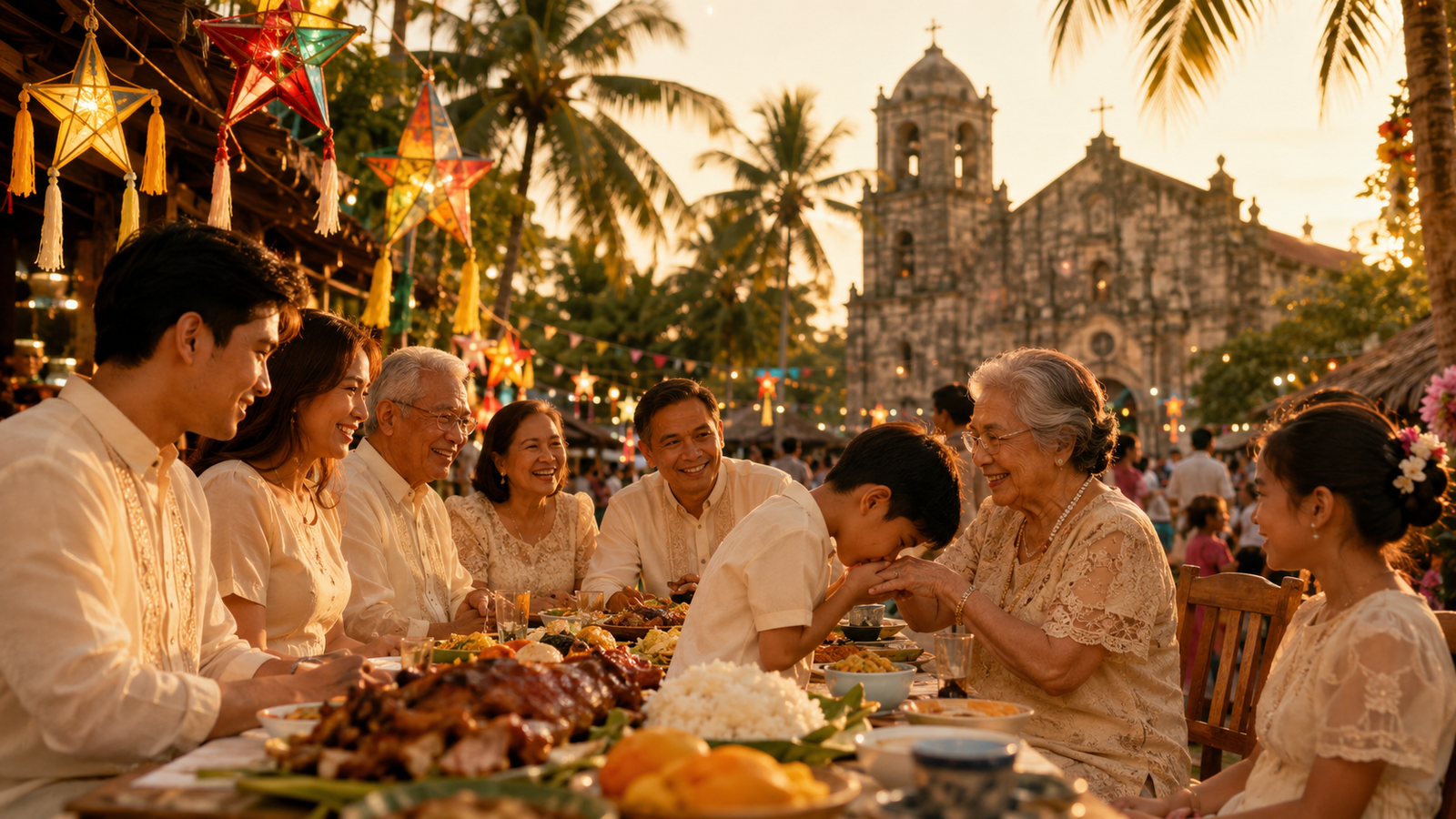
Filipino culture is defined by hospitality, strong family bonds, vibrant festivals, and deep faith — a living blend of Malay, Spanish, American, and Asian influences.
Filipino culture is a living blend of Malay, Spanish, American, and Asian influences built on core values of family loyalty, bayanihan (communal unity), hiya (social propriety), and pakikisama (group harmony). The Philippines is the only Christian nation in Asia, the third-largest English-speaking country in the world, and home to over 140 ethnic groups across 7,641 islands. Filipinos are widely regarded as among the most hospitable people on earth — hospitality here is not courtesy, it is identity.
I am Filipino — born in Cebu City, raised in Dumaguete, now living in Zamboanga del Sur in Mindanao. I have lived Filipino culture from the inside my entire life. This guide is not written from research alone. It comes from thirty years of mano po to my grandparents every morning, of bayanihan during typhoon recovery, of every fiesta where the whole barangay cooked together and no one left hungry.
What follows is a complete, honest guide to Filipino culture — what it actually is, how it works, and what it means for travelers who want to engage with Filipinos beyond the surface of beach tourism.
1. Core Filipino cultural values
These seven values are not abstract ideals — they are lived daily in Filipino households, communities, and workplaces. Understanding them is the single most important key to understanding Filipino behavior, communication, and social life.
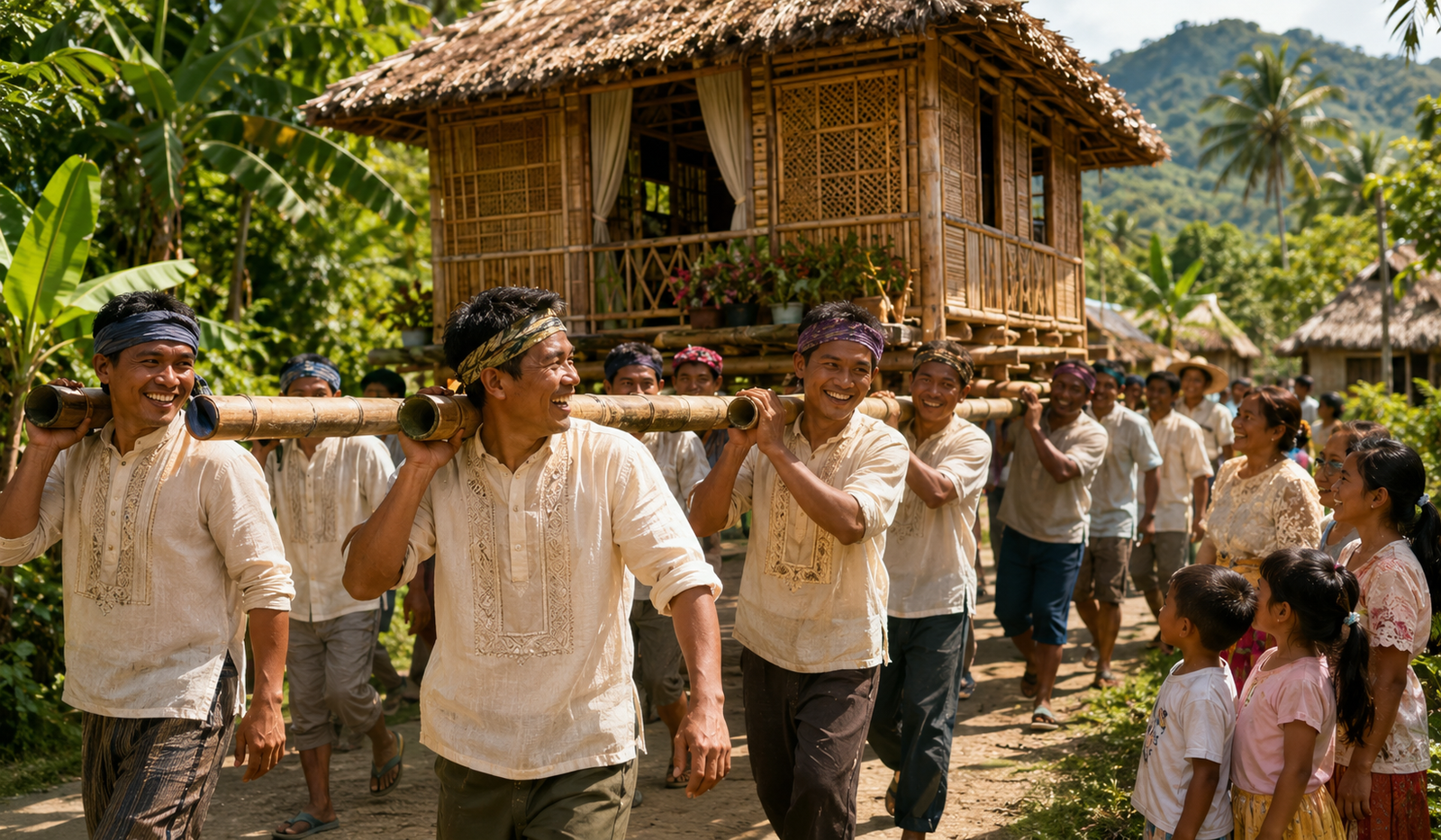
Bayanihan in action — a whole community carrying a neighbor’s house together. This practice is the origin of one of Filipino culture’s most defining values: helping others without expectation of reward.
2. Family and social life in Filipino culture
The Filipino family is multigenerational, extended, and central to everything. Three generations — grandparents, parents, and children — living in the same household is not unusual. Adult children living with parents well into their 30s and 40s carries no social stigma. This is not dependence — it is a deliberate cultural choice rooted in mutual care and shared responsibility.
Filipino social life revolves around family gatherings called handaan or salu-salo — for birthdays, fiestas, graduations, christenings, and holidays. Food is always at the center. A Filipino party table is never small — abundance is both hospitality and pride. A host who runs out of food feels genuine shame.
The compadrazgo system (ritual co-parenthood) extends family networks further. Ninong (godfather) and ninang (godmother) relationships from baptism, confirmation, and weddings create lifelong social bonds. Godparents are expected to contribute financially and emotionally to a godchild’s milestones throughout life — making a Filipino with many godparents effectively part of an extended welfare network.
3. Religion in the Philippines
The Philippines is approximately 85% Roman Catholic — the largest Catholic nation in Asia and one of only two Catholic-majority countries in Asia (the other being East Timor). This is the direct legacy of 333 years of Spanish colonization beginning in 1565. Catholicism in the Philippines is not just religion — it is woven into daily life, social customs, language, festivals, and the political calendar.
Every Filipino town has a patron saint and celebrates a town fiesta in that saint’s honor — an annual event of food, music, street dancing, and community reunion that is often the most important event in the barangay’s year. The world’s longest Christmas season — starting as early as September when Filipino radio stations begin playing carols — is a direct expression of Catholic faith and Filipino festive culture.
About 6% of Filipinos are Muslim, concentrated in the Bangsamoro Autonomous Region in Muslim Mindanao (BARMM). Islam arrived in Mindanao over 200 years before Spanish colonization and remains a deeply rooted part of Mindanaoan culture, distinct in food, dress, music, architecture, and social customs. I live in Zamboanga del Sur — Muslim culture is part of everyday life here, and its coexistence with Catholic and indigenous traditions is one of the things that makes Mindanao culturally extraordinary.
Indigenous animist beliefs persist among the Igorot peoples of the Cordillera, the Lumad of Mindanao, and other highland ethnic groups. These communities maintain ancestral spiritual traditions alongside or separate from introduced religions, with deep respect for nature, ancestral spirits, and the spiritual dimensions of daily life.
4. Language and communication
The Philippines has two official languages — Filipino (based on Tagalog) and English — and over 180 regional languages. Most Filipinos are multilingual, switching comfortably between their regional language, Filipino, and English in a single conversation. This code-switching is so natural it has its own names: Taglish (Tagalog + English), Bislish (Bisaya + English), Cebglish (Cebuano + English).
The Philippines is the third-largest English-speaking country in the world — a legacy of American colonization that established English as the primary medium of public education in 1901. This has made the Philippines one of the world’s largest exporters of English-speaking labor: Filipino nurses, teachers, seafarers, engineers, and call center workers are found on every continent.
| Language | Region | Speakers | Useful phrase |
|---|---|---|---|
| Filipino / Tagalog | Luzon, nationwide | 45M+ | “Kumain ka na ba?” — Have you eaten? |
| Cebuano / Bisaya | Visayas, Mindanao | 20M+ | “Maayo man ko” — I’m fine |
| Ilocano | Northern Luzon | 8M+ | “Naimbag nga aldaw” — Good day |
| Hiligaynon / Ilonggo | Western Visayas | 7M+ | “Kamusta ka?” — How are you? |
| Waray | Eastern Visayas | 3.6M+ | “Maupay nga aga” — Good morning |
| Kapampangan | Central Luzon | 2.8M+ | “Manyaman ya!” — It’s delicious! |
| Bicolano | Bicol Region | 2.5M+ | “Marhay na aldaw” — Good day |
| Maranao | Lanao del Sur, Mindanao | 1.8M+ | “Mapia so gawi” — Good morning |
5. Filipino festivals and celebrations
The Philippines has one of the richest festival cultures in Asia. Every town has its own fiesta, and the national festivals are among the most visually spectacular in Southeast Asia. Philippine festivals are almost always rooted in Catholic devotion to a patron saint, blended with pre-colonial indigenous celebration traditions that predate Spanish contact.
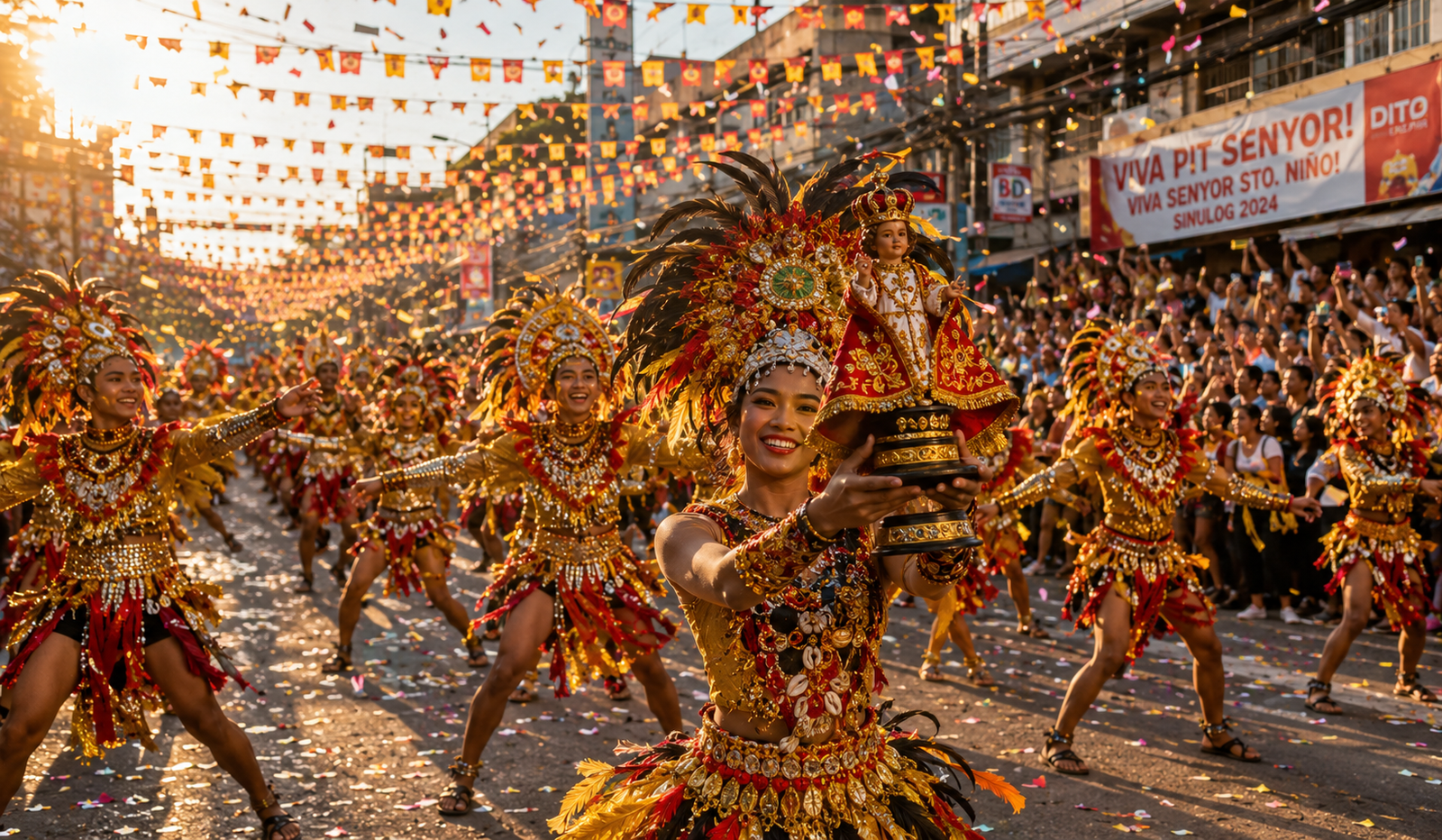
Sinulog Festival, Cebu City — the most famous Filipino festival, held every January in honor of the Santo Niño. Millions of dancers and devotees fill the streets in one of Asia’s greatest street parties.
6. Food as Filipino culture
In Filipino culture, food is not sustenance — it is the primary language of love, hospitality, and social bonding. The first thing a Filipino says to any guest, family member, or passing neighbor is “Kain tayo” (Let’s eat) — regardless of whether a meal has been prepared. Sharing food is an act of inclusion. Refusing food is, mildly, a rejection.
Filipino cuisine is the product of thousands of years of trade, colonization, and migration — a fusion of Malay, Chinese, Spanish, American, and indigenous flavors that has evolved into something entirely its own. The defining flavor profile — a balance of sour, salty, and savory — is unlike the cuisine of any neighboring country. Dishes like adobo (meat braised in vinegar and soy sauce), sinigang (tamarind-sour soup), and lechon (whole roasted pig) are inseparable from Filipino cultural identity.
Food marks every social milestone — fiestas, christenings, weddings, birthdays, and even funerals are defined by what is served. The effort put into a meal is a direct measure of care and respect. A Filipino host who cannot offer abundant food feels genuine shame. This is why Filipino parties are always over-catered — scarcity at a gathering is not just inconvenient, it is a social failure.
7. Arts, music, and traditional practices
Filipino artistic tradition spans from pre-colonial craftsmanship to contemporary global creative expression. The Ifugao rice terraces of Banaue — hand-carved over 2,000 years into the Cordillera mountains — are a UNESCO World Heritage Site and one of the greatest engineering achievements of the ancient world. The T’nalak weaving of the T’boli people of South Cotabato, the malong textiles of Mindanao, and the buri weaving of Visayas all represent indigenous textile traditions with centuries of continuous practice.
Filipino music ranges from the ancient kulintang (gong ensemble of Mindanao) to the Spanish-influenced kundiman (romantic ballad), to OPM (Original Pilipino Music) — a global category of pop, ballad, and R&B that has produced internationally recognized artists. Karaoke — or as Filipinos call it, the videoke — is not merely entertainment. It is a social institution. A Filipino neighborhood without a karaoke session on a Friday evening is genuinely unusual.
Traditional dances like Tinikling (the bamboo pole dance — the national dance of the Philippines), Pandanggo sa Ilaw (dance with oil lamps balanced on the hands and head), and Singkil (the royal Maranao court dance performed with bamboo poles) are taught in every Philippine school as part of the national curriculum.
8. Courtship, life milestones, and Filipino traditions
Traditional Filipino courtship — panliligaw — is a formal, family-involved process. A young man would visit the woman’s family home repeatedly, performing household tasks and showing respect to her parents before being permitted to court her. Harana (serenading a woman at her window with songs and a guitar, accompanied by friends) was the most romantic expression of courtship — a tradition still occasionally practiced in rural provinces today.
Filipino life milestones are marked by elaborate celebrations that reinforce family and community bonds. The christening (baptism) establishes godparent relationships. The debut — a grand 18th birthday celebration for Filipino women — is the equivalent of a coming-of-age ball, involving 18 roses, 18 candles, and 18 treasures presented by significant men in her life. Filipino weddings are multi-day events involving the entire extended family and often the whole barangay.
9. Filipino etiquette and customs for travelers
Understanding Filipino etiquette will transform your experience in the Philippines from tourist to guest. These are not rules imposed by authorities — they are living social practices that Filipinos follow naturally every day.
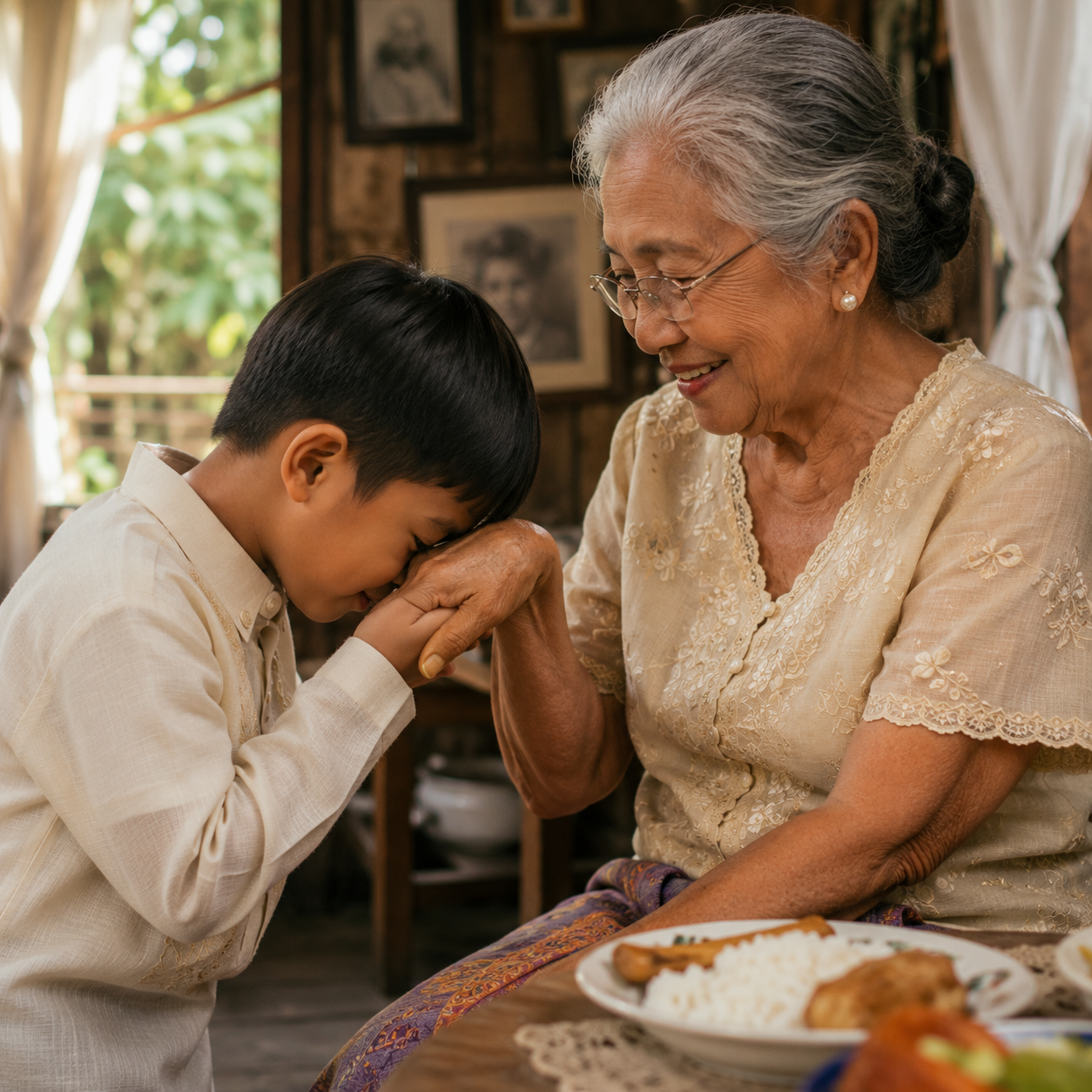
Mano po — a child presses a lola’s (grandmother’s) hand to the forehead in a gesture of deep respect. This daily practice is one of the most visible expressions of Filipino values in action.
| ✅ Do this | ❌ Avoid this |
|---|---|
| Accept the mano po gesture from elders — press their offered hand to your forehead respectfully | Refusing food offered by a Filipino host more than once — it reads as rejection |
| Use “po” and “opo” when speaking to older Filipinos — it signals deep respect | Direct, confrontational criticism in public — Filipinos value face-saving and indirect communication |
| Remove your shoes before entering a Filipino home — always check if there’s a pile of shoes at the door | Pointing at things or people with your index finger — use your lips (a mouth point) or an open hand instead |
| Bring a small gift (sweets, fruit, or bread) when invited to a Filipino home | Expecting strict punctuality — Filipino time is flexible (arriving 30 minutes late to social events is normal) |
| Dress modestly when visiting churches — cover shoulders and knees | Loud or aggressive behavior in public — it causes hiya (shame) for everyone nearby |
| Smile and greet everyone you pass — warmth is reciprocated immediately | Assume that a Filipino smiling and agreeing means they’re happy — hiya means disagreement is often expressed indirectly |
| Learn a few words in the local language — even “salamat” (thank you) in Tagalog or “salamat” in Bisaya goes a long way | Discuss sensitive political topics — the Philippines’ political history is complex and personal for many Filipinos |
Frequently asked questions about Filipino culture
