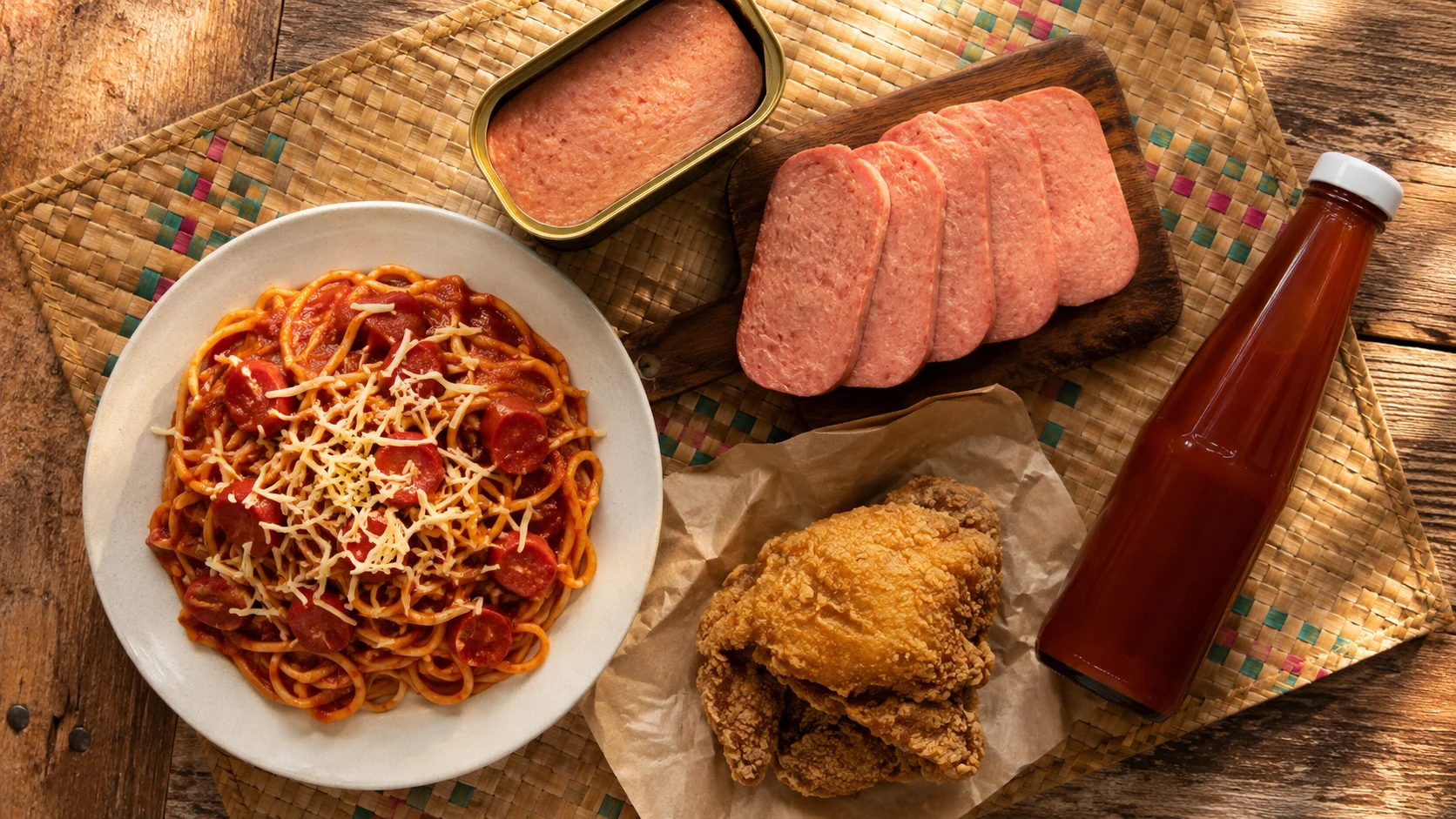
The most iconic American-influenced Filipino foods: sweet spaghetti, Spam, banana ketchup, and Jollibee’s Chickenjoy — all born from 48 years of US colonization adapted through Filipino ingenuity.
Quick answer
American food began shaping Filipino cuisine after 1898, when the US took control of the Philippines. American soldiers and colonizers introduced Spam, canned goods, hot dogs, bread, fried chicken, and fast food culture. Filipinos absorbed these and reinvented them — creating banana ketchup (invented by Maria Orosa during WWII tomato shortages), Filipino sweet spaghetti (with hot dogs and banana ketchup sauce), spamsilog, and ultimately Jollibee — a Filipino fast food chain that now outsells McDonald’s in the Philippines.
I grew up in Dumaguete eating sweet spaghetti at every birthday party, pan de sal from the neighborhood panaderia every morning, and Spam fried in garlic oil on weekends. I never thought of these as “American” foods — they were just Filipino food. That is exactly the point.
American food influence in the Philippines is so complete, so deeply woven into everyday eating, that most Filipinos no longer recognize it as foreign. This guide traces the full history — from 1898 to today — of how American colonization permanently changed what 110 million Filipinos eat, and how Filipinos made every single American food entirely their own.
1898 — When America Arrived on the Plate
The year 1898 marks a turning point not just in Philippine politics, but in Philippine food. When Spain ceded the Philippines to the United States after the Spanish-American War, a new wave of culinary influence began that would permanently reshape what Filipinos eat, how they cook, and how they think about food.
Unlike the Spanish, who blended into Philippine life over 333 years through religion and family, the Americans arrived with a different kind of cultural export — industrial food. Canned goods, refrigeration, standardized recipes, and eventually fast food chains were all part of what American colonization brought. The Philippine public school system, established by American teachers called the Thomasites, taught not just English but also American home economics — including American-style cooking methods, nutrition science, and baking techniques that had never existed in Filipino households before.
“The Americans didn’t just bring guns and schools to the Philippines — they brought Spam, hot dogs, and the concept of breakfast as we know it today.” — Giovanni Carlo Bagayas
Then came World War II, and with it, American military rations flooding the islands. Spam — the canned pork product — arrived with American GIs as a practical, shelf-stable protein source during a time of severe food insecurity. Filipino households embraced it immediately. Decades later, the Philippines became one of the top Spam consumers in Asia, and spamsilog (Spam + sinangag + itlog) became as Filipino as adobo.
From 1898 to independence in 1946 — and well beyond — American food culture wove itself so deeply into Filipino daily life that most Filipinos today don’t experience it as foreign at all. It is simply Filipino food.
American Foods That Became Filipino Staples
These nine American-introduced foods are now so embedded in Filipino cuisine that most Filipinos consider them entirely their own. Each one has a specific story of how it arrived, how it was adopted, and how Filipinos inevitably made it better.
🥫
Spam
Introduced: WWII (1940s) · via American GIs
Brought as military rations, Spam became a Filipino breakfast icon. Today it stars in spamsilog — Spam, garlic fried rice, and egg — one of the Philippines’ most popular morning meals. The Philippines is among Asia’s top Spam consumers per capita.
🌭
Hot Dogs
Introduced: American colonial era (1900s)
Filipino hot dogs are distinctly different from the American original — brighter red, much sweeter, and made with pork. They appear in hotsilog (hot dog + sinangag + itlog) and are the defining protein ingredient in Filipino-style sweet spaghetti.
🍞
Bread & Pan de Sal
Evolved through: American baking education
American-style commercial baking culture flourished under US rule. Pan de sal — the Philippines’ beloved breakfast roll — evolved into its modern soft form during this era. Every Filipino neighborhood has a panaderia (bakery) because of American baking influence.
🍅
Banana Ketchup
Invented: WWII (1942) · by Maria Y. Orosa
When tomatoes became scarce during WWII, food scientist Maria Orosa invented a ketchup substitute from bananas, sugar, spices, and red dye. Today it is a Filipino pantry essential — sweeter and tangier than tomato ketchup — used in spaghetti sauce, burgers, and as a dipping sauce for fried chicken.
🍗
Fried Chicken
Popularized: post-WWII American influence
American Southern-style fried chicken inspired Filipino versions that are now more popular than the American original. Jollibee’s Chickenjoy — crispy batter, juicy inside, served with gravy — is arguably the most beloved fried chicken in the Philippines and a direct descendant of American fried chicken culture.
🍝
Filipino-Style Spaghetti
Adapted: mid-20th century
The Philippines’ most beloved reinvention of American-Italian pasta. Filipino spaghetti uses a sweet tomato-banana ketchup sauce with ground meat and sliced hot dogs, topped with grated cheese. It is the centerpiece of every Filipino birthday party and one of the most distinctly Filipino foods in existence.
🥗
Macaroni Salad
Introduced: American colonial era
American mayo-based macaroni salad was adopted and transformed into a sweet Filipino dessert-side dish — with condensed milk, fruit cocktail, cheese, and diced vegetables. Served at fiestas, Christmas parties, and reunions. A perfect example of Filipino sweetening everything American.
🍦
Ice Cream & Sorbetes
Introduced: early 1900s · via soda fountains
American-style ice cream parlors and soda fountains arrived with colonization. Filipino ice cream culture evolved to include local flavors like ube (purple yam), macapuno (coconut sport), and queso (cheese) — a direct Filipinization of an American institution. Street cart sorbetes (dirty ice cream) is the most beloved local evolution.
🥞
Pancakes & Graham Float
Introduced: American home economics education
American-style pancakes entered Filipino breakfast through school home economics. The Graham float — layers of American Graham crackers, cream, and condensed milk — became one of the Philippines’ most popular no-bake desserts. Known as “ref cake” or “icebox cake,” it is made entirely from American-introduced ingredients.
How Filipinos Filipinized American Food — Comparison Table
Filipinos didn’t just adopt American food — they transformed every single one. This is the complete before-and-after of the most significant American food adaptations in Philippine culinary history.
Original American food
→
Filipino adaptation
What changed
Tomato ketchup
→
Banana ketchup
Made from bananas; sweeter, tangier, dyed red
Italian-American spaghetti
→
Filipino sweet spaghetti
Sweet sauce, sliced hot dogs, banana ketchup base, topped with cheese
Spam (canned pork)
→
Spamsilog
Served with sinangag (garlic fried rice) and itlog (fried egg)
Hot dogs
→
Red Filipino hot dogs / hotsilog
Dyed red, much sweeter pork flavor, served with rice and egg
Southern fried chicken
→
Chickenjoy (Jollibee)
Crispier batter, served with gravy and rice, no sides required
Macaroni salad
→
Filipino macaroni salad
Sweetened with condensed milk, fruit cocktail added, served as dessert-side
Graham crackers
→
Graham float / ref cake
No-bake layered dessert with all-purpose cream and condensed milk
American ice cream
→
Sorbetes / dirty ice cream
Local flavors: ube, macapuno, queso, langka; sold from street carts
American diner burger
→
Jollibee Yumburger
Sweeter bun, served with rice combo option, banana ketchup condiment
Corned beef (canned)
→
Corned beef guisado / cornsilog
Sautéed with onion and potato, served with garlic rice and egg
Banana Ketchup — A Filipino War Story
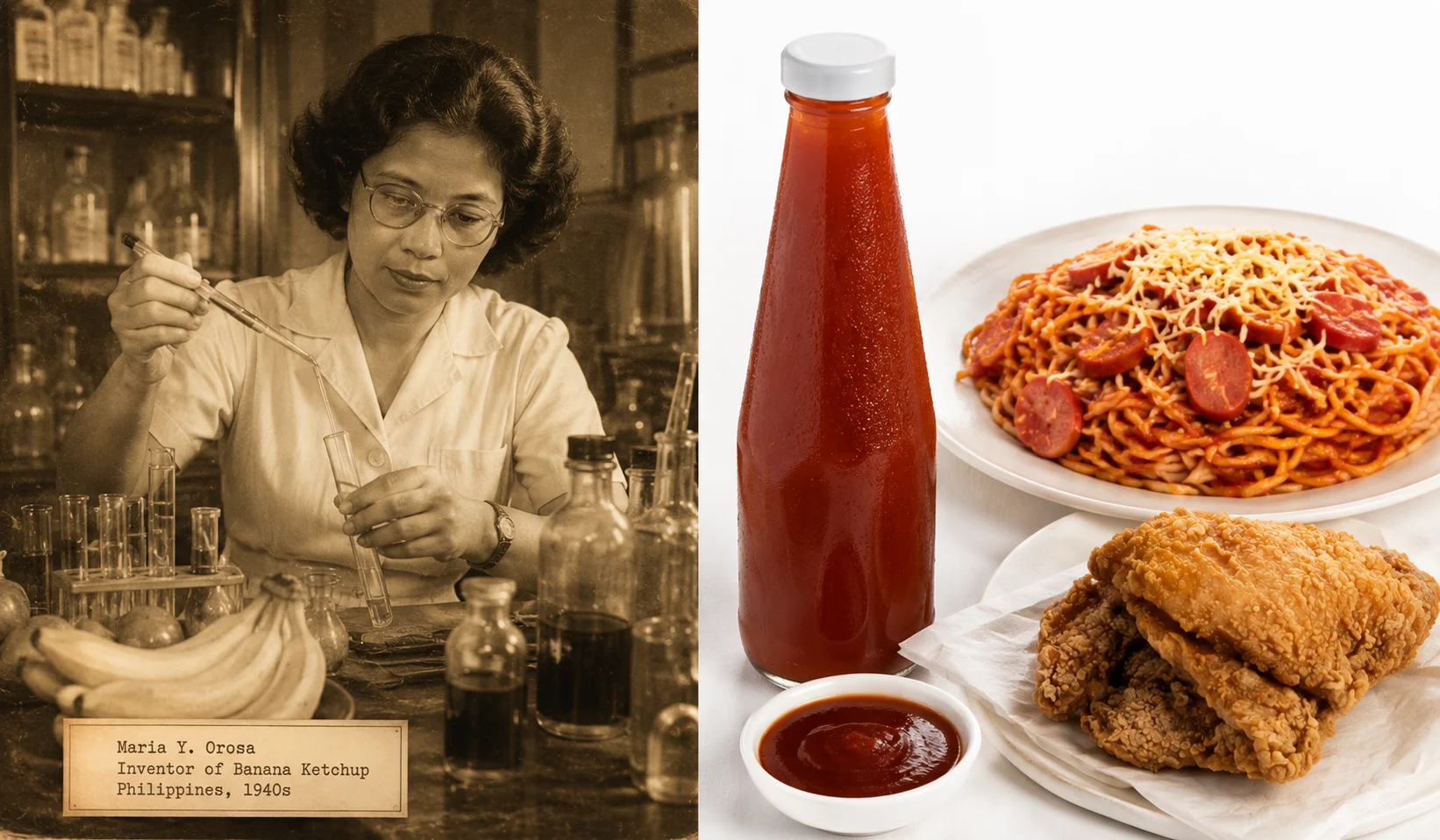
Banana ketchup — the most uniquely Filipino food invention of the American era. Born from wartime necessity, it is now a pantry staple in every Filipino home.
No story of American food influence in the Philippines is complete without banana ketchup — arguably the most uniquely Filipino food invention to emerge from the American colonial era.
During World War II, the Japanese occupation of the Philippines disrupted food supplies across the islands. Tomatoes — needed to make the American-introduced tomato ketchup that Filipinos had come to love — became scarce. Filipino food scientist and chemist Maria Y. Orosa — who had studied food technology in the United States and returned to serve her country — invented a ketchup substitute using the Philippines’ most abundant crop: bananas. She added sugar, spices, and red dye to match the color of the American original. The result was something sweeter, tangier, and entirely Filipino.
Today, banana ketchup is sold in every Philippine supermarket and is used in Filipino kitchens daily — as the base for sweet spaghetti sauce, as a dipping sauce for fried chicken, in Filipino-style burgers, and as a marinade ingredient. The most popular brand is Jufran, recognizable by its tall brown bottle.
Gio’s note: Maria Orosa deserves far more recognition than she gets. She didn’t just invent banana ketchup — she also developed food preservation techniques that saved Filipino lives during WWII. She was killed by shrapnel in 1945 during the Battle of Manila, still working to feed her people. Banana ketchup is her legacy on every Filipino dinner table.
Banana ketchup stands as the perfect symbol of how Filipinos have always responded to American influence: not by simply copying, but by innovating with what they had — and in the process, creating something that is now proudly and unmistakably Filipino.
Filipino Sweet Spaghetti — A Birthday Party Institution
If you grew up Filipino, you know exactly what Filipino spaghetti tastes like before you even read this sentence. It is sweet — noticeably, unapologetically sweet — with a thick tomato-banana ketchup sauce, ground pork, sliced red hot dogs, and a generous shower of grated cheese on top. It is the food that appears at every Filipino birthday party without exception, from barangay celebrations to five-star hotel children’s parties.
Filipino spaghetti arrived as a Filipinization of the American-Italian pasta that came with colonization. Where American spaghetti tends toward savory and tomato-forward, Filipinos sweetened it — with banana ketchup, a touch of sugar, and the distinctly Filipino addition of sliced hot dogs. The cheese on top, rather than grated parmesan, is typically the processed sandwich cheese variety, which melts into the sweet sauce in a way that is deeply, specifically Filipino.
Jollibee’s Jolly Spaghetti — served at every Jollibee location including the now 1,500+ international stores — is the global face of Filipino spaghetti. It is one of the most ordered items on the Jollibee menu worldwide, introduced Filipino-style spaghetti to the American market in California, New York, and Texas, and is now one of the most recognizable distinctly Filipino foods internationally.
“Filipino spaghetti isn’t a bad version of Italian spaghetti. It is a completely different dish that happens to share a name and a pasta shape. Understanding that distinction is the first step to understanding Filipino cuisine.” — Giovanni Carlo Bagayas
Silog Culture — The American Breakfast, Completely Reinvented
Silog is the defining category of Filipino breakfast — a combination of sinangag (garlic fried rice) and itlog (fried egg) with a protein. The name is always a portmanteau of the protein and “silog.” The most common varieties are:
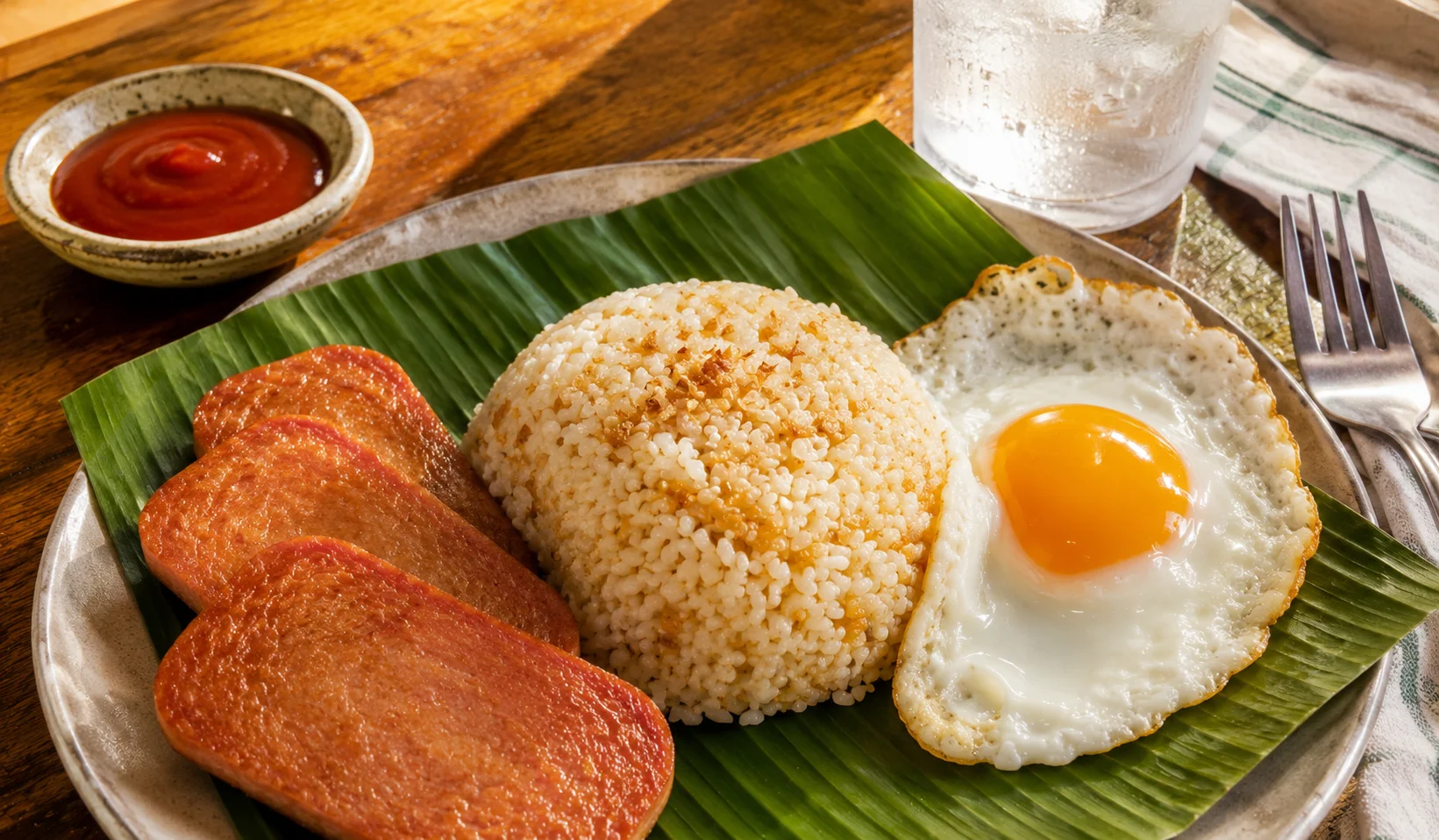
Spamsilog — Spam, sinangag (garlic fried rice), and itlog (fried egg). One of the Philippines’ most beloved breakfast meals, born directly from American GIs introducing Spam during WWII.
The American influence is specifically in the canned protein half of the silog equation. Spam was introduced by American GIs. Corned beef came from American canned goods. Hot dogs arrived with colonization. The structured breakfast concept itself — protein + starch + egg as a complete, portable morning meal — reflects American breakfast culture absorbed during the colonial era and rebuilt around Filipino pantry staples and leftover rice.
Today, silog restaurants (tapsihan) are open 24 hours across the Philippines, serving every variation to workers on every shift. The silog is not just a breakfast — it is the Philippine national meal, available at any hour, at any price point, in any region. And it exists because of Spam.
Fast Food — America’s Biggest Culinary Export to the Philippines
The most visible and lasting legacy of American food influence in the Philippines is fast food culture. American chains arrived first — but the Philippines didn’t just adopt them. It created its own version that beat the Americans at their own game.
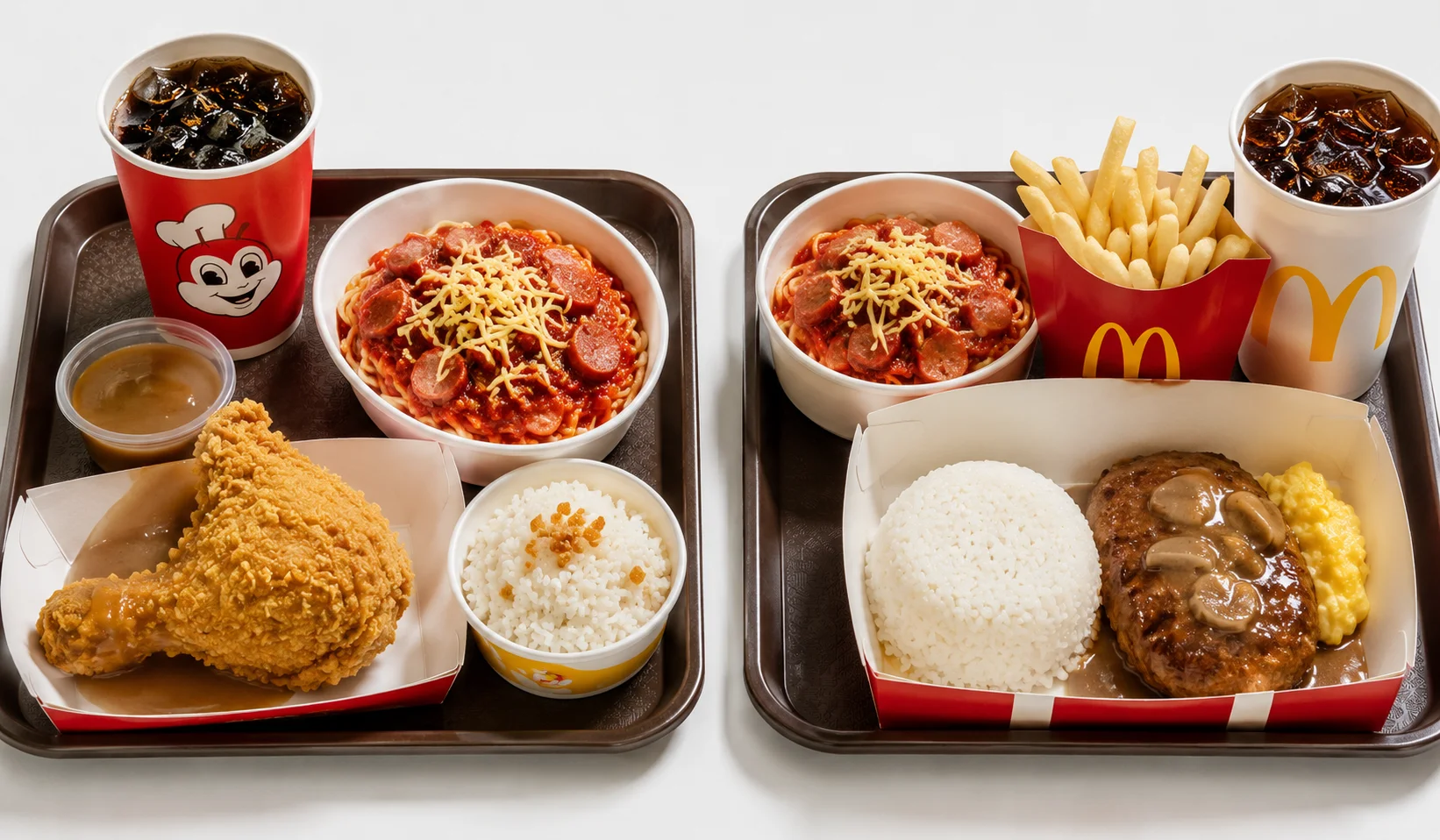
Two trays, two stories — the Filipino fast food meal (Chickenjoy, sweet spaghetti, garlic rice) versus the American adaptation (burger, fries, McSpaghetti). Jollibee outsells McDonald’s in the Philippines by understanding what Filipinos actually want.
🇵🇭 Filipino-born
🐝 Jollibee
The Philippines’ homegrown fast food giant — born from American fast food inspiration, completely Filipinized. Chickenjoy, sweet spaghetti, and Yumburger consistently outsell McDonald’s in the Philippines. Founded 1978. Now 1,500+ stores globally including the US, UK, Canada, and the Middle East.
🇺🇸 American chain
🍟 McDonald’s Philippines
Arrived in 1981. Added rice meals, McSpaghetti (Filipino-style sweet spaghetti), and local breakfast items to compete with Jollibee. McSpaghetti is one of the most notable examples of an American company adopting Filipino taste preferences to survive in the market.
🇺🇸 American chain
🍗 KFC Philippines
Offers rice with every order — a non-negotiable Filipino requirement. Gravy is one of the most popular add-ons, directly inspired by American Southern comfort food. KFC’s Philippine menu is one of the most localized of any KFC operation globally.
🇵🇭 Filipino-born
🍗 Max’s Restaurant
Founded in 1945 specifically to serve American soldiers stationed in the Philippines after WWII. Max’s “The House That Fried Chicken Built” is a direct product of American military presence shaping Filipino food business. Now a national institution serving fried chicken, kare-kare, and sinigang.
🇵🇭 Filipino-adapted
🍕 Greenwich / Yellow Cab
American pizza culture was adopted and reinvented. Greenwich — a Filipino pizza chain — tops its pizzas with longanisa, corned beef, and other Filipino proteins. American pizza became a vehicle for Filipino flavors, not a replacement for them.
🇵🇭 Filipino-born
🥐 Goldilocks / Red Ribbon
Filipino bakery chains born from American-influenced baking culture. Their cakes, pastries, and mamon (Filipino sponge cakes) reflect American baking techniques taught during the colonial era — completely reimagined with ube, pandan, leche flan, and macapuno flavors.
Timeline of American Food Influence in the Philippines
1898
Spain cedes the Philippines to the United States after the Spanish-American War. American soldiers, administrators, and teachers begin arriving — bringing American food products and eating habits.
1901
American Thomasites establish the Philippine public school system with English as the medium of instruction. American home economics education — including American cooking methods, nutrition science, and baking — is introduced to Filipino households through schooling.
1900s–1930s
American canned goods — corned beef, condensed milk, evaporated milk, and processed foods — become widely available in Philippine markets. American-style panaderias multiply. Soda fountains and ice cream parlors appear in Manila and major cities.
1941–1945
World War II. American GIs bring Spam, C-rations, and military-issue canned goods. Food supplies are disrupted by Japanese occupation. Maria Y. Orosa invents banana ketchup as a wartime substitute for American tomato ketchup.
1945
Max’s Restaurant is founded in Quezon City specifically to serve American soldiers after WWII liberation. Fried chicken becomes the centerpiece of what will become one of the Philippines’ most enduring restaurant brands.
1946
The Philippines gains independence from the United States. American food influence is already so deeply embedded that it continues to grow organically, no longer requiring colonization to spread.
1978
Tony Tan Caktiong opens Jollibee in Quezon City — originally an ice cream parlor, pivoting to burgers and fried chicken after observing McDonald’s popularity. Jollibee Filipinizes the American fast food model: sweet spaghetti, rice with everything, Chickenjoy with gravy.
1981
McDonald’s enters the Philippine market. Jollibee adapts and fights back — eventually outselling McDonald’s in the Philippines through superior local flavor adaptation. McDonald’s adds McSpaghetti and rice meals to compete.
2000s–2020s
Filipino food goes global. Filipino-style sweet spaghetti, banana ketchup, and Jollibee’s Chickenjoy are introduced to international markets. Filipino cuisine — shaped profoundly by American influence — is recognized internationally as one of the world’s most interesting food cultures.
Today
Jollibee operates 1,500+ stores globally including the US, Canada, UK, Australia, and the Middle East. Filipino-style spaghetti, banana ketchup, and spam are exported worldwide. American food influence has completed the cycle — Filipinized American food is now influencing food culture globally.
Frequently Asked Questions
How did American food influence Filipino cuisine?
American food began influencing Filipino cuisine after 1898 when the US took control of the Philippines. Soldiers and colonizers introduced canned goods, Spam, hot dogs, fried chicken, bread, and fast food culture. Filipinos absorbed and reinvented these — creating banana ketchup, Filipino sweet spaghetti, spamsilog, hotsilog, and Jollibee — all of which remain everyday Filipino foods today.
What American foods are popular in the Philippines?
The most popular American-influenced foods in the Philippines are Spam (spamsilog), fried chicken (Jollibee’s Chickenjoy), hot dogs (sweet spaghetti and hotsilog), burgers (Jollibee’s Yumburger), macaroni salad (sweetened Filipino version), canned corned beef (cornsilog), and condensed milk (used in desserts and coffee). All have been significantly adapted to Filipino tastes — almost always made sweeter and always served with rice.
Why is Spam so popular in the Philippines?
Spam became popular during World War II when American GIs brought it as military rations. Its long shelf life, affordable price, and savory flavor suited Filipino households perfectly. It evolved into spamsilog — Spam, sinangag (garlic fried rice), and itlog (fried egg) — one of the Philippines’ most beloved breakfast meals. The Philippines remains one of Asia’s highest Spam-consuming countries today.
Who invented banana ketchup and why?
Banana ketchup was invented by Filipino food scientist Maria Y. Orosa during World War II. When Japanese occupation made tomatoes scarce, Orosa created a substitute using the Philippines’ abundant bananas, adding sugar, spices, and red dye to mimic tomato ketchup’s color. Today banana ketchup is a Filipino pantry staple — used in sweet spaghetti sauce, as a dipping sauce for fried chicken, and in Filipino-style burgers. The most popular brand is Jufran.
How is Filipino spaghetti different from American spaghetti?
Filipino spaghetti is much sweeter than American or Italian spaghetti. The sauce is made with banana ketchup and tomato sauce, giving it a distinctly sweet flavor. It includes ground pork and sliced red hot dogs, and is topped with grated processed cheese. This sweet, hot dog-studded version is a Filipino birthday party staple — a complete Filipinization of the American-Italian dish introduced during colonization.
How did American colonization affect Filipino food culture?
American colonization from 1898 to 1946 affected Filipino food in five major ways: (1) introduced canned and processed foods — Spam, corned beef, condensed milk — that became pantry staples; (2) established home economics education that taught baking and American cooking methods; (3) created the fast food culture the Philippines later Filipinized with Jollibee; (4) introduced the structured breakfast concept that evolved into silog culture; and (5) caused wartime food shortages that led to Filipino innovations like banana ketchup.
Is Jollibee an American or Filipino brand?
Jollibee is a Filipino brand — but directly inspired by American fast food culture. Founded in 1978 by Tony Tan Caktiong, it started as an ice cream parlor and pivoted to burgers and fried chicken after observing McDonald’s. Jollibee Filipinized the American model — adding sweet spaghetti with hot dogs, serving rice with everything, and creating Chickenjoy fried chicken with gravy. It now outsells McDonald’s in the Philippines and operates 1,500+ stores globally.
What is silog and how is it connected to American food influence?
Silog is the Filipino breakfast category combining sinangag (garlic fried rice) and itlog (fried egg) with a protein — creating tapsilog, longsilog, spamsilog, hotsilog, and cornsilog among others. The American connection is in the canned proteins: Spam, corned beef, and hot dogs were all introduced by American colonizers and soldiers and became affordable, accessible staples in Filipino silog culture.
Filipino · Born in Cebu City · Raised in Dumaguete · Based in Zamboanga del Sur, Mindanao
I grew up eating sweet spaghetti at every birthday, pan de sal every morning, and Spam on weekends. I never thought of them as American — they were just Filipino food. That is the point of this article. I write about Filipino food and culture at Best Philippines Travel Guide from the perspective of someone who has lived it his entire life across three Philippine regions.