
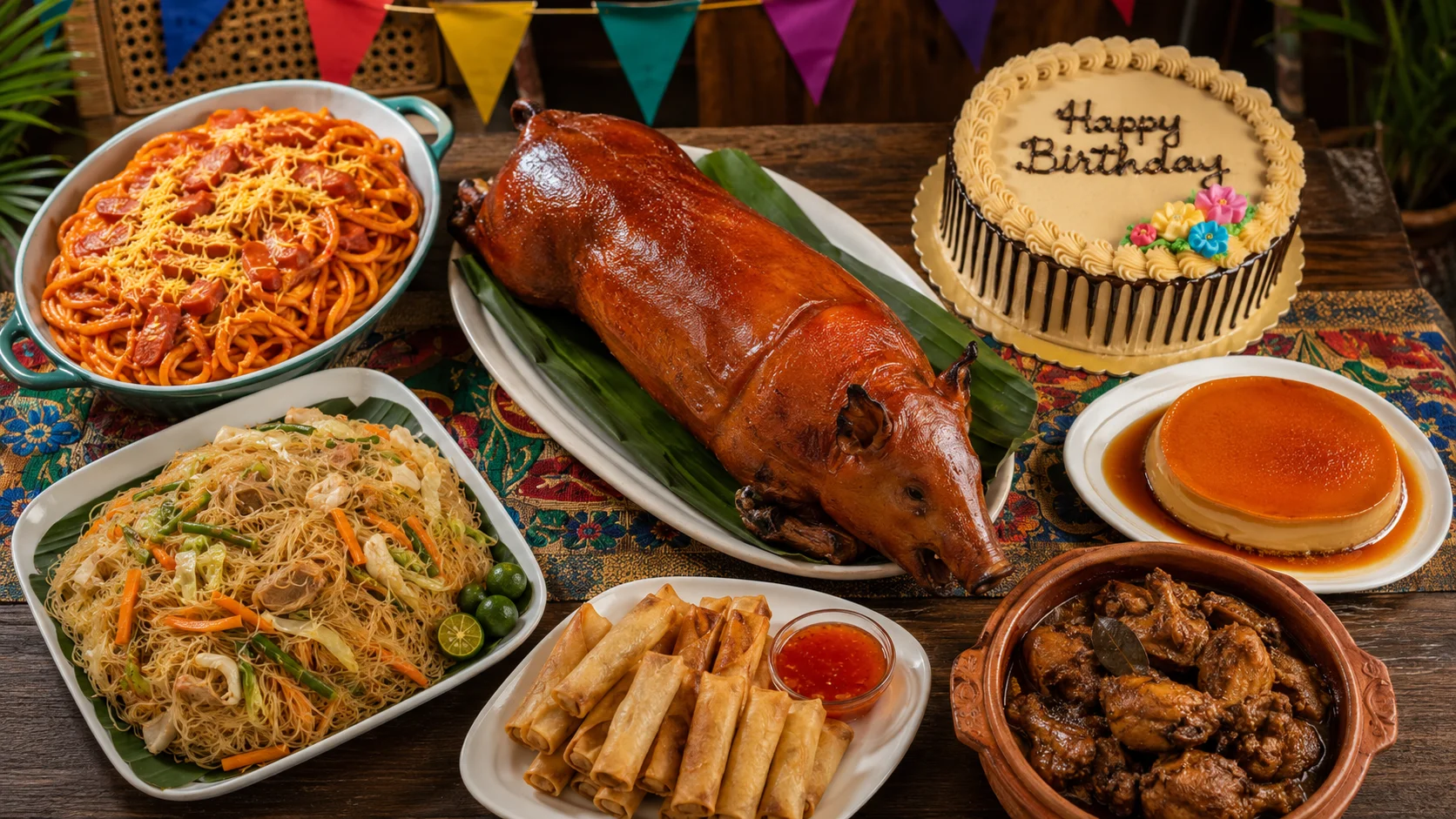
A Filipino birthday party food spread — pancit bihon takes center stage, joined by lumpia, lechon, Filipino-style spaghetti, and leche flan. No Filipino birthday is complete without pancit — the noodles symbolize long life for the celebrant.
Traditional Filipino birthday party food includes lechon (whole roasted pig), Filipino-style spaghetti (sweet, with hotdogs), pancit (noodles — symbolizing long life), lumpia Shanghai (fried spring rolls), chicken adobo, kare-kare, leche flan, halo-halo, and a Goldilocks or Red Ribbon birthday cake. For 50 guests, budget ₱8,000–₱15,000 (~USD 140–270) for home-cooked food. Pancit noodles are the one dish that is never skipped — they represent long life for the birthday celebrant.
I’ve attended more Filipino birthday parties than I can count — from simple backyard celebrations in Dumaguete where the neighbors brought extra plastic chairs, to full catered affairs in Cebu City with a whole lechon on the center table. Filipino birthdays are not just parties. They are declarations. The food says: I prepared this for you. You matter. Everyone is welcome at this table.
This guide covers everything about Filipino birthday party food — the complete traditional menu, exact serving sizes for 50 and 100 guests, budget breakdowns in PHP and USD, and a dedicated section for OFWs and overseas Filipinos who want to recreate a Filipino birthday party abroad with whatever is available at Asian supermarkets.
The Complete Traditional Filipino Birthday Party Menu
A traditional Filipino birthday party follows a loosely structured menu that has remained consistent for generations — with minor regional variations. Here are the 12 essential dishes, in the order they are typically served:
Lechon — whole spit-roasted pig — is the undisputed king of Filipino birthday party food. Its presence on the table signals that the host means business. The crispy, golden skin that shatters when tapped, the juicy meat inside, the liver sauce on the side — this is the dish every guest comes for.
A whole lechon weighing 15–20 kg feeds approximately 50–80 people as part of a multi-dish party spread. Order from a local lechonero at least 3–5 days in advance. In Metro Manila, popular choices include Lydia’s Lechon and Elar’s Lechon. In Cebu, CNT Lechon and Zubuchon are the gold standard. In provinces, your local palengke will have a trusted lechonero.
Budget alternative: If whole lechon is beyond budget, replace with lechon kawali (crispy deep-fried pork belly) — same flavor experience at roughly ₱300–₱500 per kg, feeding 4–5 people per kg. This saves ₱3,000–₱8,000 while still serving crispy pork.
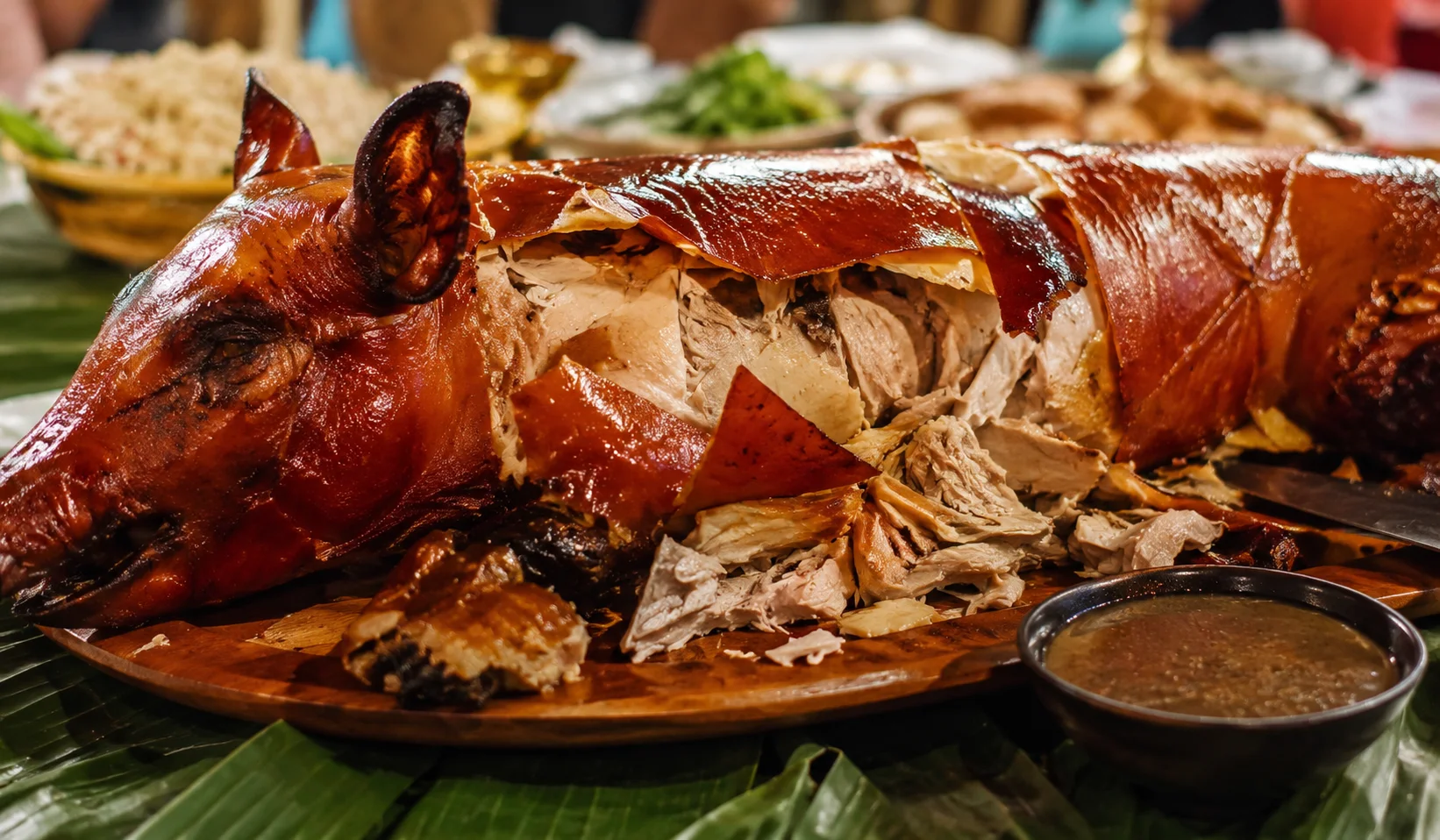
Lechon — the undisputed king of Filipino birthday party food. Golden crispy skin, juicy meat, and liver sauce on the side. Its presence on the table signals that the host means business.
Filipino-style spaghetti is one of the most distinctively Filipino dishes in existence — and a non-negotiable at children’s birthday parties. Unlike Italian spaghetti, Filipino spaghetti is noticeably sweet, using banana ketchup combined with tomato sauce for a red-orange, fruity-sweet flavor. It is loaded with ground pork or beef, sliced hotdog (Vienna sausage), and finished with grated cheese on top.
The sweetness surprises non-Filipino guests every time. The children love it. The adults eat it too. Jollibee’s version — with its bright orange sauce and visible hotdog slices — is the commercial reference point that every Filipino recognizes immediately.
For a party of 50: cook 3–4 kg of spaghetti pasta with 2 kg ground pork, 500g sliced hotdogs, 4 cans banana ketchup, 3 cans tomato sauce, and 500g grated cheese for topping.
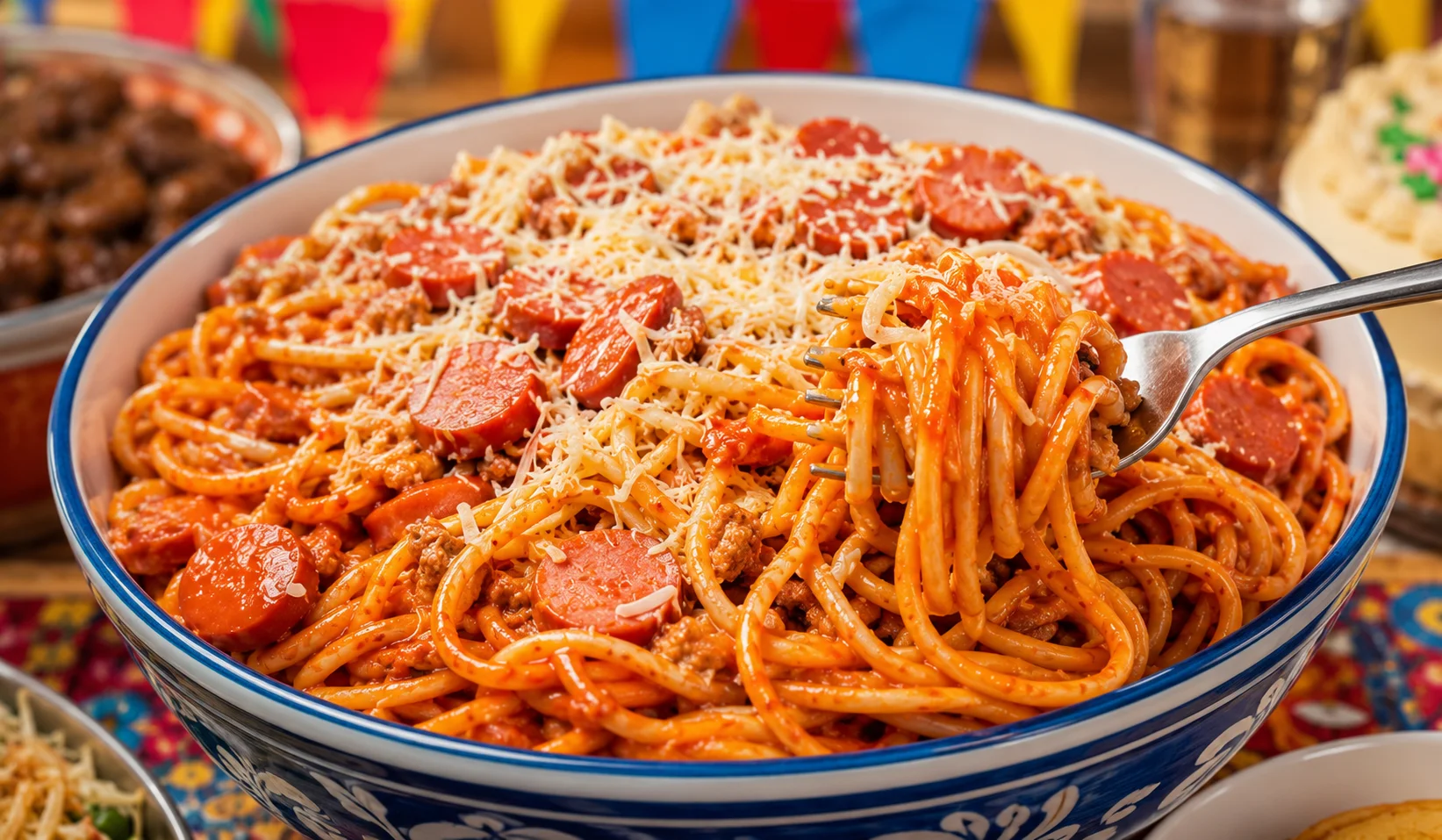
Filipino-style spaghetti — sweet, orange-red sauce loaded with hotdog slices and topped with grated cheese. Nothing like Italian spaghetti, and that’s exactly the point. A non-negotiable at every Filipino children’s birthday party.
Pancit is the most culturally important dish at a Filipino birthday party — the one item that cannot be substituted or skipped. The long noodles represent long life and good health for the birthday celebrant, a tradition that comes from Chinese cultural influence on Filipino food customs. Cutting the noodles before serving is considered bad luck — they must be left long.
The two most popular types for birthday parties are pancit bihon (thin rice vermicelli, lighter and drier) and pancit canton (thick egg noodles, richer and more filling). Many Filipino birthday parties serve both. The noodles are stir-fried with carrots, cabbage, green beans, pork or chicken, shrimp, and fish sauce, finished with a squeeze of calamansi (Philippine lime).

Pancit bihon — the one dish that is never skipped at a Filipino birthday party. The long noodles symbolize long life for the birthday celebrant. Never cut them short before serving.
Lumpia Shanghai are thin, crispy fried spring rolls filled with seasoned ground pork, minced carrots, onions, and garlic — the Filipino version of Chinese spring rolls, smaller and crispier than most Asian versions. They are an essential party finger food, universally loved by children and adults, and easy to make in bulk the night before.
For a party of 50, prepare 200–250 pieces. They can be made ahead and frozen uncooked, then fried in batches on the day of the party. Serve with banana ketchup or sweet chili sauce for dipping. Lumpiang sariwa (fresh spring rolls without frying) is the less common but equally loved alternative for adult parties.
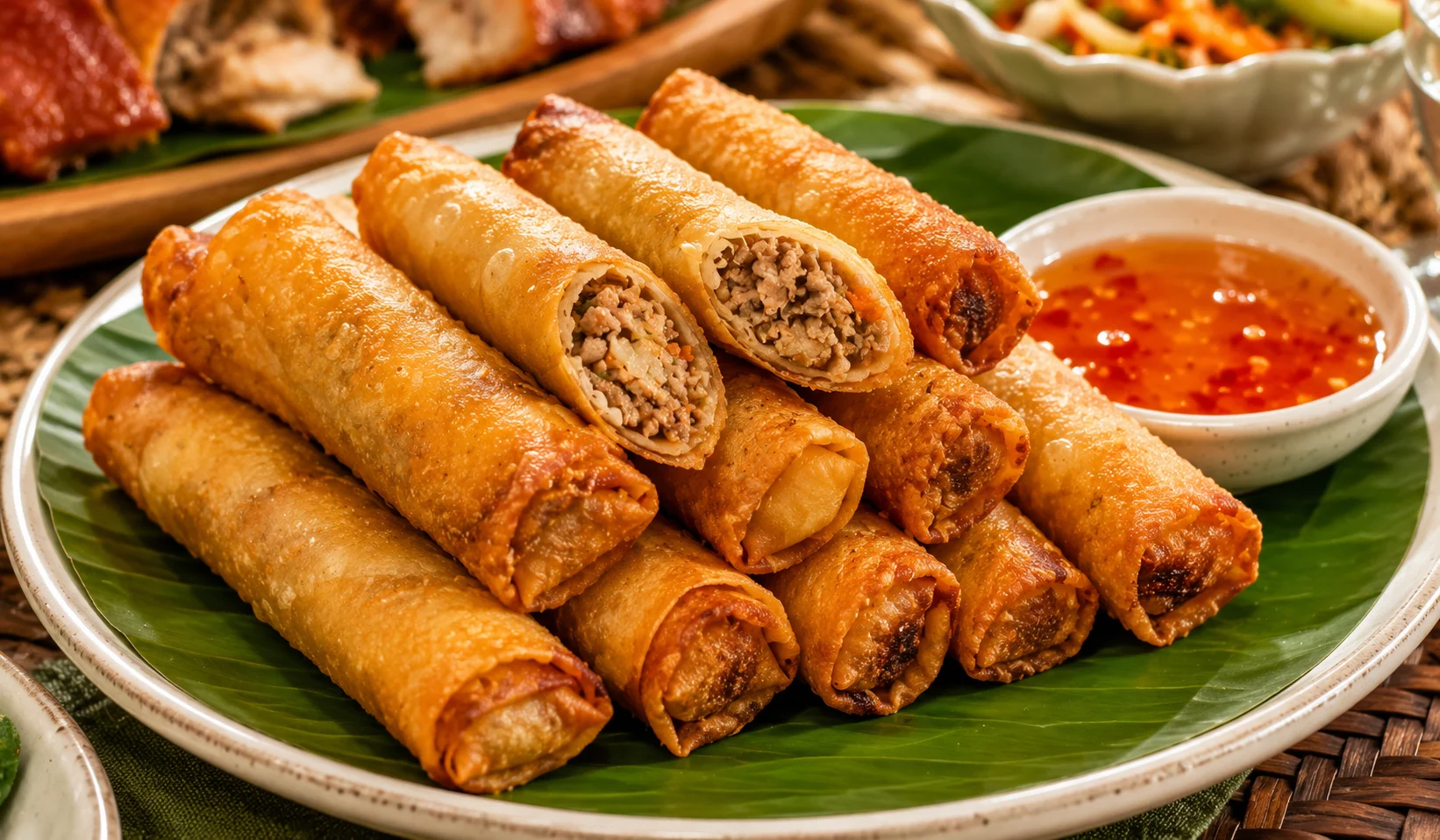
Lumpia Shanghai — thin, crispy fried spring rolls that disappear from the table faster than any other Filipino party dish. Make 200+ the night before and fry in batches on party day.
Chicken adobo — braised in soy sauce, vinegar, garlic, bay leaves, and black pepper — is the national dish of the Philippines and one of the most forgiving large-batch dishes in Filipino cooking. It tastes better the next day, holds well at room temperature for hours, and scales easily to any party size. For 50 guests as part of a multi-dish party, prepare 8–10 kg of chicken adobo.
Fried chicken is the children’s party alternative — crispy, familiar, and universally popular. Many Filipino birthday parties for young children skip adobo entirely and go straight to fried chicken, which can be ordered from Chowking, Jollibee, or Max’s Restaurant in pre-party bulk packages.
Kare-kare is the premium viand of Filipino party food — a rich, creamy stew made from oxtail (or tripe, or beef shank) in a peanut-based sauce with banana blossoms, eggplant, and long beans. The sauce is thick, golden, and intensely savory, always paired with bagoong (fermented shrimp paste) whose pungent saltiness cuts through the richness of the peanut sauce. Kare-kare signals effort and generosity — it takes time to cook properly and uses expensive cuts of meat.
Not every birthday party serves kare-kare — it’s more common at larger, more formal celebrations and adult parties. For children’s parties it is often replaced with simpler viands.
Puto (white steamed rice cakes) and kutsinta (brown steamed rice cakes with a chewy texture) are traditional Filipino party snacks — served alongside the main meal as a starchy side or as part of the merienda (snack) spread. They are almost always ordered from a neighbor or local puto maker rather than made at home. The combination of puto and kutsinta on a single plate, often with grated coconut on top, is one of the most nostalgically Filipino visual combinations in party food.
Leche flan is the undisputed queen of Filipino birthday party desserts — a dense, silky caramel custard made from egg yolks, condensed milk, and evaporated milk, steamed in an oval aluminum mold (llanera). Its golden caramel glaze and impossibly smooth texture make it the dessert guests reach for first. Most Filipino households have a family leche flan recipe that is considered the definitive version — and fiercely defended as superior to all others.
For a party of 50, prepare 6–8 llaneras. Leche flan is made one to two days in advance and refrigerated — it improves with resting time. This is one of the few Filipino party dishes that is better when not freshly made.
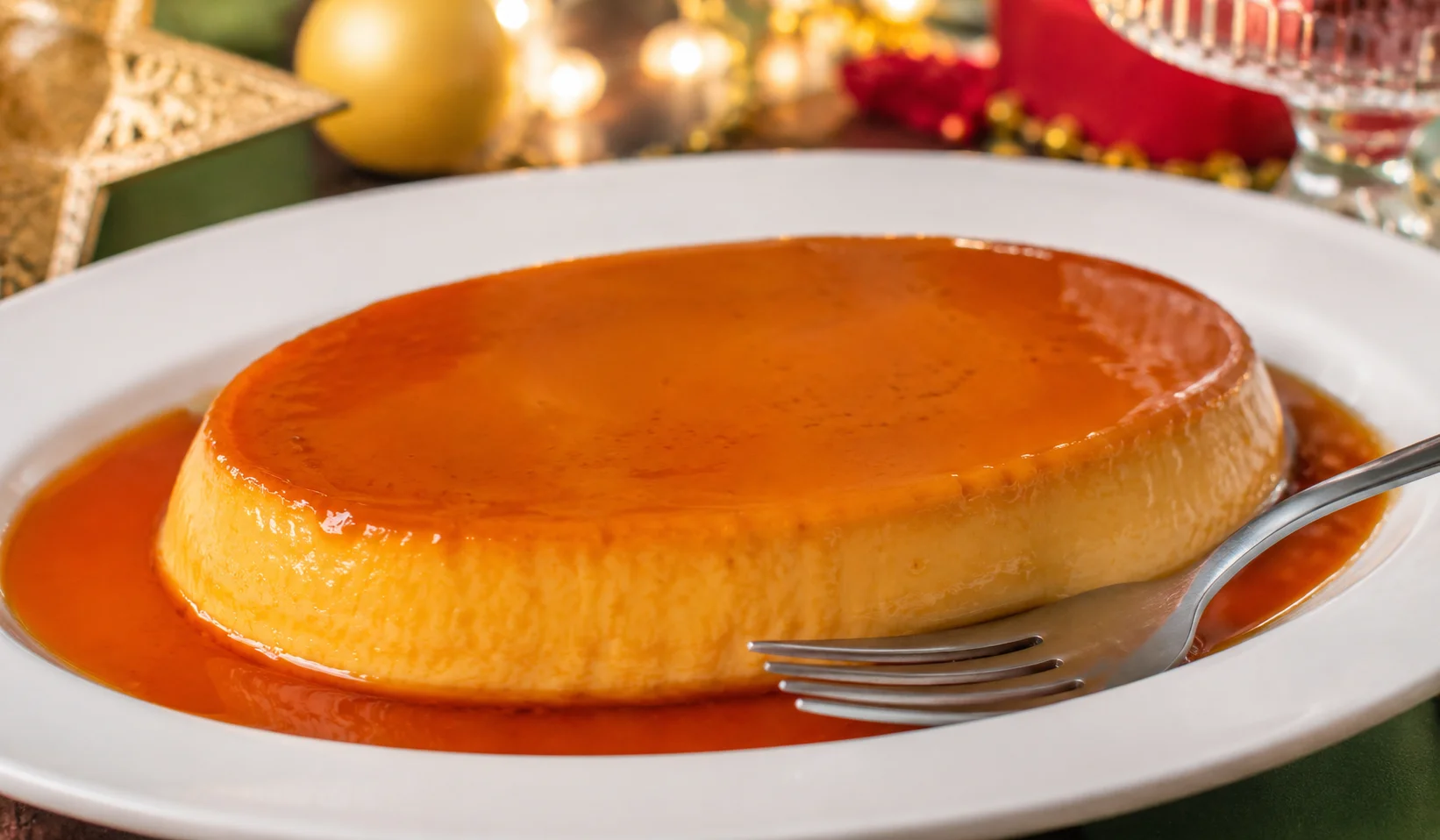
Leche flan — the queen of Filipino birthday party desserts. Made 1–2 days in advance and refrigerated. It tastes better rested, making it the perfect make-ahead party dessert.
Halo-halo (Tagalog: “mix-mix”) is the Philippines’ most iconic cold dessert — a tall glass of crushed or shaved ice piled with preserved sweet beans (mongo, chickpeas), kaong (sugar palm fruit), nata de coco (coconut jelly), macapuno (coconut sport), sago pearls, sliced banana, ube (purple yam) halaya, a scoop of ube or mango ice cream, evaporated milk, and a slice of leche flan on top. It is mixed vigorously before eating. It looks visually spectacular and tastes like every sweet thing simultaneously.
For a party, a self-serve halo-halo station is increasingly popular — lay out each component in separate bowls and let guests build their own. A shaved ice machine (available on Lazada for ₱1,500–₱3,000) makes this practical for home parties.
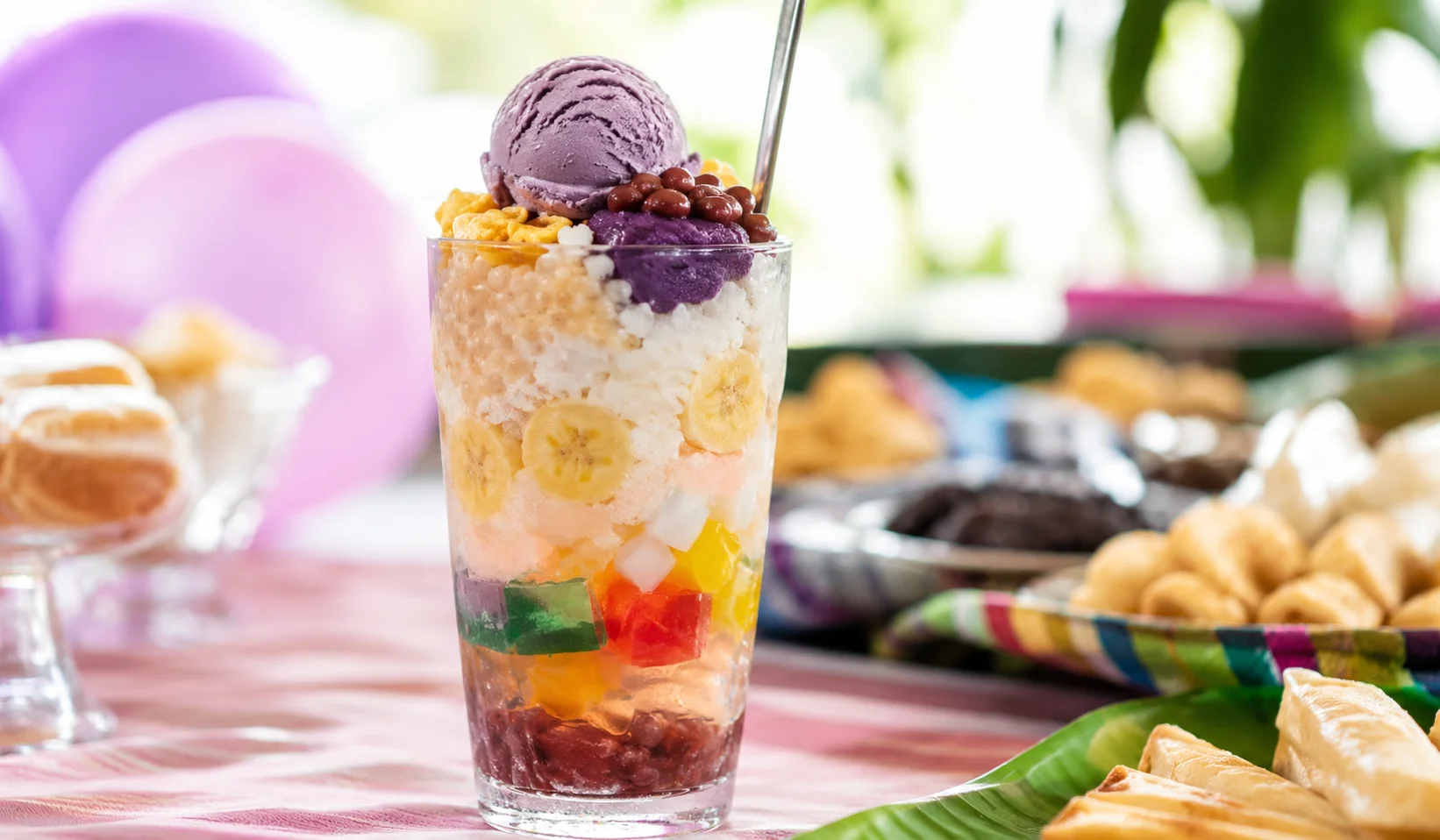
Halo-halo — the Philippines’ most iconic cold dessert. Shaved ice piled with colorful sweet toppings and a scoop of ube ice cream. A self-serve halo-halo station is the most popular party version.
Filipino fruit salad is not the Western fruit salad — it is a creamy, sweet dessert made from all-purpose cream, condensed milk, kaong (sugar palm fruit), nata de coco (coconut jelly), canned mixed fruits (peaches, pineapple, fruit cocktail), and sometimes macaroni or sago pearls. The result is a rich, creamy, dessert that sits somewhere between a fruit bowl and a pudding. It is made the night before and refrigerated — like leche flan, it is better cold and rested.
Kakanin is the collective term for Filipino rice-based sweets — a category that includes biko (sticky rice with coconut milk and brown sugar), sapin-sapin (layered purple, white, and yellow rice cake), bibingka (rice cake with salted egg and coconut), palitaw (flat rice cakes in sesame and coconut), and many more. A traditional Filipino birthday party includes a kakanin platter as part of the dessert spread — typically an assortment of 3–4 types arranged on banana leaves.
The Filipino birthday cake is dominated by two brands: Goldilocks and Red Ribbon. Goldilocks is the most traditional — its mocha dedication cake or caramel cake with the celebrant’s name piped in icing is the defining image of a Filipino birthday. Red Ribbon is famous for its Black Forest cake and mango chiffon. For children’s parties, Goldilocks offers character-themed cakes (Disney, Jollibee) that have been a Filipino birthday staple for decades.
The birthday cake is the moment the room comes together — the candles, the song, the wish. In the Philippines, the birthday celebrant’s wish is serious business, kept secret with the same gravity other cultures reserve for prayer.
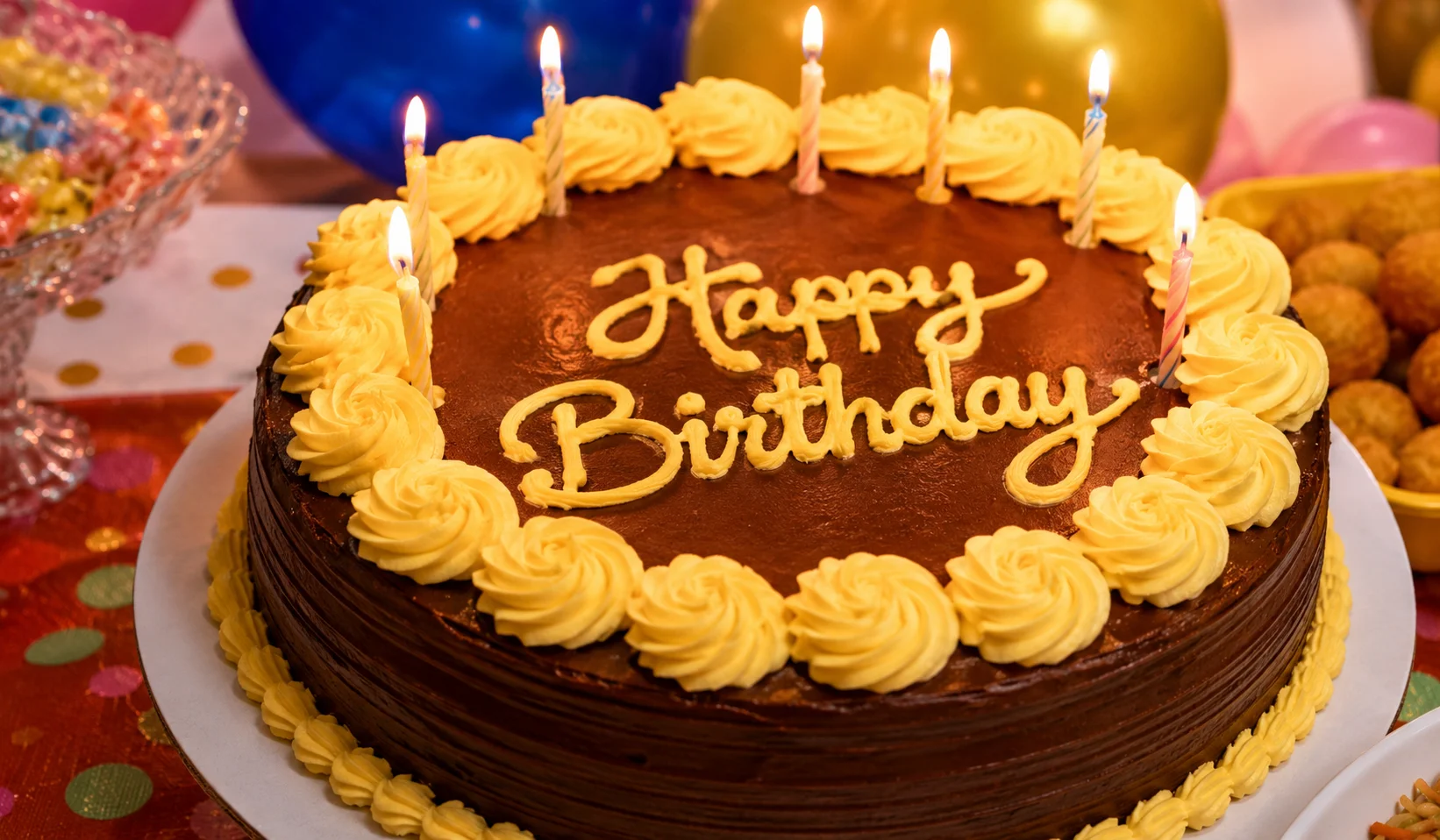
The Goldilocks birthday cake — the defining image of a Filipino birthday party. Mocha or caramel dedication cake with the celebrant’s name piped in icing. Order 3–7 days in advance.
Serving Sizes — 50 and 100 Guests
| Dish | For 50 guests | For 100 guests | Notes |
|---|---|---|---|
| Lechon | 1 whole pig (15–20 kg) | 2 whole pigs | Order 3–5 days in advance |
| Filipino spaghetti | 3 kg pasta | 6 kg pasta | Cook sauce with 2 kg ground pork per 3 kg pasta |
| Pancit bihon/canton | 2 kg noodles | 4 kg noodles | Do not cut noodles — symbolizes long life |
| Lumpia Shanghai | 200–250 pieces | 400–500 pieces | Make night before, fry in batches day of party |
| Chicken adobo/fried chicken | 8–10 kg chicken | 16–20 kg chicken | Adobo can be cooked day before — tastes better |
| Kare-kare | 4–5 kg oxtail | 8–10 kg oxtail | Must serve with bagoong (fermented shrimp paste) |
| Leche flan | 6–8 llaneras | 12–15 llaneras | Make 1–2 days before, refrigerate |
| Fruit salad | 3–4 large bowls | 6–8 large bowls | Make night before, refrigerate |
| Birthday cake | Size 10 (serves 50) | Two size 10 cakes | Order from Goldilocks/Red Ribbon 3–7 days ahead |
| Rice | 10–12 kg raw rice | 20–24 kg raw rice | Always cook more than you think — rice runs out |
| Soft drinks | 10–12 liters (2L bottles) | 20–25 liters | Royal (orange), Coke, and Sprite are the standard |
Budget Guide — Filipino Birthday Party Food Costs 2026
Budget for 50 guests — Home-cooked
| Item | Quantity | PHP | USD approx. |
|---|---|---|---|
| Lechon (whole pig, 15 kg) | 1 | ₱5,500–₱8,000 | ~USD 98–143 |
| Filipino spaghetti | 3 kg pasta + sauce | ₱600–₱900 | ~USD 11–16 |
| Pancit bihon | 2 kg noodles + ingredients | ₱400–₱600 | ~USD 7–11 |
| Lumpia Shanghai (200 pcs) | 200 pcs | ₱600–₱900 | ~USD 11–16 |
| Chicken adobo (8 kg chicken) | 8 kg | ₱1,400–₱1,800 | ~USD 25–32 |
| Leche flan (7 llaneras) | 7 pcs | ₱600–₱900 | ~USD 11–16 |
| Fruit salad | 3 large bowls | ₱500–₱800 | ~USD 9–14 |
| Rice (12 kg) | 12 kg | ₱600–₱800 | ~USD 11–14 |
| Soft drinks + water | 10 x 2L bottles | ₱500–₱700 | ~USD 9–13 |
| Birthday cake (Goldilocks size 10) | 1 | ₱1,200–₱2,500 | ~USD 21–45 |
| Puto, kutsinta, kakanin | Assorted | ₱500–₱800 | ~USD 9–14 |
| TOTAL (home-cooked) | ₱12,000–₱18,700 | ~USD 214–334 |
Budget options — Save money without losing quality
- Replace whole lechon with lechon kawali (crispy pork belly) — saves ₱3,000–₱6,000, same flavor experience
- Make pancit and lumpia yourself instead of ordering — saves ₱500–₱1,000
- Order birthday cake from local bakers instead of Goldilocks — saves ₱500–₱1,500 and supports local
- Replace kare-kare with beef caldereta or mechado — 60–70% cheaper, equally festive
- Make halo-halo instead of ice cream desserts — cheaper ingredients, more interactive for guests
- Cook rice in bulk — never spend on rice delivery, always have a neighbor help cook it
Filipino Children’s Birthday Party Food
A Filipino children’s birthday party has a slightly different menu emphasis — simpler, sweeter, kid-friendlier. The adult dishes (kare-kare, adobo) are often still served for the parents, but the children’s spread focuses on:
- Filipino spaghetti — the absolute non-negotiable. This is the dish children remember as “birthday food.”
- Fried chicken — from Jollibee, Chowking, or homemade. Children prefer fried over roasted.
- Mini lumpia Shanghai — smaller than the standard size, easier for small hands.
- Pancit bihon — always present for long life symbolism, even at children’s parties.
- Hotdog skewers — a children’s party staple. Sliced hotdogs on toothpick skewers with ketchup on the side.
- Fruit salad cups — individual plastic cups of fruit salad served as dessert.
- Birthday cake — Goldilocks character cake (Disney, Peppa Pig, Jollibee) with the child’s name and age.
- Loot bags — not food exactly but the loot bag (with candy, chips, and small toys) is a mandatory children’s party tradition.
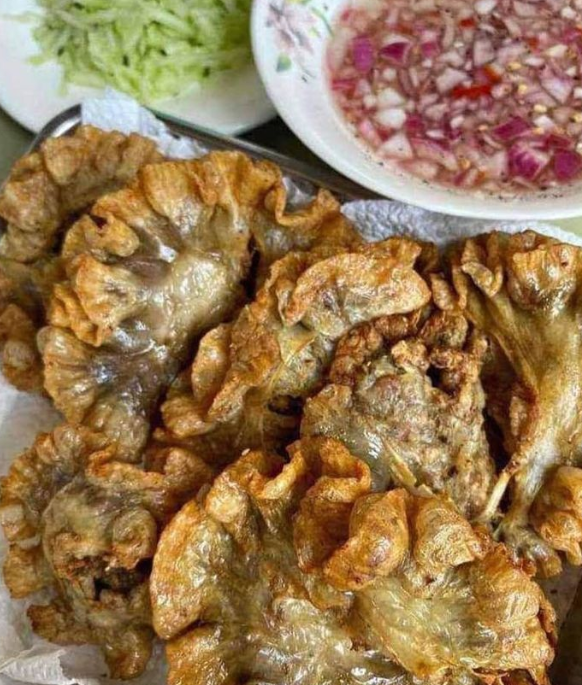
Chicharon bulaklak — crispy deep-fried pork intestines, one of the most popular Filipino party finger foods. Served with vinegar and chili dipping sauce. A staple at adult birthday parties and pulutan spreads.
OFW Guide — Making Filipino Birthday Food Abroad
This section is specifically for Filipinos living abroad — in the US, Canada, UK, UAE, Saudi Arabia, Australia, Japan, or anywhere else — who want to throw a proper Filipino birthday party without access to Filipino specialty stores.
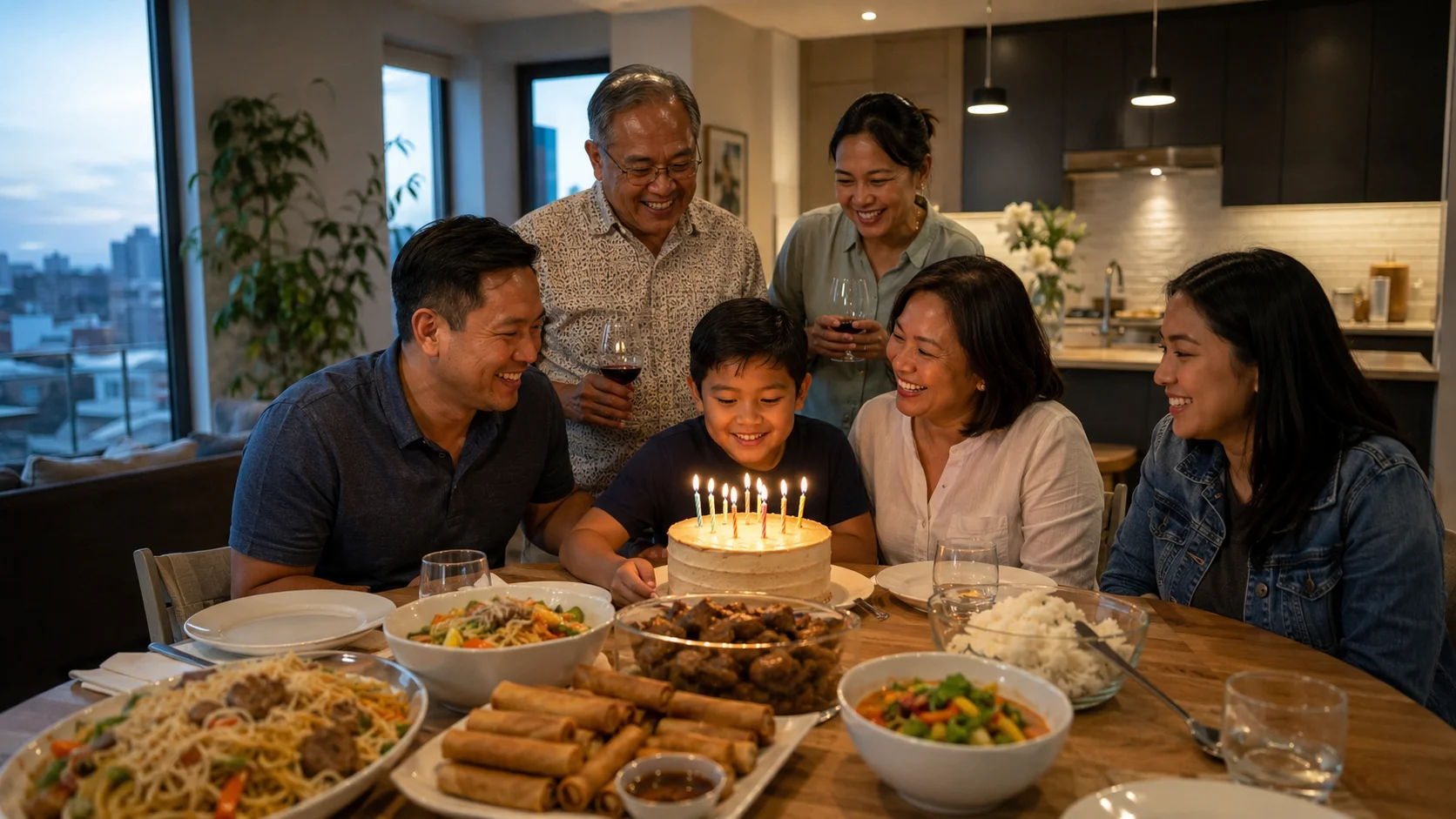
Filipino families abroad recreating a proper Filipino birthday party — pancit, lumpia, adobo, and a birthday cake. With the right substitutions, every essential dish is achievable anywhere in the world.
🌍 What you can find at any Asian grocery store worldwide
These dishes use ingredients available at virtually any Chinese, Vietnamese, or Korean grocery store:
Party Day Preparation Timeline
- 1 week before: Order lechon, order birthday cake from Goldilocks/Red Ribbon, buy all dry ingredients
- 2 days before: Make leche flan, marinate chicken adobo, make lumpia filling
- Day before: Roll and freeze lumpia, make fruit salad, cook adobo (it tastes better the next day), order puto/kutsinta from the neighborhood maker
- Day of party — morning: Cook pancit, cook spaghetti sauce (pasta cooked last), pick up lechon 2 hours before party
- 2 hours before: Fry lumpia in batches, cook pasta, set up table
- 30 minutes before: Arrange food on table. Refrigerate leche flan and fruit salad until serving time.
- Party time: Bring out lechon last — it should still be warm and the skin still crackling when guests first see it.
Frequently Asked Questions

I’ve attended Filipino birthday parties across three Philippine regions — from backyard celebrations in Dumaguete where the neighbors brought extra plastic chairs, to full catered parties in Cebu City. Filipino birthday food is not a research topic for me. It is the smell of lechon arriving at the table and the sound of “Happy Birthday” being sung in three different languages simultaneously. I write about Filipino food and culture at Best Philippines Travel Guide.