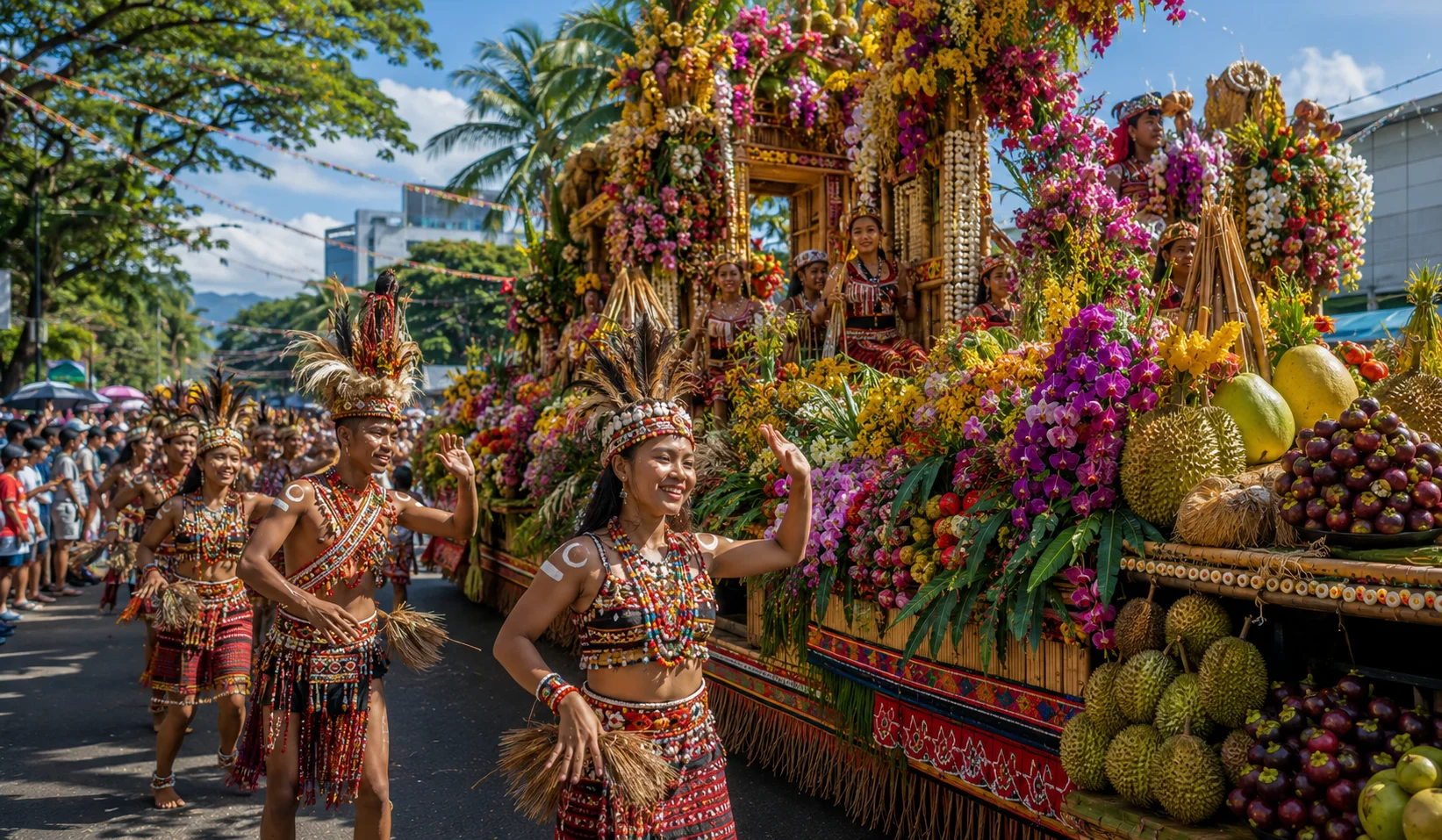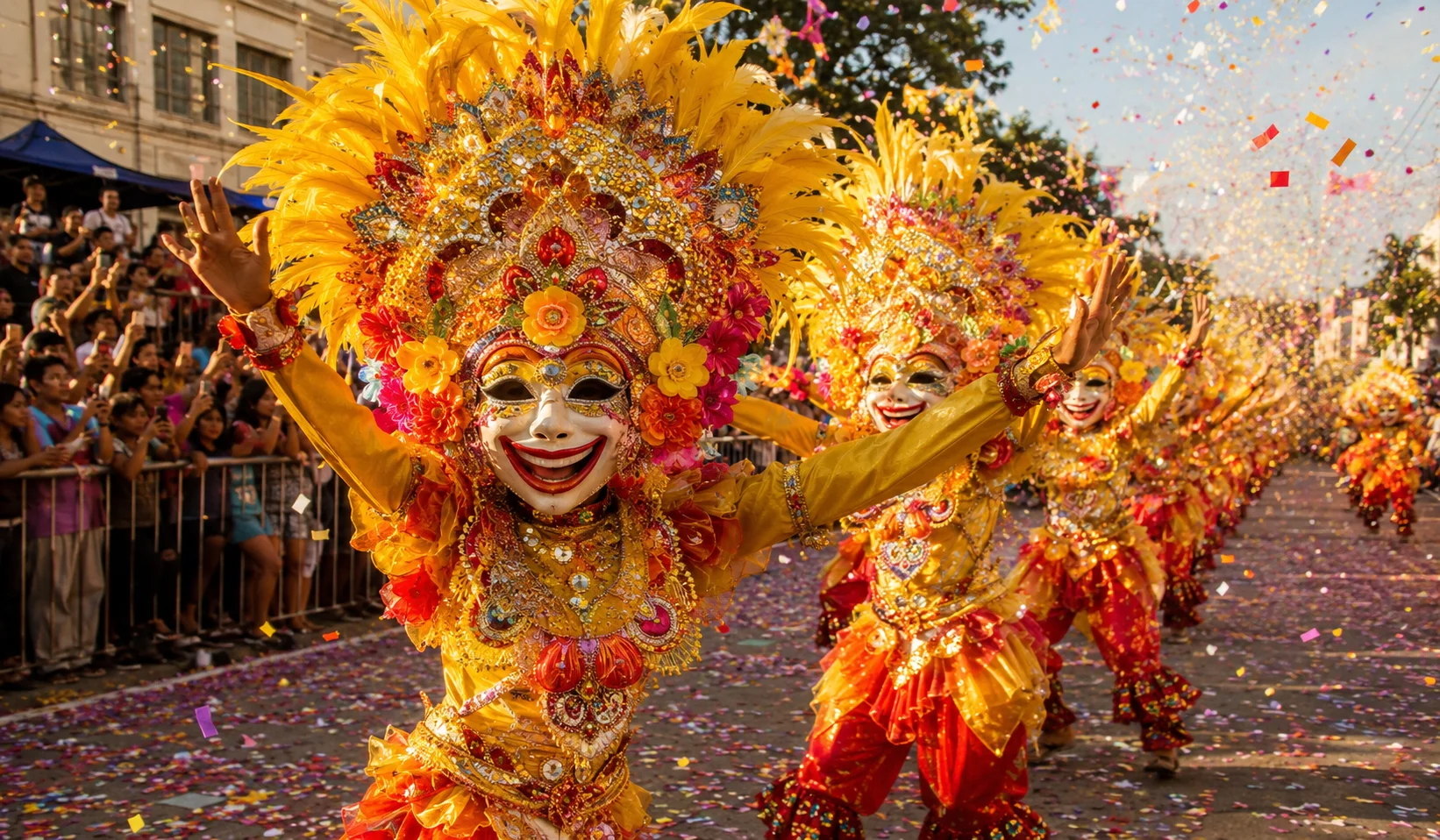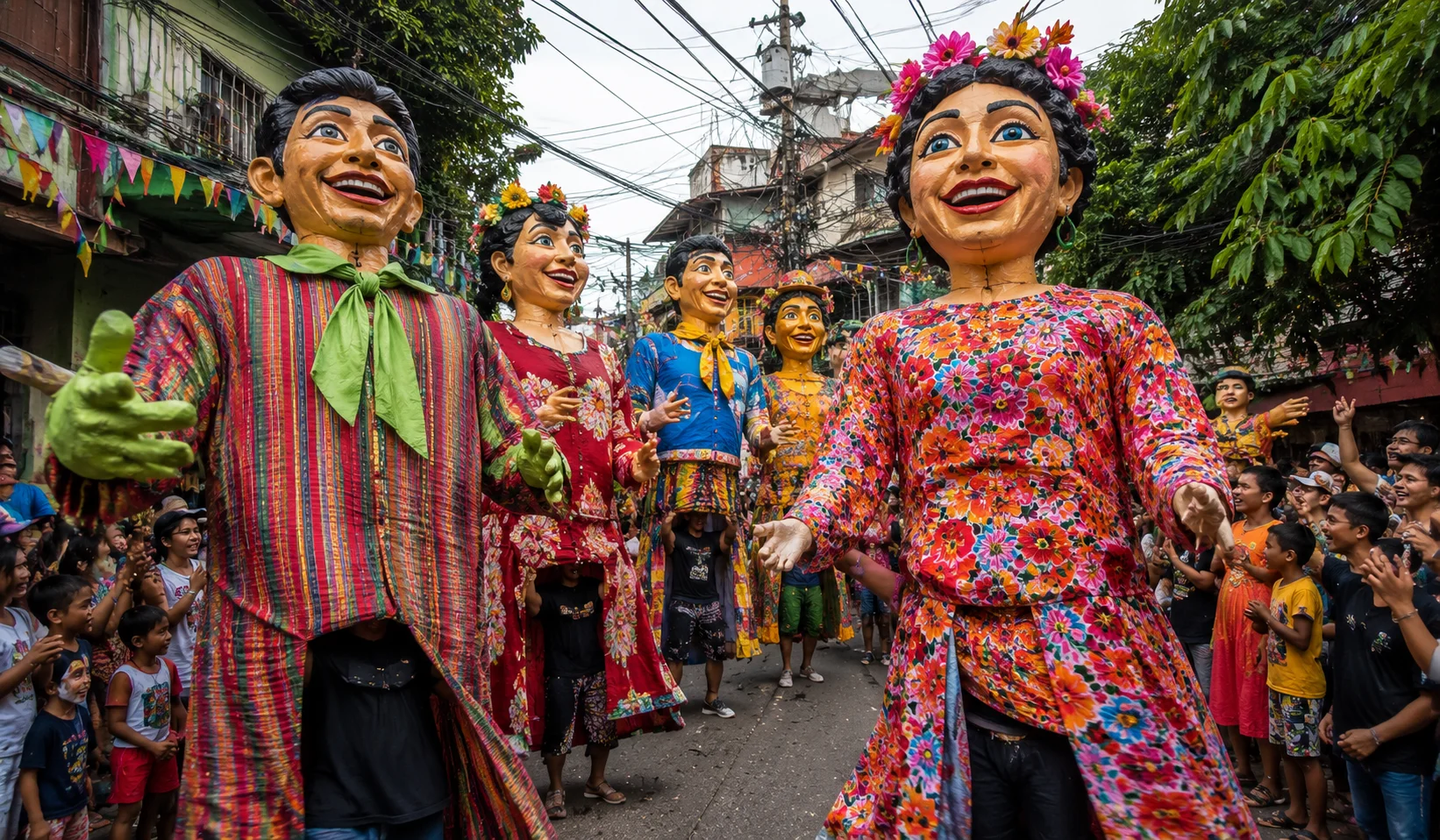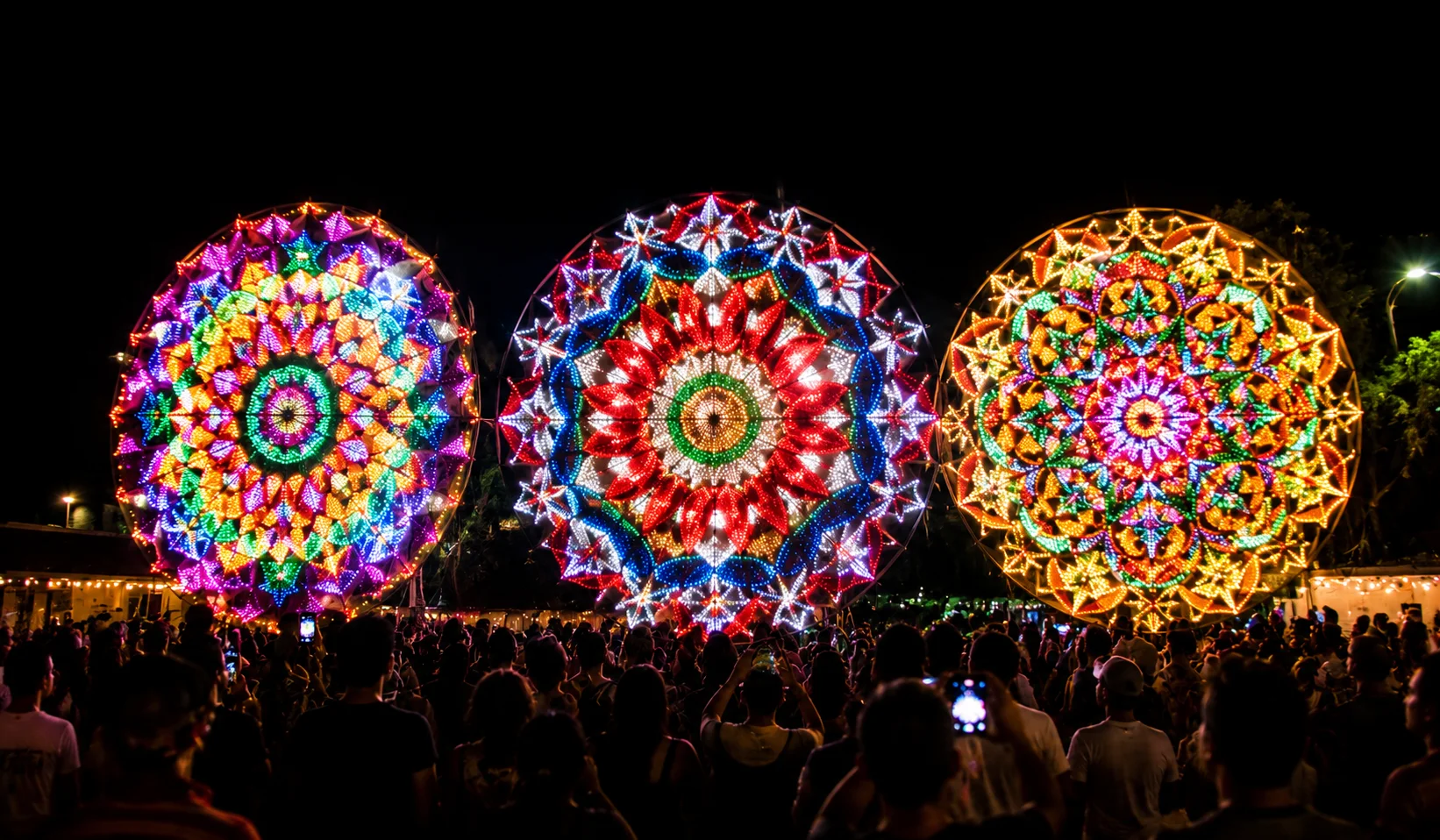
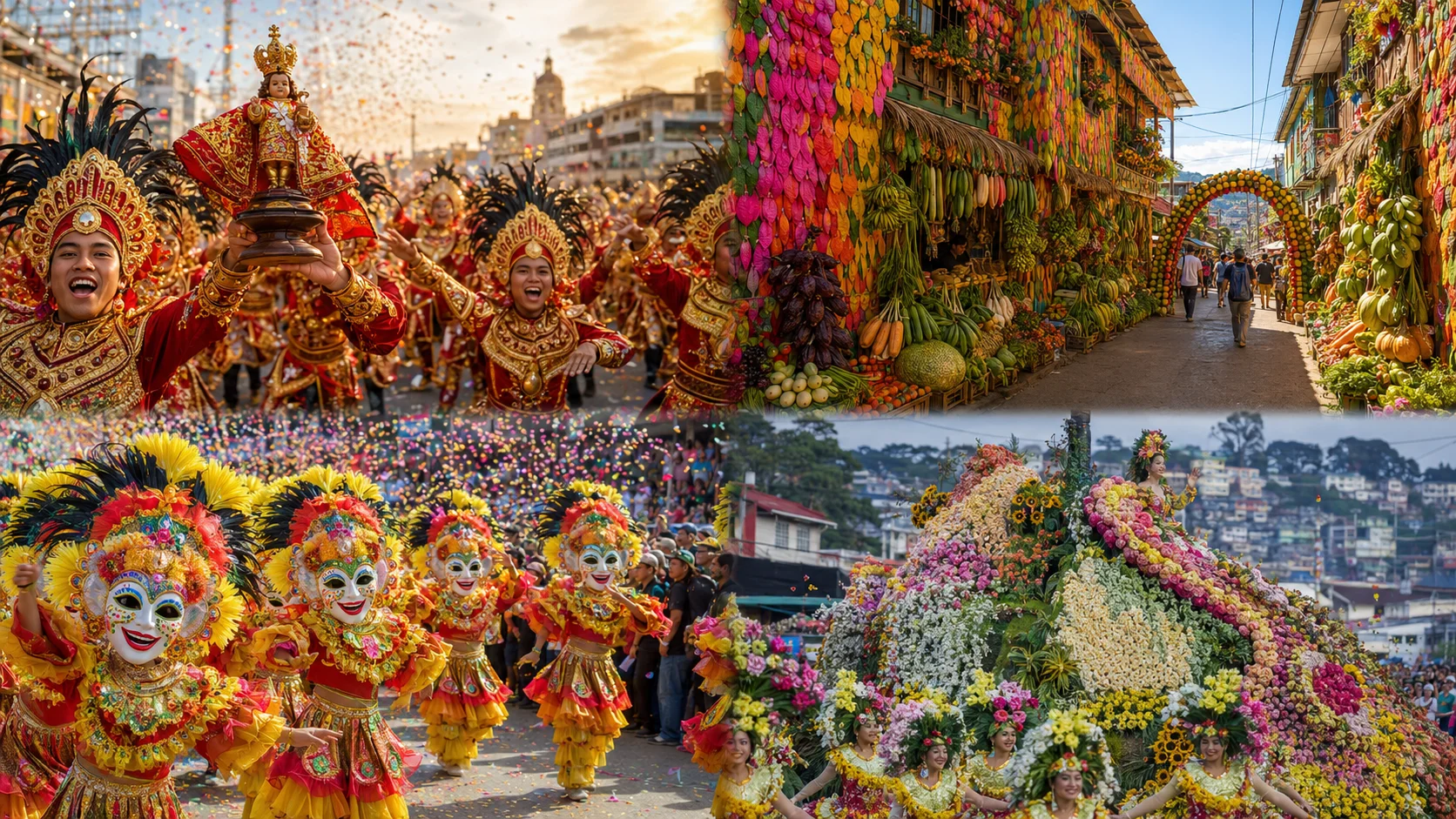
Philippine festivals — Sinulog (Cebu), Pahiyas (Lucban), MassKara (Bacolod), and Panagbenga (Baguio). The Philippines hosts over 42,000 festivals a year — more than any other nation on earth.
The most famous Philippine festivals are Sinulog (Cebu City, January — one of Asia’s biggest street festivals), Ati-Atihan (Kalibo, Aklan, January — the “Mother of all Philippine Festivals”), Pahiyas (Lucban, Quezon, May 15 — houses decorated with coloured rice wafers), MassKara (Bacolod, October — the Festival of Smiles), Panagbenga (Baguio, February — month-long flower festival), and Kadayawan (Davao, August). The Philippines celebrates over 42,000 festivals per year — more than any other country on earth.
I was born in Cebu City — which means I was born into Sinulog. The chant of “Pit Señor!” is one of my earliest memories: the city transformed, millions of people in the streets, the drumbeats that you feel in your chest before you hear them with your ears. Philippine festivals are not performances for tourists. They are living faith, living community, living history — and you are invited to participate in all of them.
The Philippines holds the record for the most festivals per year of any nation on earth — over 42,000 annually. Every barangay, every municipality, every province has its patron saint and its fiesta. This guide covers the 20 most important — the ones worth planning an entire trip around — organized by month, with exact 2026 dates, travel tips, and practical information for US, UK, and Australian visitors visiting the Philippines.
Philippine Festivals 2026 — By Month
Ati-Atihan Festival — Kalibo
Dinagyang Festival — Iloilo
Black Nazarene — Manila (Jan 9)
Bambanti Festival — Isabela
Complete 2026 Festival Calendar
| Month | Festival | Location | 2026 Date | Tier |
|---|---|---|---|---|
| January | Sinulog Festival | Cebu City | January 18, 2026 (3rd Sunday) | ★★★ Must-see |
| January | Ati-Atihan Festival | Kalibo, Aklan | 3rd Sunday of January | ★★★ Must-see |
| January | Dinagyang Festival | Iloilo City | 4th Sunday of January | ★★★ Must-see |
| January | Feast of the Black Nazarene | Quiapo, Manila | January 9, 2026 | ★★ Major |
| January | Bambanti Festival | Ilagan, Isabela | 3rd week of January | ★★ Major |
| February | Panagbenga Flower Festival | Baguio City | Entire month of February | ★★★ Must-see |
| Feb–Mar | Kaamulan Festival | Malaybalay, Bukidnon | Last week Feb – March 10 | ★★ Major |
| Holy Week | Moriones Festival | Marinduque | Holy Week 2026 | ★★★ Unique |
| April | Aliwan Festival | Pasay City, Metro Manila | April 2026 | ★★ Major |
| April | Bangus Festival | Dagupan, Pangasinan | April 2026 | ★★ Regional |
| May 15 | Pahiyas Festival | Lucban, Quezon | May 15, 2026 (fixed) | ★★★ Must-see |
| May | Carabao Festival | Pulilan, Bulacan | May 14–15, 2026 | ★★ Regional |
| June | Pintados-Kasadyaan | Tacloban, Leyte | June 29, 2026 | ★★ Major |
| August | Kadayawan Festival | Davao City | 3rd week of August | ★★★ Must-see |
| September | Peñafrancia Festival | Naga City, Camarines Sur | 3rd Saturday of September | ★★★ Spectacular |
| October | MassKara Festival | Bacolod City | All October; main parade ~Oct 18 | ★★★ Must-see |
| October | Maskali Festival | Camiguin Island | October 2026 | ★★ Regional |
| November | Higantes Festival | Angono, Rizal | November 22–23, 2026 | ★★★ Unique |
| December | Giant Lantern Festival | San Fernando, Pampanga | Weekend before Christmas Eve | ★★★ Spectacular |
January — The Best Month for Philippine Festivals
January is the undisputed peak of Philippine festival culture. Three of the country’s most famous festivals — Sinulog, Ati-Atihan, and Dinagyang — all happen within the same two-week window in January, all honoring the Santo Niño (Holy Child Jesus). If you are planning one trip to experience Philippine festivals, January is the month to come.
🎉 Biggest in Philippines
The Sinulog Festival is the Philippines’ most famous street festival and one of the largest religious street festivals in Asia. Held every third Sunday of January in Cebu City in honor of the Santo Niño de Cebu — the miraculous statue of the Child Jesus kept at the Basilica Minore del Santo Niño — Sinulog draws millions of participants, dancers, and devotees every year.
The word Sinulog comes from the Cebuano word for “current” — describing the two-steps-forward, one-step-back movement of the street dancers that mimics the current of the old Pahina River where early converts bathed. On Sinulog Sunday, the entire city moves. Street dancers in elaborate tribal costumes perform for 12+ straight hours. The chant “Pit Señor!” — “Come closer, Lord!” — fills Cebu City from before sunrise until well past midnight. The sound, the scale, and the collective devotion of millions of Filipinos are genuinely overwhelming in the most transcendent sense.
Sinulog is not just a parade. It is a religious procession, a cultural competition, a street party, and a spiritual event simultaneously. I was born in Cebu City and have seen Sinulog many times. It never gets smaller.
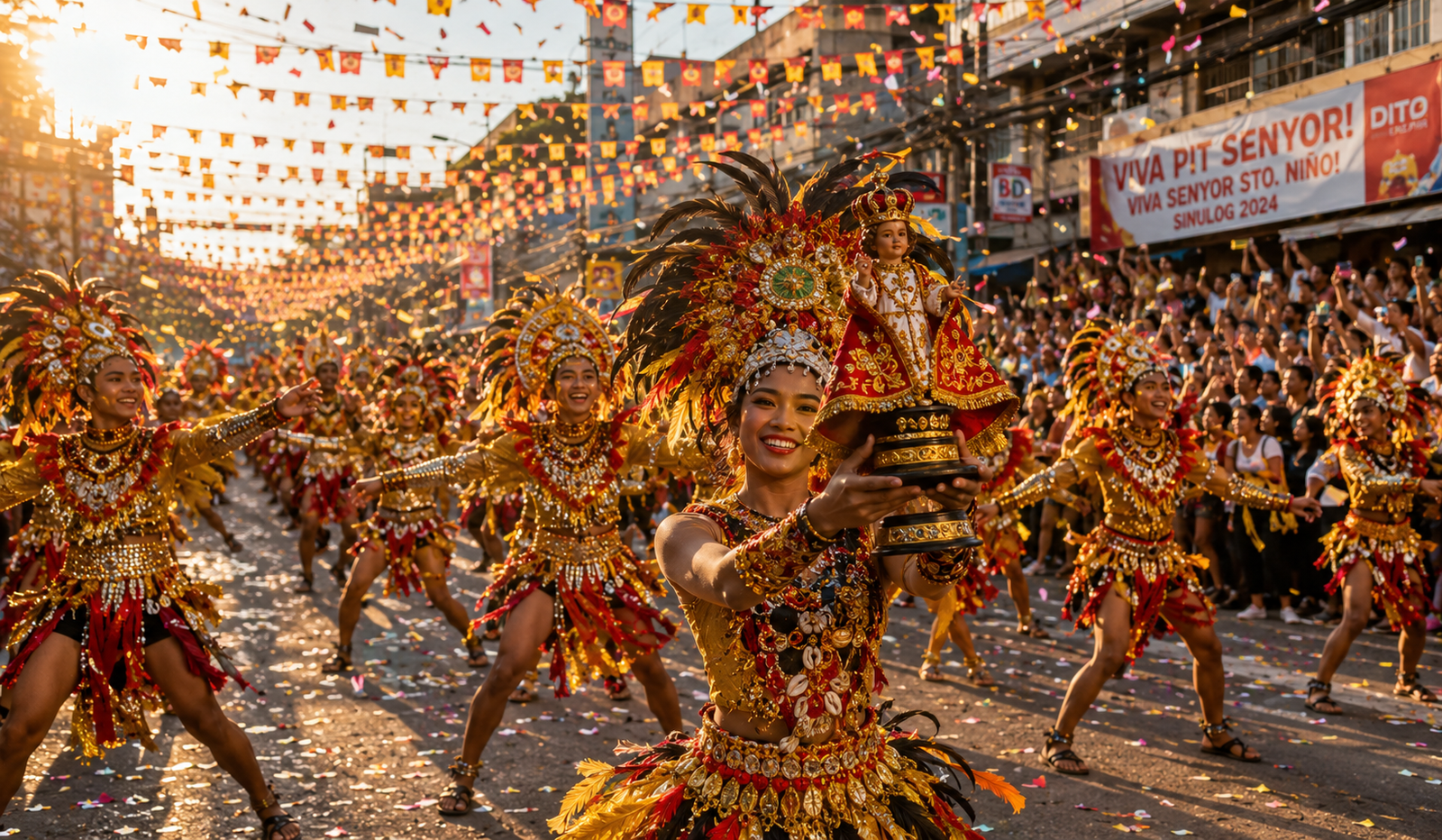
Sinulog Festival, Cebu City — millions of street dancers fill the city every third Sunday of January. The chant “Pit Señor!” echoes from before sunrise until past midnight.
- Book hotels 3–6 months in advance. Every hotel in Cebu City sells out for Sinulog weekend. January 16–19, 2026 is the critical window. Budget: expect hotels to cost 3–5x normal rates.
- The main street dancing parade route runs through Osmeña Boulevard. Arrive by 6–7 AM for a viewing spot.
- Grandstand tickets at the competition venue are sold separately — buy online months in advance.
- Wear light clothing and bring water. January in Cebu is warm and the crowds are dense.
- Fly directly into Mactan-Cebu International Airport — direct flights from Singapore, Hong Kong, Tokyo, Seoul, and Australian cities operate during Sinulog season.
👑 Mother of all festivals
The Ati-Atihan Festival is considered the “Mother of all Philippine Festivals” — the oldest and arguably the most spiritually intense of the three January Santo Niño celebrations. It commemorates the legendary peace pact between the indigenous Ati people and the Malay settlers who purchased land from them approximately 800 years ago.
Participants paint their faces and bodies black with soot, don elaborate tribal costumes with feathers, shells, and indigenous materials, and dance continuously to the relentless beat of drums for three full days. The energy is primal and celebratory at once. The chant “Hala Bira! Pwera Pasma!” — a call of endurance and wild joy — fills the streets of Kalibo. Unlike Sinulog, where you watch the parade, Ati-Atihan invites tourists to join the dancing — face paint and all. There is no sideline.
Getting to Kalibo is straightforward — it has its own airport (Kalibo International Airport) with regular flights from Manila and Cebu, and it is the gateway to Boracay Island (1 hour by bus + ferry from Kalibo). Combine Ati-Atihan with 3 days in Boracay for a perfect Visayas January itinerary.
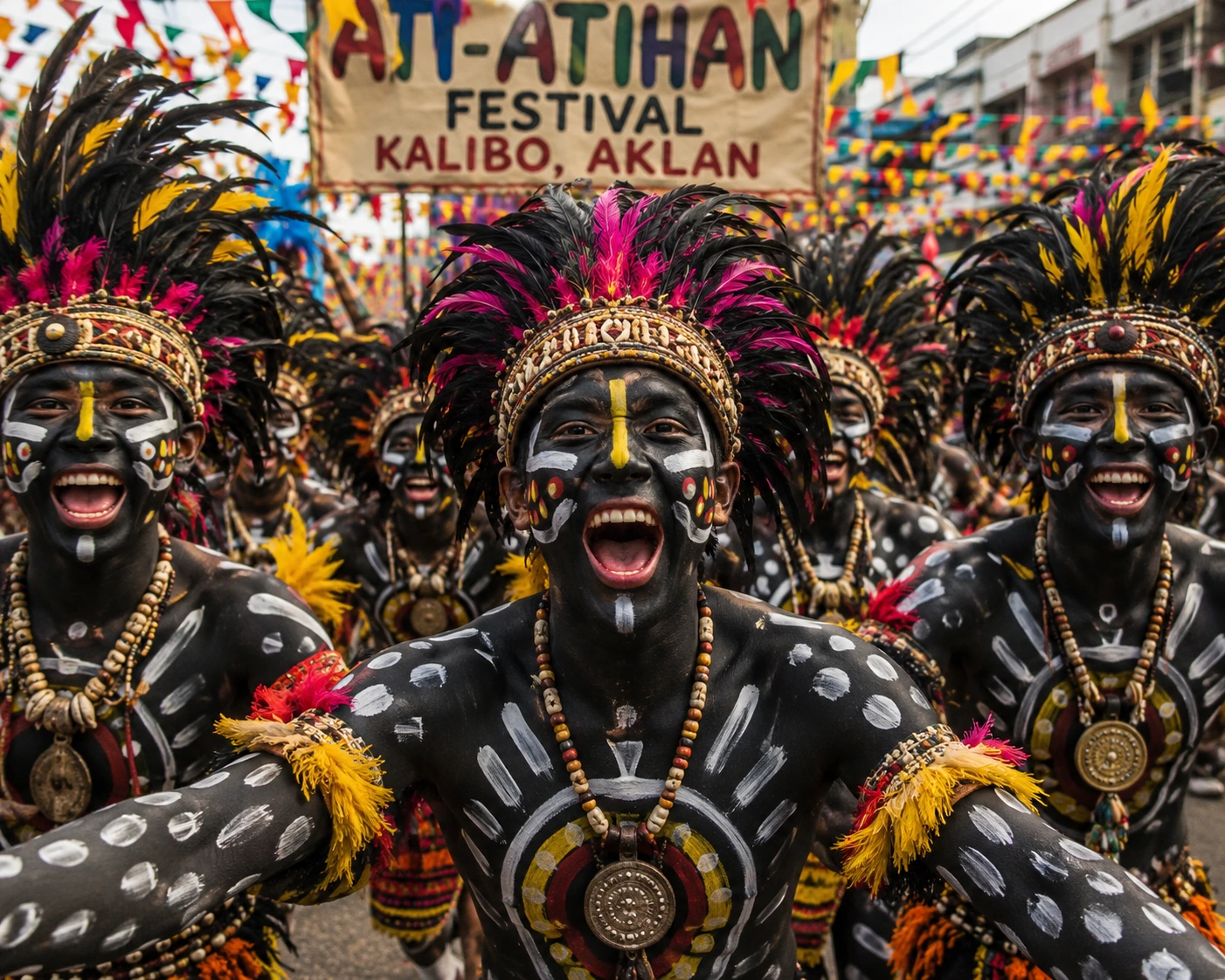
Ati-Atihan Festival, Kalibo, Aklan — participants paint their faces and bodies black and dance continuously for three days. Unlike Sinulog, tourists are actively invited to join the dancing. Face paint is available from vendors throughout the town.
- Fly into Kalibo International Airport from Manila or Cebu. Alternatively, fly to Caticlan (closer to Boracay) and travel by land to Kalibo for the festival.
- Buy face paint in Kalibo town before the festival — vendors sell it everywhere. Black is traditional; all colors are welcome.
- Less crowded than Sinulog — hotel booking 1–2 months in advance is usually sufficient.
- The three-day festival is continuous — Day 1 and 2 are more intimate, Day 3 (festival Sunday) is the peak.
🥁 Most artistic of the three
The Dinagyang Festival in Iloilo City is the third of the triumvirate of January Santo Niño festivals — and the most artistically competitive. Held every fourth Sunday of January, Dinagyang features competing tribes who perform precisely choreographed, drumbeat-driven dances through the streets of Iloilo City in elaborate tribal costumes. The performances are judged on choreography, visual design, story, and precision — making Dinagyang more of a world-class cultural performance competition than a street party.
Iloilo City is one of the Philippines’ most sophisticated and food-rich cities — La Paz batchoy (pork offal noodle soup), kadios baboy langka (KBL), baye-baye, and barquillos are all uniquely Iloilo delicacies best tried during festival week when the city’s food scene operates at full intensity. Dinagyang is the best choice among the three January festivals for visitors who want to attend a structured, ticketed event with designated viewing areas and crowd management — it is notably better organized than Sinulog for first-time Philippine festival visitors.
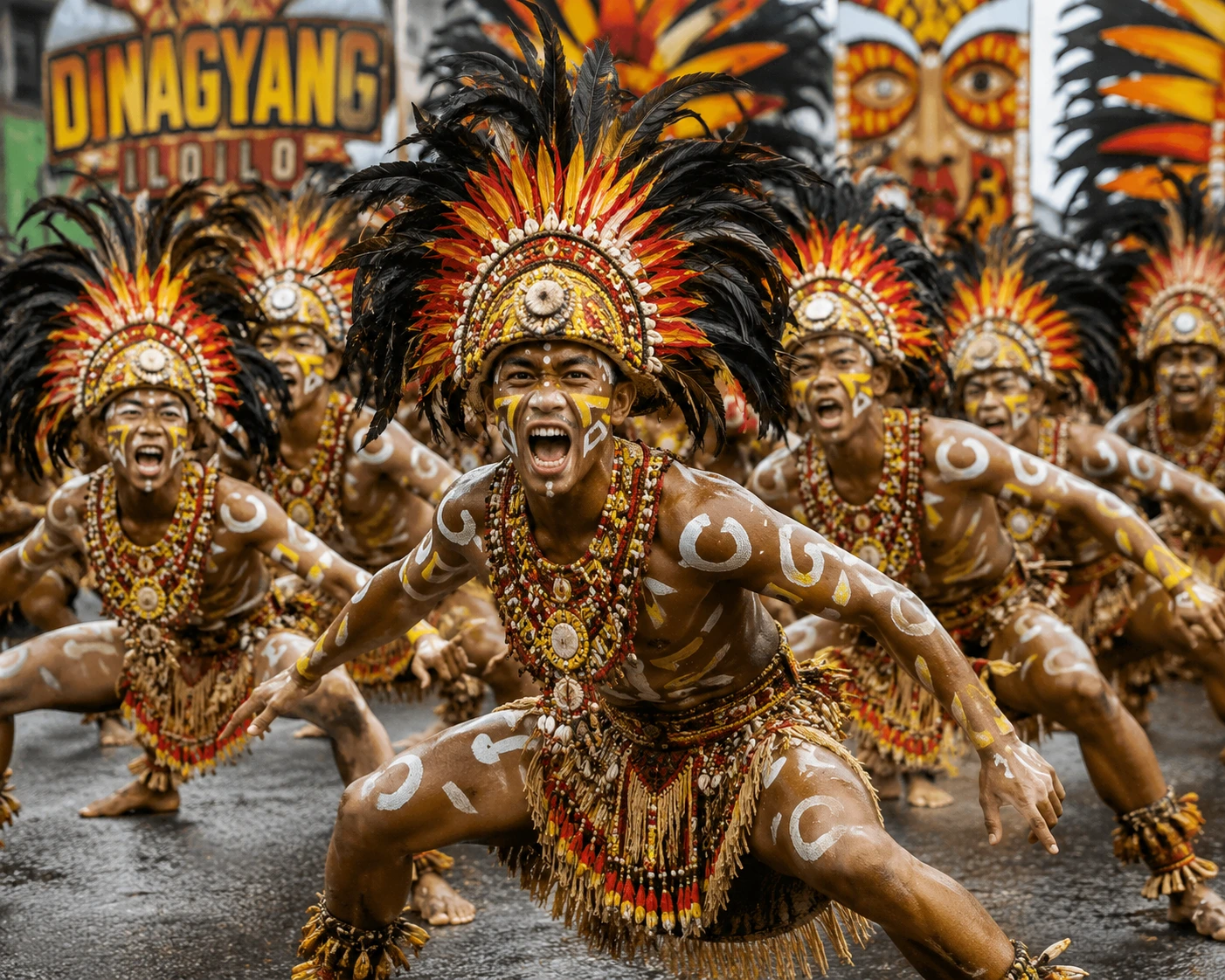
Dinagyang Festival, Iloilo City — the most artistically competitive of the three January Santo Niño festivals. Tribes perform highly choreographed, drumbeat-driven dances judged on precision, costume design, and storytelling.
- Iloilo (Iloilo International Airport) has flights from Manila, Cebu, and Singapore. Ferry from Bacolod (1 hour) makes a Dinagyang + MassKara double itinerary possible in one trip.
- Grandstand tickets for the main competition are sold via the Iloilo City government website — buy in advance.
- Try La Paz Batchoy at Ted’s Original Batchoy on Ledesma Street — the most famous version of Iloilo’s most famous dish.
🙏 Millions of barefoot devotees
Every January 9, millions of barefoot Filipino Catholic devotees crowd the streets of Quiapo, Manila to accompany the Black Nazarene — a life-size dark wood sculpture of Jesus Christ carrying the cross — on its annual traslación (transfer) procession through the streets of Manila. The crowds are among the largest in the world for a single religious event — estimated at 8–10 million participants in recent years. The devotion is absolute: men and women push through dense, dangerous crowds to touch the carriage or wipe a cloth across the statue, believing physical contact brings miraculous healing and answered prayers. The procession can last 12–18 hours as the carriage moves slowly through the packed streets.
February — Panagbenga & Highland Festivals
🌸 Month-long flower festival
The Panagbenga Festival (Kankanaey for “a season of blooming”) is Baguio City’s month-long celebration of flowers — held throughout February when the highland city’s celosia, sunflowers, roses, and chrysanthemums are at peak bloom. Panagbenga was founded in 1995 as a response to the 1990 Luzon earthquake that devastated Baguio — a community act of rebuilding through beauty. The festival’s climax is the massive float parade on the last Sunday of February, where enormous floats built entirely from fresh flowers move through Baguio’s Session Road.
Baguio’s cool mountain climate (15–20°C in February) is a dramatic contrast to the tropical heat of the lowlands — one of the main attractions for Manila-based visitors. The city’s strawberry farms in La Trinidad, Burnham Park, and the Mines View Park are all accessible during Panagbenga. Book accommodations in Baguio at least 1 month in advance for February weekends.
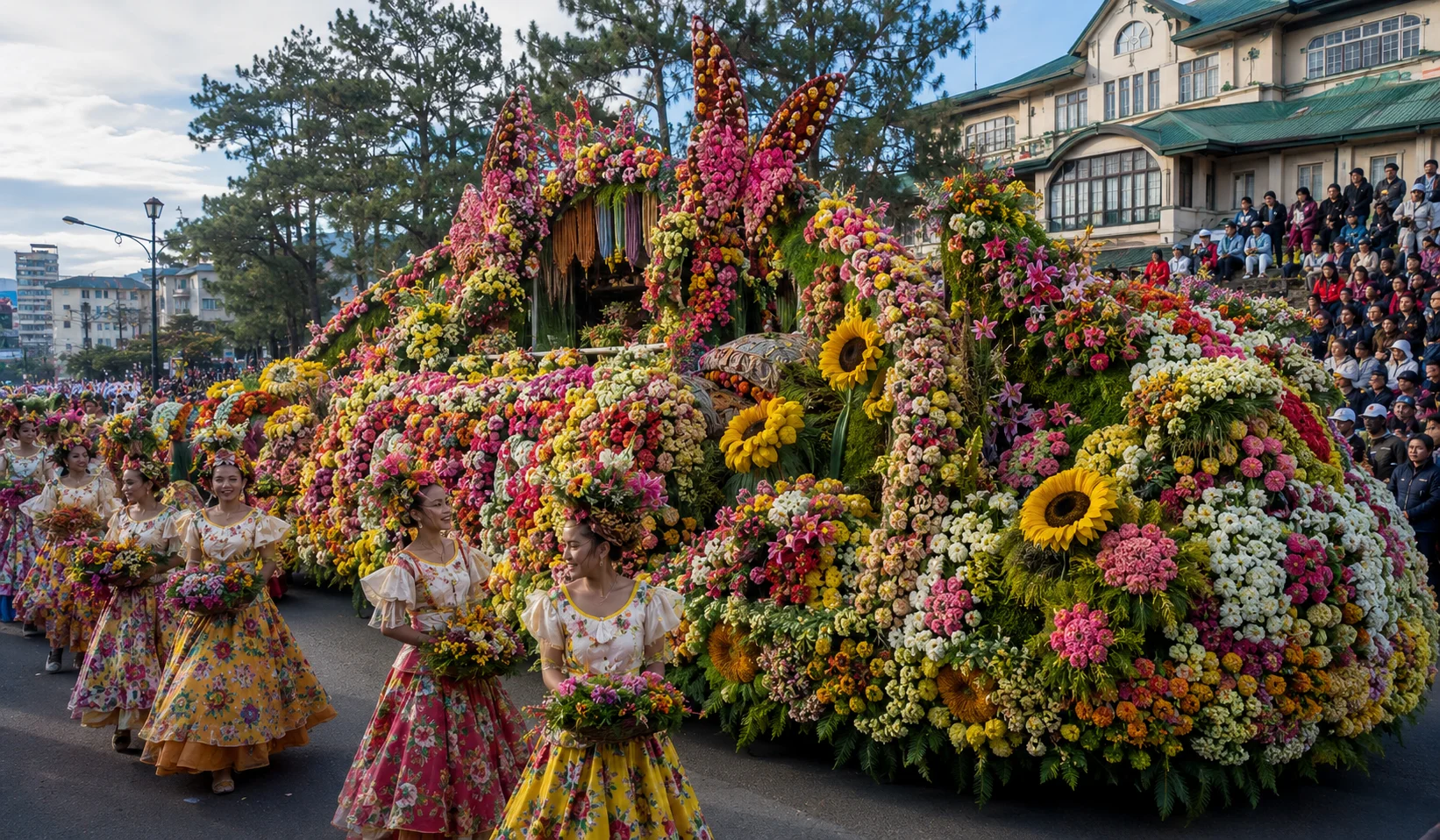
Panagbenga Flower Festival, Baguio City — the highlight float parade on the last Sunday of February, where enormous floats built entirely from fresh flowers move through Session Road in Baguio’s cool highland air.
🌿 Indigenous heritage
The Kaamulan Festival is one of the Philippines’ most authentic indigenous cultural celebrations — a gathering of Bukidnon’s seven indigenous tribes (Bukidnon, Higaonon, Talaandig, Manobo, Matigsalug, Tigwahanon, and Umayamnon) who come together to celebrate their ancestral traditions through ritual, music, dance, and craftsmanship. Unlike many Philippine festivals which are Catholic in origin, Kaamulan is purely indigenous — no patron saint, no colonial overlay. Just the living heritage of Mindanao’s highland peoples. I am based in Zamboanga del Sur and Mindanao festivals hold a special place for me — Kaamulan is one that every serious Philippines traveler should experience.
Holy Week — Moriones Festival
🎭 Most unique Holy Week festival
The Moriones Festival is one of the most visually extraordinary and internationally underappreciated festivals in the Philippines. Held throughout Holy Week on the island of Marinduque, it features participants dressed as moriones — Roman soldiers wearing elaborate carved wooden helmets and masks with exaggerated features — who re-enact the story of Longinus, the Roman soldier who pierced Jesus at the crucifixion and was miraculously healed when the blood touched his blind eye.
Throughout the week, moriones walk the streets of Marinduque’s towns in full Roman soldier costume, interacting with the community and chasing a figure representing Longinus. On Easter Sunday, the final climactic chase ends with Longinus’s capture and execution — re-enacted publicly in the town plaza. There is nothing quite like it anywhere in the world. The carved wooden masks are works of art that take months to make. Marinduque is a small island — easily reached by ferry from Lucena City — and the festival remains intimate, authentic, and genuinely moving in ways that larger festivals cannot match.
- Ferry from Lucena City (Quezon Province) to Balanacan or Cawit ports in Marinduque — approximately 3–4 hours. From Manila: 3-hour bus to Lucena + ferry.
- Book accommodations in Boac or Santa Cruz towns — Marinduque’s main population centers. Guesthouses fill up during Holy Week.
- The masks and costumes are sold as souvenirs throughout the festival — among the most authentic Philippine craft items you can bring home.
- Combine with a visit to Tres Reyes Islands for diving — Marinduque has excellent marine sanctuary reefs.
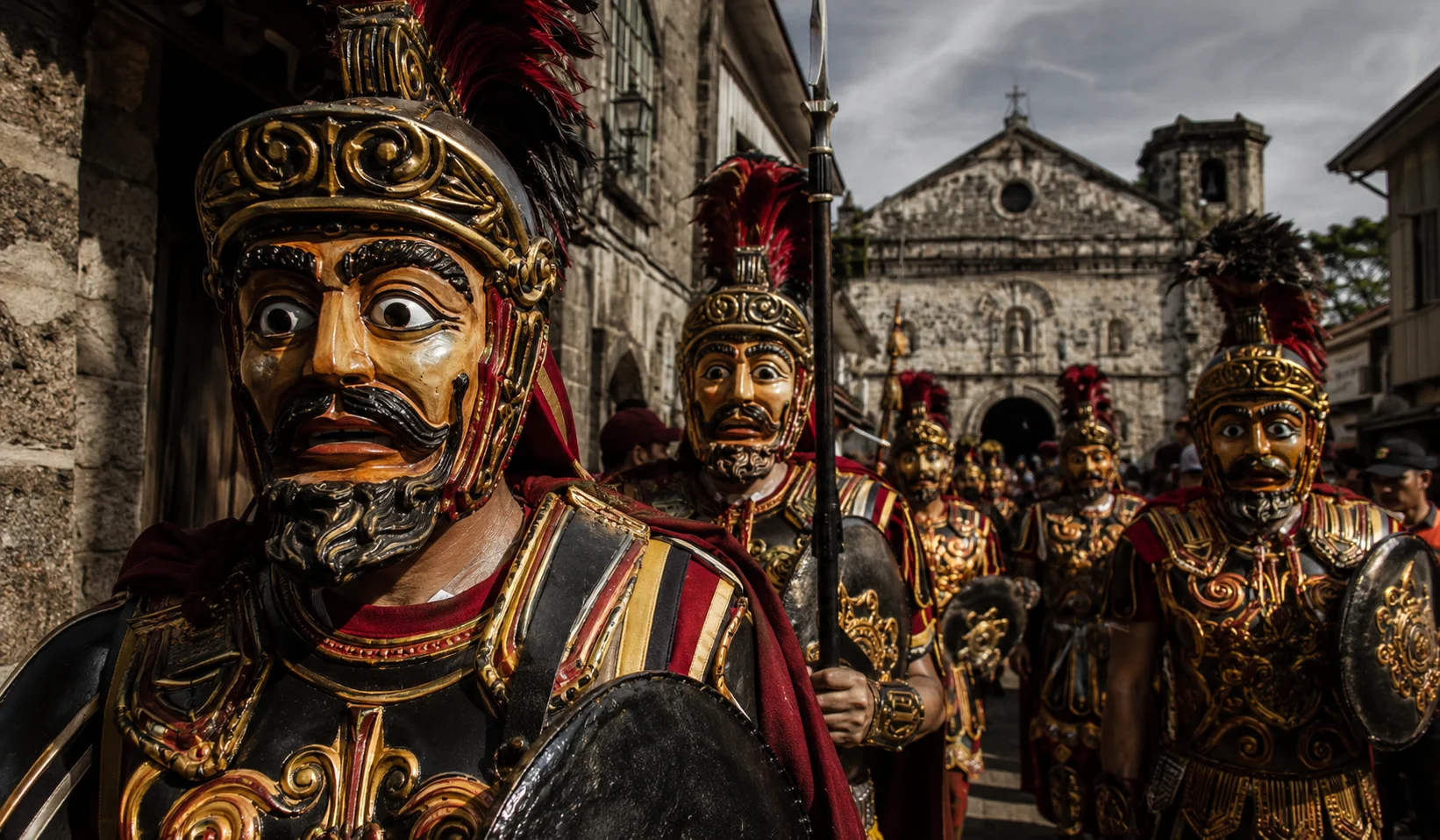
Moriones Festival, Marinduque — participants wear hand-carved wooden masks that take months to make. The festival re-enacts the story of Longinus throughout Holy Week, culminating in a dramatic public execution on Easter Sunday.
April — Aliwan & Bangus Festival
🏆 Festival of festivals
The Aliwan Festival is a unique meta-festival — a competition in Metro Manila where representatives from the Philippines’ most famous regional festivals compete against each other in street dancing, float design, and cultural performance. Sinulog dancers compete against Dinagyang performers against Kadayawan participants — all on the same stage. For visitors in Manila who cannot travel to multiple provinces, Aliwan is the rare opportunity to experience multiple Philippine festivals in one weekend. Held at Pasay City near the Mall of Asia complex.
May — Pahiyas & Carabao Festival
🌈 Most visually extraordinary
The Pahiyas Festival is held every May 15 — the feast day of San Isidro Labrador, patron saint of farmers — in the small town of Lucban in Quezon Province. It is the most visually extraordinary festival in the Philippines: residents decorate the entire façade of their homes with kiping (leaf-shaped wafers made from glutinous rice dyed in vivid colors), together with vegetables, tropical fruits, rice stalks, fresh flowers, and agricultural produce arranged in astonishing displays of abundance and creativity. Every house on every street becomes an elaborate, colourful art installation that took months to prepare.
After the religious procession honoring San Isidro, residents take down their decorations and give away or sell the kiping and produce to passersby — a final act of generosity that mirrors the original spirit of harvest thanksgiving. The entire experience is completed in one day. Lucban is approximately 3–4 hours from Manila by bus from Buendia terminal. Best done as an early-morning departure to arrive before 8 AM when the light is best for photography and the streets are not yet packed.
- Take the Jam Liner or ALPS bus from Buendia or Cubao terminal to Lucban — depart by 4–5 AM to arrive early.
- Try Lucban longganisa (the town’s famous spiced pork sausage) and pancit habhab (noodles eaten off banana leaf) while in town.
- Bring cash — most stalls are not cashless. Nearest ATM is outside Lucban town proper.
- The decoration judging begins the morning before (May 14) — arriving the night before and staying in nearby towns lets you experience both.
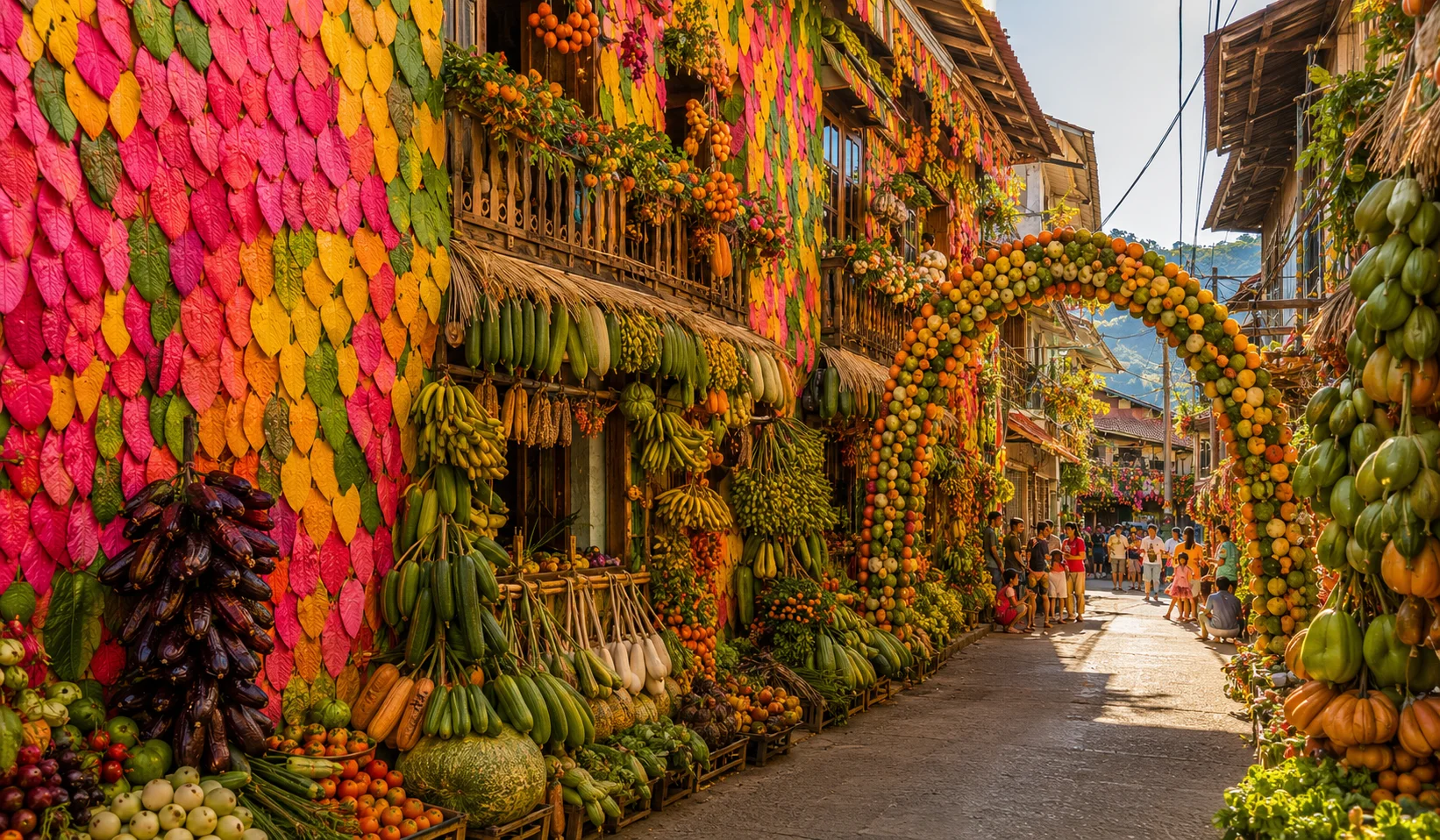
Pahiyas Festival, Lucban, Quezon — every house on every street becomes an art installation of kiping (coloured rice wafers), tropical fruits and vegetables. May 15, fixed every year. One of the most visually extraordinary festivals in Southeast Asia.
🐃 Water buffalo kneeling ritual
The Carabao Festival in Pulilan, Bulacan — held the same day as Pahiyas (May 14–15) in thanksgiving to San Isidro Labrador — features the most unexpected sight in Philippine festivity: hundreds of elaborately decorated carabaos (water buffalo) kneeling in front of San Isidro Parish Church. Farmers bathe, groom, and decorate their carabaos with flowers, ribbons, and paint before leading them to the church, where the animals genuflect in what Filipino farmers interpret as an act of thanksgiving. Easy day trip from Manila — 1.5 hours north of the city.