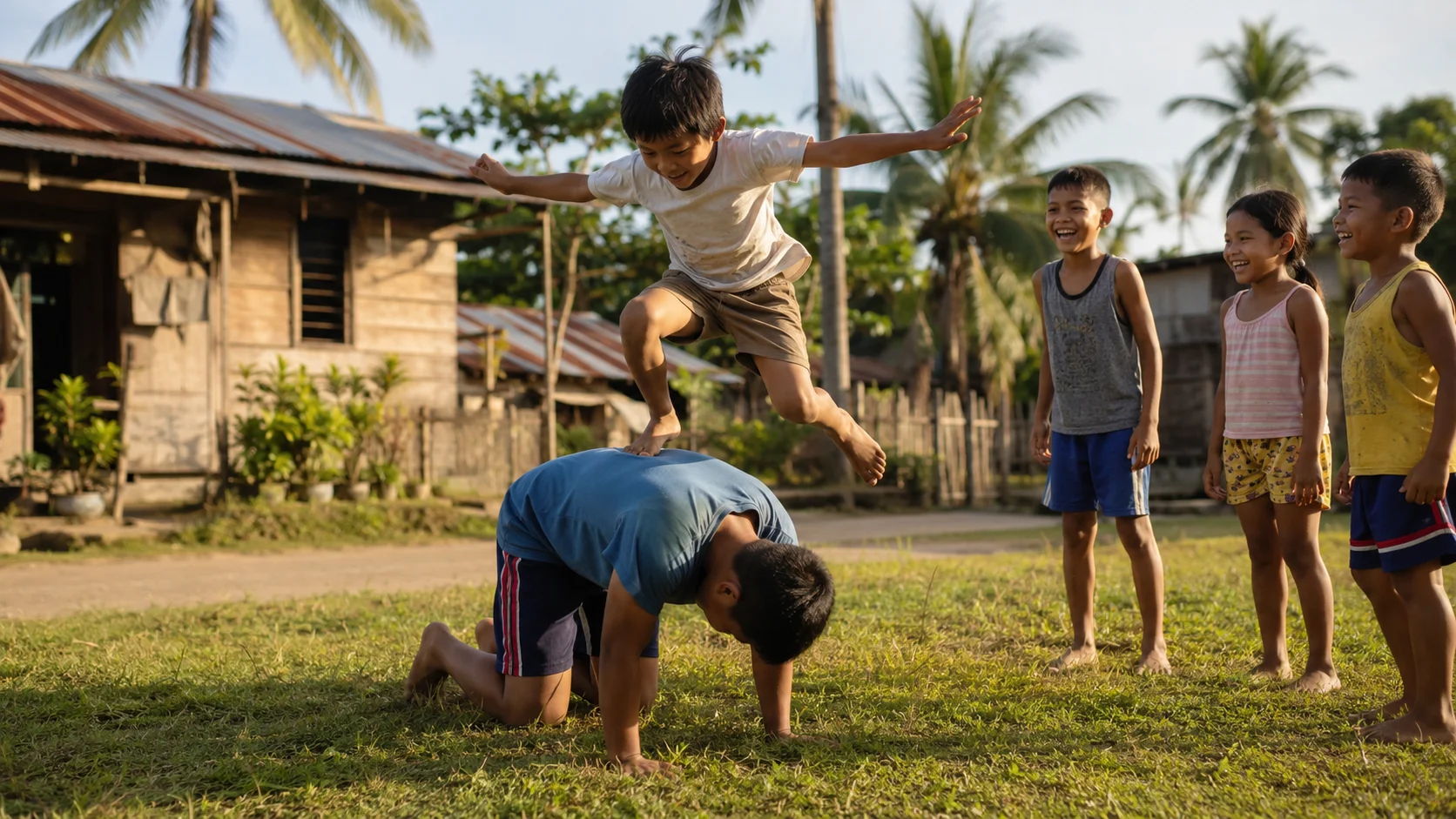
Luksong Baka — one of the most beloved traditional Filipino games. One player crouches as the baka (cow) while others jump over, with the baka rising higher each round.
Quick answer
Luksong Baka (English: Jump Over the Cow) is a traditional Filipino outdoor game where one player crouches as the baka (cow) while others take turns jumping over them. After each successful round, the baka rises higher — making each jump harder. It originated in Bulacan, requires no equipment, needs at least 3 players, and is one of the Philippines’ most beloved larong lahi (heritage games). A player who fails to clear the jump becomes the new baka.
BulacanOrigin province
3–10Players needed
NoneEquipment needed
BakaMeans “cow”
Larong LahiHeritage category
FreeCost to play
I played Luksong Baka as a child in Dumaguete — barefoot in the yard after school, in the gap between the last lesson and dinner being called. No equipment, no referees, no schedule. Just the neighborhood kids, an open patch of grass, and the increasingly difficult challenge of clearing a classmate who kept standing taller.
Every Filipino who grew up before smartphones has this memory. This guide covers everything about Luksong Baka — what it is, exactly how to play it step by step, where it came from, how it compares to other Filipino traditional games, and why it still matters today.
What is Luksong Baka?
Luksong Baka is one of the Philippines’ most iconic larong lahi — traditional heritage games passed down through generations of Filipino children. The name comes from two Tagalog words: luksong (to jump or leap) and baka (cow). Together: Jump Over the Cow.
The game is beautifully simple. One player crouches on the ground — hands on knees, back flat — imitating a cow grazing in a field. The rest of the players line up and take turns leaping over the crouching player. After everyone successfully clears the jump, the baka rises slightly higher. The game continues, round after round, the baka getting taller, the jumps getting harder, until someone fails and becomes the new baka.
“Luksong Baka isn’t just a game — it’s a Filipino childhood. Every Filipino who grew up before smartphones knows the sound of bare feet hitting a grassy yard and the burst of laughter when someone finally wipes out.” — Giovanni Carlo Bagayas
Luksong Baka belongs to the category of Filipino outdoor games that require no equipment, no budget, and no special space — just a group of players and an open patch of ground. This zero-cost accessibility made it universal across every barangay, province, and island in the Philippines. It is officially classified as a larong lahi by the Philippine Sports Commission, meaning it is recognized as part of the country’s intangible cultural heritage — alongside Patintero, Tumbang Preso, Piko, and Sipa.
How to Play Luksong Baka — Step-by-Step Rules
All you need is 3–10 players and a flat open area. No equipment, no setup, no cost. Watch the video below to see how the game is played, then follow the step-by-step rules.
Watch Luksong Baka being played — see the baka position, jumping technique, and how the height increases each round.
1
Choose the baka (cow)
One player is chosen as the baka through a coin toss, rock-paper-scissors (jack-en-poy), or group agreement. This player crouches on all fours — hands placed on their knees, back flat and parallel to the ground, head tucked down — mimicking a cow grazing. This is the starting position: the lowest and easiest height to jump over.
💡 Play on grass or soft ground. Avoid concrete — players who miss their landing will thank you.
2
Players jump over the baka one by one
Players form a line and take turns running up and jumping over the baka’s crouched body. The goal is to clear the jump completely — landing safely on the other side without touching or falling on the baka. Only the hands may briefly touch the baka’s back to assist the jump. Full body contact, sitting on, or knocking over the baka counts as a failed jump.
💡 The baka should keep their head down and stay still. A moving baka makes jumping dangerous and unfair.
3
The baka rises higher after each full round
Once all players have successfully jumped in a round, the baka rises to a higher position. The progression goes: fully crouched (all fours) → higher crouch (hands on shins) → hunched with hands on knees → bent-over with hands above knees → nearly upright with arms extended. Each level makes the jump progressively harder. What was easy in round one becomes a serious athletic challenge by round five.
💡 The baka rises slowly and consistently — not suddenly. Fair play means giving every player a clear, stable target.
4
Fail the jump — become the new baka
Any player who fails to clear the baka — touches it with their legs, falls on top, or knocks it over — immediately becomes the new baka. They take the crouching position and the game resets to the lowest level. The original baka rejoins the jumping group. There is no elimination — just rotation. The game is continuous.
5
Game ends when players decide to stop
Luksong Baka has no fixed end condition or official winner. The game continues until the group decides to stop — from exhaustion, dinner being called, or needing to go home. The unspoken honor is lasting as long as possible without becoming the baka. The player who avoids becoming the baka the longest earns the most bragging rights in the group.
💡 A common house rule declares the winner as the last player who has never become the baka — but this is a variation, not the original game.
Origin and History of Luksong Baka
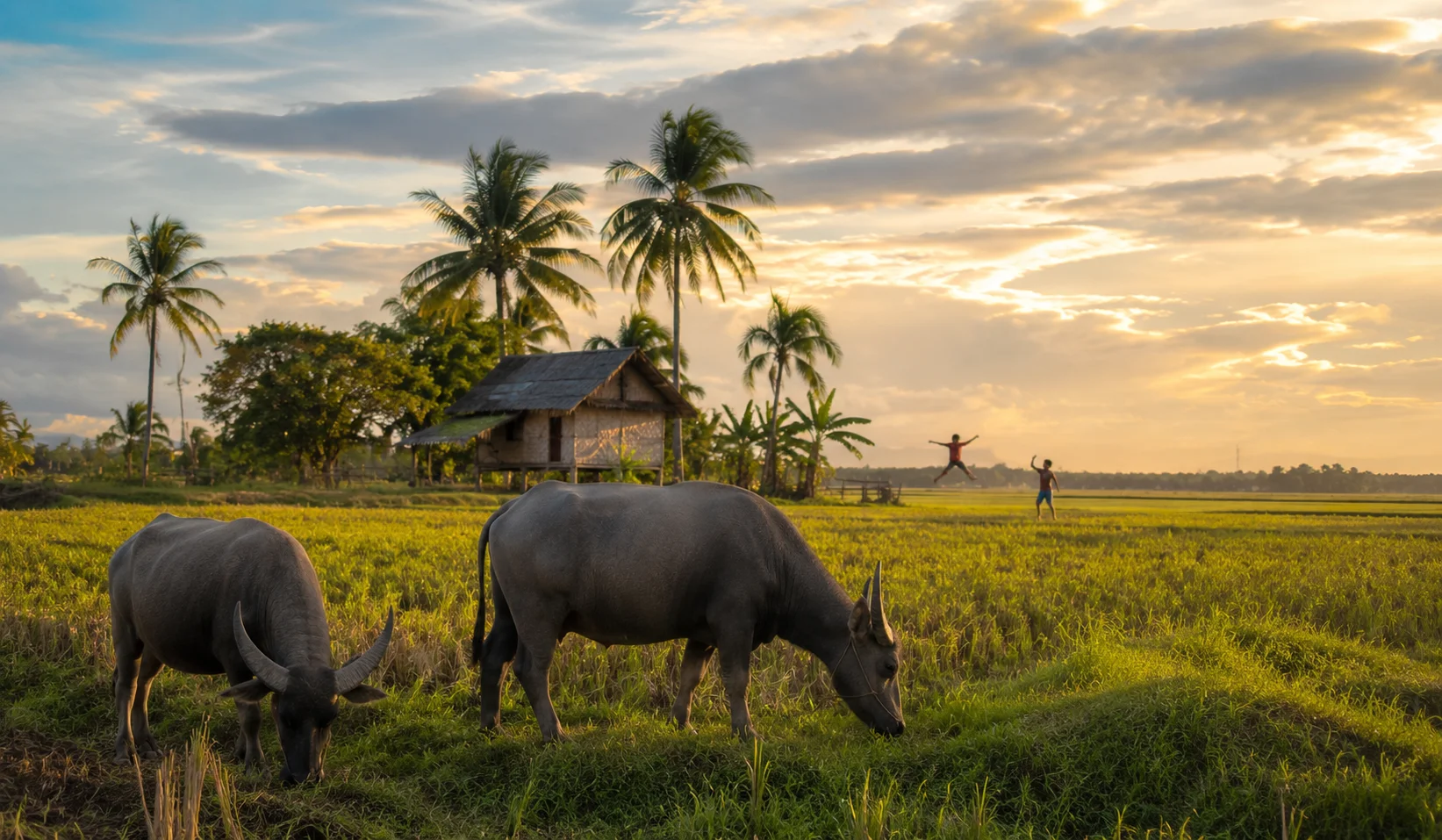
Bulacan’s rural farm landscape — the birthplace of Luksong Baka. Children growing up around cattle and carabaos naturally invented a game based on jumping over grazing animals.
Luksong Baka originated in Bulacan province in Central Luzon — one of the Philippines’ historically rich provinces just north of Manila. Its exact origins are undocumented — like most folk games, it was passed down orally and through play rather than written records — but it is believed to have developed in rural agricultural communities where cattle and carabaos (water buffalo) were central to daily farm life.
Children growing up on farms naturally mimicked the animals around them. The image of leaping over a grazing cow or carabao — a common sight in Philippine rural life — became the basis of a game that required nothing but the imagination to play. The carabao (water buffalo) was the real-life inspiration — the Philippines’ most iconic farm animal, used for plowing rice fields, pulling carts, and as a symbol of Filipino agricultural life.
Over generations, Luksong Baka spread from Bulacan across the entire Philippine archipelago. It is now recognized by the Philippine Sports Commission as an official larong lahi — one of the traditional Filipino games that the government actively promotes to preserve Filipino cultural heritage, alongside Patintero, Tumbang Preso, Piko, and Sipa.
“Before PlayStation and smartphones, Luksong Baka was how Filipino children spent their afternoons. It was free, it was social, and it was ours — a thread connecting every Filipino childhood across every island.” — Giovanni Carlo Bagayas
Gio’s note: I grew up in Dumaguete — far from Bulacan — and Luksong Baka was as common there as it was everywhere else in the Philippines. That’s the power of a truly great folk game. It needed no instruction manual and no advertising. It spread the way all the best things do: from child to child, barangay to barangay, generation to generation.
Benefits of Playing Luksong Baka
Luksong Baka looks like simple fun — but it develops a wide range of physical, social, and cultural skills that modern organized sports often struggle to match.
🏃
Physical fitness
Jumping builds explosive leg strength, agility, and cardiovascular endurance. Running approaches develop speed and timing. The progressively higher baka ensures continual athletic challenge — each round is harder than the last.
🤝
Social skills
Taking turns, encouraging others, accepting the baka role graciously, and following unwritten group rules — all core social lessons delivered through play. No coach, no referee, no adult supervision required.
💪
Resilience
Failing a jump and becoming the baka teaches children to accept setbacks, reset, and keep trying without losing enthusiasm. The game normalizes failure as part of play — one of the most important lessons in child development.
🎯
Spatial awareness
Judging the height of the baka, calculating the right approach speed, and landing safely develop spatial reasoning and body awareness — skills that transfer directly to other sports, gymnastics, and physical activities.
🇵🇭
Cultural identity
Playing Luksong Baka connects Filipino children to generations who played the same game. For Filipino children abroad — in the US, Canada, UAE, or Europe — it is a direct, physical connection to their heritage that no classroom lesson can replicate.
💰
Zero cost
No equipment, no app, no subscription, no court rental. Luksong Baka is completely free and equally accessible to every child in every barangay across the Philippines — from Manila to Mindanao. This is still its greatest strength.
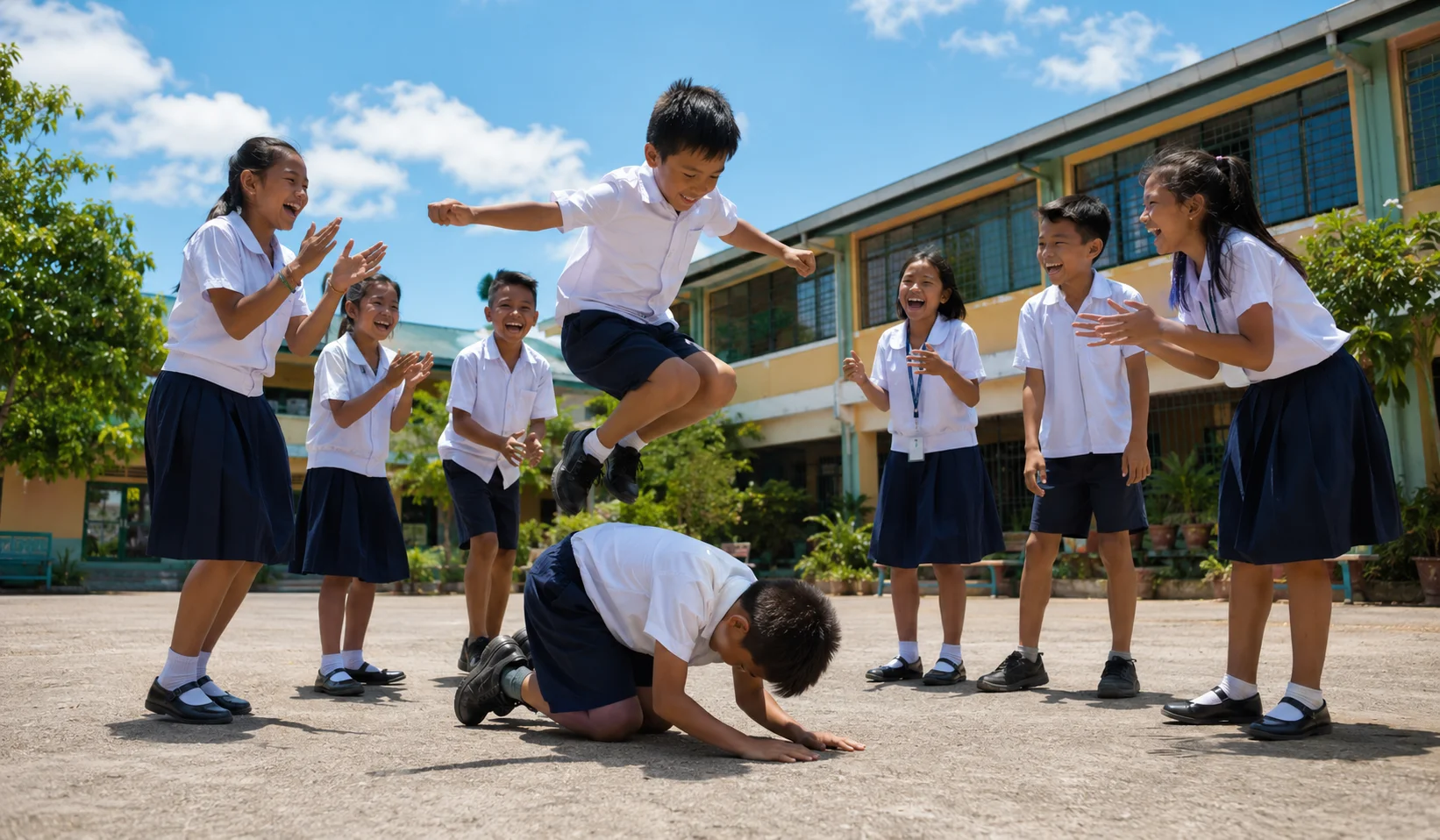
Filipino children playing Luksong Baka during school recess — the game develops physical fitness, social skills, resilience, and cultural identity all at once, with zero cost and no equipment needed.
Luksong Baka vs Luksong Tinik — What’s the Difference?
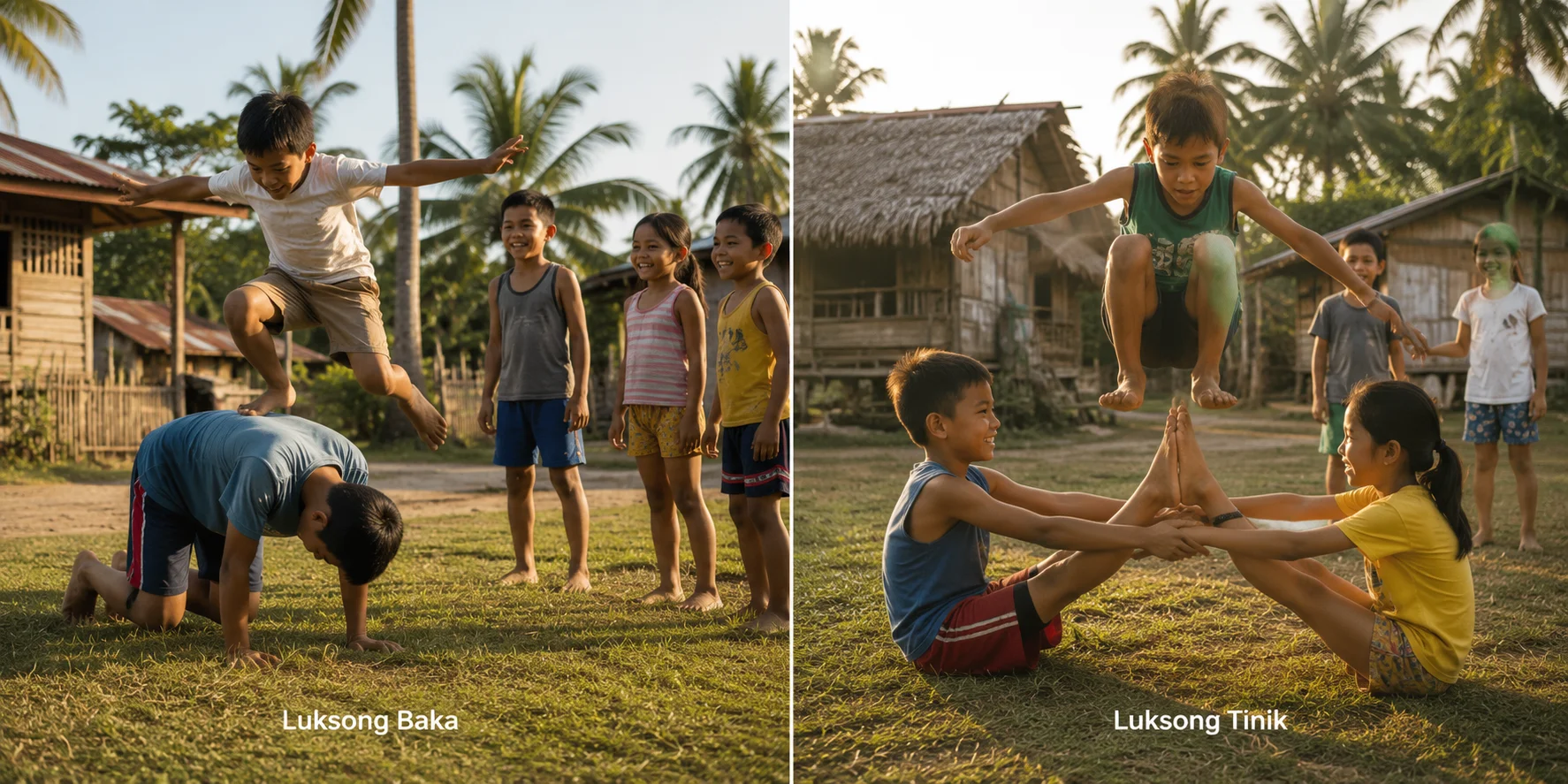
Luksong Baka and Luksong Tinik are the two most famous traditional Filipino jumping games and are frequently confused. Here is how they differ:
Luksong Baka (left) — one crouching baka that rises progressively higher. Luksong Tinik (right) — two players create a thorn obstacle with stacked hands and feet, played in teams.
Feature
Luksong Baka
Luksong Tinik
Meaning
Jump Over the Cow
Jump Over the Thorns
Obstacle
One crouching player (the baka) who rises higher each round
Two sitting players who stack hands and feet like thorns
Format
Individual — each player jumps solo
Team-based — players jump as a group
Special role
None — all players are jumpers or baka
Nanay (mother) — can save a failing teammate with a jump
Difficulty progression
Baka rises higher each round until someone fails
Stack height increases as players add more hands and feet
Origin
Bulacan, Central Luzon
Nueva Ecija, Central Luzon
Players needed
3–10
Teams of 4+ (even numbers)
What it teaches
Individual agility, resilience, turn-taking
Team coordination, communication, collective strategy
Both games are classified as larong lahi by the Philippine Sports Commission and are taught in Philippine physical education classes. Luksong Baka tends to be more popular in younger age groups because it requires fewer players and has a simpler structure. Luksong Tinik is more common in school PE settings because its team format suits organized classroom play.
All Traditional Filipino Games — Complete Comparison
Game
Type
Players
Equipment
Key skill
Origin
Luksong Baka
Jumping
3–10
None
Agility, jumping
Bulacan
Luksong Tinik
Jumping (team)
Teams of 4+
None
High jumping, teamwork
Nueva Ecija
Patintero
Chasing / strategy
Teams of 5+
Chalk lines
Speed, strategy
Philippines
Tumbang Preso
Throwing / aim
3–10
Can + slippers
Accuracy, aim
Philippines
Piko
Hopping / balance
1–5
Chalk, stone
Balance, coordination
Philippines
Sipa
Kicking / skill
1–4
Sipa (washer + feathers)
Foot coordination
Philippines
Agawan Base
Chasing / teamwork
Teams of 4+
None
Speed, teamwork
Philippines
Langit-Lupa
Tag / elevation
5+
None
Speed, climbing
Philippines
Other Larong Lahi to Know
Luksong Baka is part of a rich tradition of Filipino outdoor games collectively called larong lahi — heritage games recognized and promoted by the Philippine Sports Commission. Here are the most popular ones still played today:
🏃
Luksong Tinik
Jumping — team game
Two players sit facing each other and stack their hands and feet to create a thorn (tinik) obstacle. Teams jump over together. A nanay (mother player) can save a failing teammate by jumping in their place — the key team mechanic that distinguishes it from Luksong Baka.
🏁
Patintero
Chasing — strategy game
Teams cross chalk-drawn lines while defenders try to tag them. Often called the Filipino version of tag, but far more strategic — defenders must stay on their lines while attackers try to cross all lines and back. Requires speed, timing, and spatial thinking.
🥫
Tumbang Preso
Throwing — aim game
Players use slippers to knock over a tin can guarded by the preso (prisoner). One of the most strategically deep Filipino traditional games — the preso must defend the can while players retrieve their slippers. Requires aim, timing, and risk assessment.
⬜
Piko
Hopping — balance game
The Filipino version of hopscotch — players toss a stone onto numbered chalk squares and hop through the course on one foot, avoiding the square their stone occupies. Tests single-leg balance, coordination, and throwing accuracy. Particularly popular with girls.
👟
Sipa
Kicking — skill game
Players keep a weighted feathered disc (the sipa, made from a washer with feathers attached) in the air using only their feet. The national sport of the Philippines before basketball. Develops extraordinary foot coordination, balance, and concentration.
🏠
Agawan Base
Chasing — teamwork game
Two teams defend their “base” while trying to capture opponents by tagging them away from their base. Speed, teamwork, and split-second decision-making make this one of the most exciting Filipino outdoor games. Closest to capture-the-flag in Western games.
Frequently Asked Questions about Luksong Baka
What is Luksong Baka?
Luksong Baka (English: Jump Over the Cow) is a traditional Filipino outdoor game where one player crouches as the baka (cow) while others take turns jumping over them. After each successful round, the baka rises to a higher position, making each jump progressively harder. It originated in Bulacan, requires no equipment, needs at least 3 players, and is one of the Philippines’ most beloved larong lahi (heritage games).
What are the rules of Luksong Baka?
Rules: (1) One player is chosen as the baka and crouches on all fours — hands on knees, back flat, head down. (2) All other players take turns running and jumping over the baka. (3) Only hands may briefly touch the baka’s back — full contact or falling counts as failure. (4) After all players clear the jump in a round, the baka rises higher. (5) A player who fails to clear becomes the new baka and the game resets to the lowest height. Minimum 3 players, maximum 10.
What does Luksong Baka mean in English?
Luksong Baka means “Jump Over the Cow” in English. The name comes from two Tagalog words: luksong (to jump or leap) and baka (cow). It is sometimes described as the Filipino version of leapfrog, though unlike Western leapfrog, Luksong Baka features progressively increasing height each round — which is the game’s defining challenge.
Where did Luksong Baka originate?
Luksong Baka originated in Bulacan province in Central Luzon, Philippines. It developed in rural agricultural communities where cattle and carabaos (water buffalo) were central to daily farm life. Children mimicked jumping over grazing animals and turned it into a game. It is now recognized by the Philippine Sports Commission as an official larong lahi — a traditional Filipino heritage game.
How many players do you need for Luksong Baka?
Luksong Baka requires a minimum of 3 players and a maximum of 10 players. With fewer than 3 there is no jumping group once one person is the baka. With more than 10, waiting time reduces enjoyment. The ideal group is 5 to 8 players.
What is the difference between Luksong Baka and Luksong Tinik?
Luksong Baka has one crouching player (baka) who rises progressively higher — players jump individually. Luksong Tinik has two players who create a thorn obstacle by stacking hands and feet — played in teams, with a nanay (mother player) who can save failing teammates. Luksong Baka is more individual; Luksong Tinik is more team-oriented.
What are the benefits of playing Luksong Baka?
Benefits include: explosive leg strength and jumping ability, agility, cardiovascular endurance, social skills (turn-taking, fair play, group cooperation), resilience (accepting failure and resetting), spatial awareness, cultural identity and connection to Filipino heritage, and zero cost — requiring no equipment, no facility, and no budget.
Is Luksong Baka still played today?
Yes — Luksong Baka is still played in the Philippines today, particularly in provincial and rural areas, in school physical education classes, and at community events celebrating Filipino heritage. The Philippine Sports Commission actively promotes it as part of its larong lahi preservation program. Filipino communities abroad also play it during cultural festivals and Filipino Heritage Month events.
What equipment do you need for Luksong Baka?
No equipment at all. All you need is a minimum of 3 players and an open flat area — a grassy yard, a barangay court, or any clear outdoor space. No balls, no markers, no court lines, no special clothing. This zero-cost accessibility is one of the main reasons Luksong Baka became universal across all regions and economic groups in the Philippines.
Filipino · Born in Cebu City · Raised in Dumaguete · Based in Zamboanga del Sur, Mindanao
I played Luksong Baka barefoot in Dumaguete as a child — the same game, the same rules, the same laughter every time someone failed and became the baka. Filipino traditional games are not just recreational history. They are lived culture, passed from child to child without instruction manuals or apps. I write about Filipino culture and heritage at Best Philippines Travel Guide from the perspective of someone who grew up living it across three Philippine regions.