
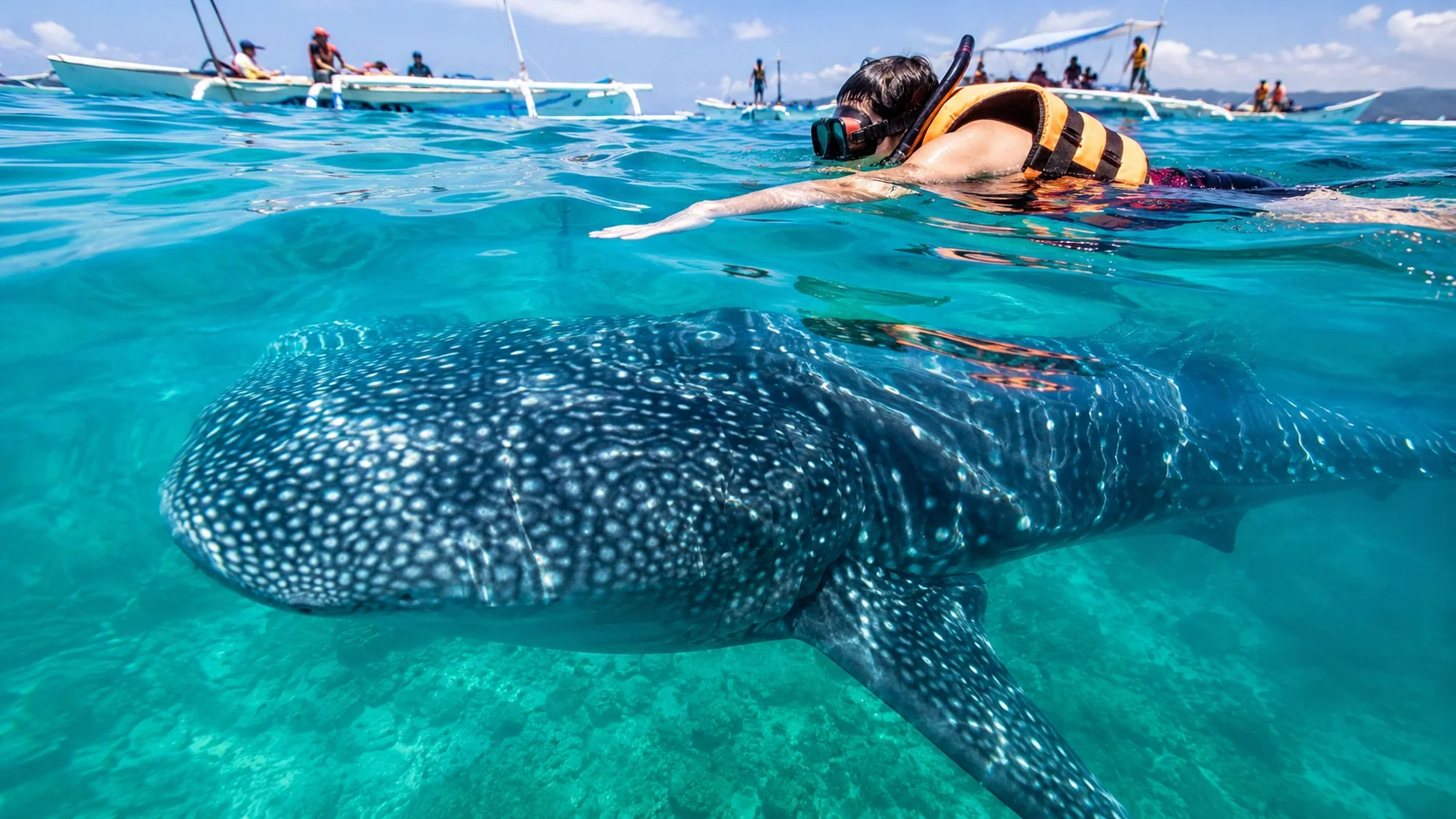
Whale shark watching in Oslob, Cebu — swimming alongside the world’s largest fish at Barangay Tan-awan. The whale sharks here grow 4–12 metres and approach within arm’s reach. ₱1,000 for snorkeling, open 6AM–12PM daily.
Whale shark watching in Oslob costs ₱500 to watch from the boat, ₱1,000 to snorkel, ₱1,500 to scuba dive. The site is at Barangay Tan-awan, Oslob — 3 to 4 hours south of Cebu City. Open 6 AM–12 PM daily (closed Good Friday only). Arrive by 5:30 AM to avoid long queues. Each session is 30 minutes in the water with 3–10 whale sharks present. Combine with Tumalog Falls (20 min away) and Sumilon Island for the perfect South Cebu day.
I was born in Cebu City. Whale sharks — called butanding or tuki in Cebuano — are not something I read about in a travel magazine. They are part of the coastline I grew up knowing. The Oslob program started in 2011 and transformed a fishing village into the Philippines’ most-visited wildlife attraction. This guide tells you everything: what it costs, how to get there, what actually happens in the water, the ethical debate you should think about, and every nearby activity worth doing the same day.
What Is Whale Shark Watching in Oslob?
Whale shark watching in Oslob is a daily marine wildlife encounter at Barangay Tan-awan, a small coastal community in Oslob municipality, southern Cebu. Local fishermen — called bangkeros — feed whale sharks (Rhincodon typus) small shrimp from outrigger boats each morning, keeping the animals near the shore. Tourists are taken out on separate non-motorized paddle boats to snorkel, dive, or watch the whale sharks from the surface during regulated 30-minute sessions.
The whale shark is the world’s largest fish — a filter feeder that can reach 12 metres in length and weigh up to 20 tonnes. Despite their size they are completely harmless to humans. Their mouths are wide but designed to filter microscopic plankton and shrimp — they cannot bite. What makes the Oslob encounter so extraordinary is the proximity: whale sharks approach within centimetres of snorkelers as they follow the feed boat, giving you an up-close view of an animal the size of a city bus moving in slow, deliberate arcs beneath you.
The programme is regulated by the LGU of Oslob under Municipal Ordinance No. 010, series of 2020. All interaction rules, fees, and operating hours are governed by this ordinance. The activity operates rain or shine — it only suspends during typhoons or dangerously rough seas.
Oslob Whale Shark Watching Entrance Fees 2026
| Activity | Fee (2026) | What’s included |
|---|---|---|
| Watching from the boat only | ₱500/person | Bangka boat ride to interaction area, 30-minute session watching from the boat |
| Snorkeling ⭐ most popular | ₱1,000/person | Bangka boat, 30 min in the water, life jacket, local spotter. Snorkel gear extra (₱100–200) unless you bring your own. |
| Scuba diving | ₱1,500/person | Descend 5–15m beneath the whale sharks. Dive equipment not included — bring your own or arrange rental. |
| Children 3 years and below | Free | Must stay on the boat with a parent |
| Snorkel gear rental | ₱100–200 | Mask and snorkel only — bring your own for hygiene |
| Underwater camera rental | ₱500 | Includes unlimited photos taken by your boatman, sent via WhatsApp or USB after |
| GoPro rental | ₱300–500 | Ask operators before booking — availability varies |
*Affiliate link — we earn a small commission at no extra cost to you. Includes transport from Cebu City, all entrance fees, snorkel gear, and guide.
Registration Process — Step by Step
Most travel guides skip this entirely. Here is exactly what happens from the moment you arrive at Tan-awan, because understanding the process eliminates the stress of not knowing what to expect:
Step 1 — Arrive and join the queue. The Oslob Whale Shark Watching Briefing Center is on the left side of the main highway as you enter Barangay Tan-awan. There is signage. Join the queue at the registration booth. Lines start forming before 6 AM. On peak weekends (December–May, Holy Week, Chinese New Year), arrive by 5 AM or earlier.
Step 2 — Fill in the registration form. You will be asked for your name, nationality, and contact number. This is logged for safety records. The registration is quick — 2 minutes per person.
Step 3 — Choose your activity and pay. Tell the registration staff whether you want to watch from the boat (₱500), snorkel (₱1,000), or scuba dive (₱1,500). Pay cash at the booth. You will receive a numbered ticket and an assigned session time.
Step 4 — Wait for your session time and watch the briefing video. Your ticket has a session time. If there is a wait, you can leave the area, have breakfast at a nearby restaurant, and return. The mandatory orientation video (10–15 minutes) covers all interaction rules. No one enters the water without completing it.
Step 5 — Board your bangka. When your session number is called, proceed to the beach. Life jackets are fitted here — mandatory for everyone regardless of swimming ability. Non-motorized outrigger boats (bangka) are paddled 50–150 metres offshore to the whale shark feeding area.
What to Expect in the Water
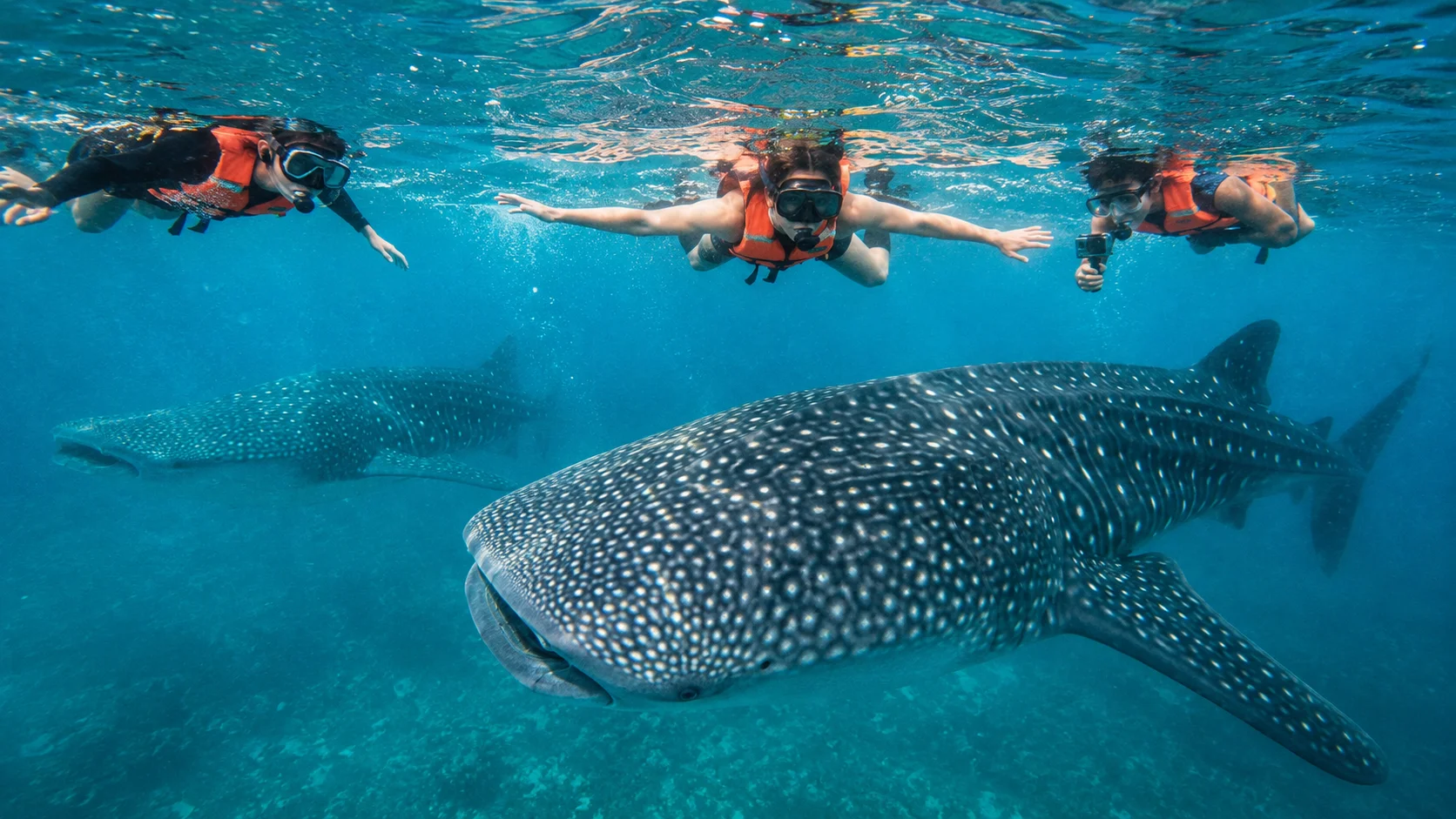
The reality of whale shark snorkeling in Oslob — the animals approach from below and beside you as they follow the feed boat. The water is 2–5 metres deep in the interaction area.
The interaction area at Tan-awan is shallow — 2 to 5 metres deep — and approximately 50 to 150 metres offshore. The water is warm and clear. On a good morning you can see 3 to 10 whale sharks simultaneously, moving in slow arcs just beneath the surface as they feed.
When you enter the water, the whale sharks are already there. They come from below — a massive dark shape materializing out of the blue that your brain will struggle to comprehend as a living animal the first time you see it. They move with slow, deliberate tail sweeps, covering ground effortlessly. The scale becomes real only when one passes at arm’s length and you realise its body is wider than you are tall.
Your local spotter stays with your group throughout, managing distances and ensuring no one touches the animals. The feed boat (the bangkero throwing shrimp) keeps the whale sharks circling in the interaction area. You follow the animals — not the reverse.
Snorkeling vs scuba diving vs boat watching — which to choose
Snorkeling (₱1,000) — the right choice for 90% of visitors. The interaction area is only 2–5 metres deep meaning whale sharks pass at surface level. You do not need to dive down to see them. Life jackets keep non-swimmers buoyant. Recommended.
Scuba diving (₱1,500) — descend to 5–15 metres beneath the feeding sharks and see them from below as they pass overhead. A completely different and more dramatic perspective. Requires a dive certification. Worth it if you dive. Bring your own equipment or pre-arrange rental.
Boat watching (₱500) — stay in the bangka and observe the whale sharks from above. You will see their dorsal fins and bodies near the surface. You cannot lean over the side into the water. Best for: elderly visitors, young children, or anyone uncomfortable in open water. Still a worthwhile experience.
Rules You Must Follow
These rules are enforced. Violations result in immediate removal from the water with no refund. They exist to protect the whale sharks, not as suggestions:
4-metre minimum distance. Stay at least 4 metres away from the whale sharks at all times. They will come closer — you step back.
No flash photography. Flash photography is banned. The flash disorients whale sharks and affects their feeding behaviour. Use natural light or underwater video mode only.
No sunscreen in the water. Chemical sunscreen is toxic to whale sharks and the marine ecosystem. Apply reef-safe sunscreen before arriving — not at the site. Do not apply anything to your skin after you register.
No unauthorized feeding. Only the licensed bangkeros may feed the whale sharks. Throwing food from the tourist boat is prohibited.
Do not ride or grab. Do not attempt to grab a fin or ride a whale shark. This has happened and the perpetrators were removed immediately and photographed for authorities.
Do not create a splash when entering the water. Slip in feet-first, quietly. A large splash startles the animals.
Mandatory safety briefing — watch the full orientation video before entering the water.
Registration — all visitors must register with name and nationality before entering.
How to Get to Oslob Whale Shark Watching
| From | Method | Duration | Cost | Notes |
|---|---|---|---|---|
| Cebu City | Ceres bus — South Bus Terminal | 3–4 hrs | ₱180–₱220 | Take “Bato via Santander” or “Oslob” bus. Depart 1–3 AM to arrive by 5–6 AM. Ask conductor to drop at Tan-awan. |
| Cebu City | Private van or car hire | 3–3.5 hrs | ₱3,000–₱4,500 | Most comfortable option. Driver waits while you do the activity. Best for groups 3+. |
| Cebu City | Klook tour package | 3–3.5 hrs | Incl. in USD 59.29 | Hotel pickup 4–5 AM, all inclusive. Easiest option — no logistics stress. |
| Moalboal | Habal-habal or tricycle to highway then Ceres bus south | 1.5–2 hrs | ₱100–₱200 | Most backpackers staying in Moalboal take the early morning bus south. |
| Moalboal | Private hire (Grab or local driver) | 1.5 hrs | ₱1,500–₱2,500 | Driver waits at Oslob, can continue to Kawasan Falls after. |
| Dumaguete (Negros) | Ferry to Liloan Port then habal-habal | 1–1.5 hrs total | ₱150–₱250 | Fastcraft Dumaguete–Liloan takes 30 min. Oslob is 20 min from Liloan port. |
| Bohol | Ferry to Oslob or Santander then bus/habal-habal | 2.5–3 hrs total | ₱300–₱500 | Tagbilaran–Santander or Oslob ferry available. |
*Affiliate link — private van with driver. Best value for groups doing the full south Cebu loop.
*Affiliate link — join-in group tour from Cebu City including transport, entrance fees, and guide.
How to Book Oslob Whale Shark Watching
Option 1 — Book on Klook (recommended for most visitors)
Klook’s Oslob Whale Shark Watching Experience costs USD 59.29 (~₱3,350) and includes hotel pickup from Cebu City, return transport, all entrance fees, snorkel gear, life jacket, and a local guide. Your session time is pre-arranged, meaning you bypass the registration queue. This is the right choice if you are based in Cebu City or Mactan and want a completely organised experience with no logistics to manage.
- Tick off a bucket list experience — swim and snorkel with whale sharks in the Philippines
- Enjoy a scenic 3-hour drive along the Southern Cebu coastline with an experienced local driver
- Participate in shark feeding and meet the gentle giants up close, plus explore surrounding coral reefs
- After your whale shark experience, you may opt to climb up to Tumalog Falls for a truly amazing experience!
 Scan QR code to book directly on Klook
*Affiliate link — we earn a small commission at no extra cost to you.
Option 2 — Oslob + Tumalog Falls + Ka Treasure Water Terraces
If you want whale sharks, Tumalog Falls, and Simala Shrine all in one day without managing your own transport, this Klook package covers all three with the same pickup-and-drop convenience:
- Capture incredible photos swimming alongside majestic whale sharks — the biggest fish on the planet
- Explore the underwater paradise of Oslob and discover vibrant marine life teeming with colorful fish
- Savor a delicious Filipino silog breakfast with coffee — the perfect start before exploring Oslob’s natural beauty
- Unwind at Ka Treasure Water Terraces — a breathtaking natural paradise with cascading waterfalls and stunning rock formations
 Scan QR code to book directly on Klook
*Affiliate link — we earn a small commission at no extra cost to you.
Option 3 — Oslob + Kawasan Falls Canyoneering Combo
The classic South Cebu full day — whale sharks at dawn, Kawasan Falls canyoneering in the afternoon:
*Affiliate link — whale sharks + Badian canyoneering in one full day including all transport.
Option 4 — Walk in directly at Tan-awan
Walk up to the registration booth at Tan-awan, pay ₱1,000 for snorkeling, and join the queue. No advance booking required for walk-ins (except during peak periods when slots may fill). Best for: independent travelers already in Oslob or Moalboal who want to keep costs at the regulated minimum without tour packages.
What to Bring to Oslob
- Your own snorkel and mask — rentals are provided but shared equipment has hygiene concerns. A basic snorkel mask (₱200–₱500) is a worthy investment.
- Reef-safe sunscreen — apply before leaving your accommodation. Do NOT apply at the site or after registration. Regular sunscreen is prohibited in the water.
- Swimwear — wear it under your clothes so you are ready to enter the water quickly
- Change of dry clothes — you will be wet after
- Waterproof bag — for phone and cash while in the water
- Cash ₱1,000–₱1,500 — exact change preferred at the booth
- GoPro or underwater camera — highly recommended. You will regret not having footage. Your boatman can also take photos/video with their rental camera for ₱500.
- Light breakfast — there are restaurants at Tan-awan and nearby but bring a snack if you depart Cebu City at 3–4 AM
- Regular sunscreen — toxic to whale sharks. Leave it at the hotel.
- Flash photography — turn off all flash on cameras and phones before entering the water
- Jewelry — falls off in the water
- Non-waterproofed phone — do not risk it. Use a dry bag or leave it onshore.
- Fins — fins are not permitted at Oslob. They increase the risk of accidentally kicking whale sharks.
- Food for the whale sharks — feeding by tourists is strictly prohibited
- Drone — drones above the interaction area are not permitted without LGU permission
Combine with Tumalog Falls and Sumilon Island
The whale shark activity ends by 9–10 AM. You have the entire rest of the day in South Cebu. Here are the three best additions:
Tumalog Falls — 20 minutes from Tan-awan
Tumalog Falls is a stunning multi-tiered curtain waterfall in Barangay Tumalog, Oslob — one of the most beautiful waterfalls in Cebu and one of the most undervisited. Just 10 minutes from the whale shark site, Tumalog Falls is a stunning waterfall that makes the perfect complement to your morning whale shark swim. Take a habal-habal from the whale shark site (₱100–₱150 return, 20–25 minutes). Entrance fee is ₱30–₱50. Most visitors spend 30–45 minutes here. Wear your swimwear — the pool at the base of the falls is cold, clear, and perfect after the ocean.

Tumalog Falls — 20 minutes by habal-habal from the Oslob whale shark site. One of the most beautiful waterfalls in Cebu and almost always overlooked by tourists who only came for the whale sharks. Entrance ₱30–₱50.
Sumilon Island — the shifting sandbar
Sumilon Island is a private island managed by Bluewater Sumilon Resort, 20 minutes by outrigger boat from the Oslob coast. It is famous for its shifting sandbar — a long white sand strip that changes shape and location with the tides — and its well-preserved marine sanctuary with excellent snorkeling, sea turtles, and clear visibility. Day use access including snorkeling and kayaking costs ₱800–₱1,200 per person.
Most travel guides mention Sumilon Island but none explain that the island is best visited between 10 AM and 2 PM when the sandbar is most exposed and the light is ideal for photos. From Oslob town, bangka boats to Sumilon can be arranged at the pier (~₱200–₱300 per person one way).
*Affiliate link — day use with snorkeling and sandbar access.
*Affiliate link — whale shark watching combined with Aguinid Falls canyoneering. Great alternative to Kawasan for visitors staying in Oslob.
The ultimate South Cebu day — whale sharks + Tumalog Falls + Kawasan Falls
6:00–7:00 AM — Arrive Tan-awan, Oslob — register and briefing
7:00–9:00 AM — Whale shark snorkeling (30 min in water + wait time)
9:00–10:30 AM — Habal-habal to Tumalog Falls — swim in the pool
10:30–11:00 AM — Drive 45 minutes to Badian Canyoneering Headquarters
11:00 AM–4:00 PM — Kawasan Falls Canyoneering (3–5 hrs, includes lunch at falls)
5:00–8:00 PM — Return to Cebu City or overnight in Moalboal
*Affiliate link — the best afternoon add-on after Oslob whale sharks. USD 60.55 includes guide, gear, and lunch.
*Affiliate link — fully packaged 2-day tour: Day 1 Oslob + Tumalog + Sumilon, Day 2 Moalboal sardine run + Kawasan Falls. USD 129.49.
The Ethical Debate — Is Oslob Worth It?
No honest guide about Oslob can skip this. You deserve to make an informed decision before you go.
- Daily feeding changes the whale sharks’ natural migration patterns — animals that should move on stay resident at Tan-awan year-round
- Resident juveniles may not develop normal foraging behaviour, potentially affecting reproduction and long-term health
- Whale sharks learn to associate boats with food — dangerous if they encounter poachers or fishing boats
- The “no touch” rule is not always strictly enforced when crowds are large
- 100% of the whale sharks present are juveniles — the feeding may be disrupting their transition to adulthood
- Marine biologists and conservation groups including WWF have raised concerns about the program
- The programme employs fishing families who previously harmed whale sharks — incentivising protection over hunting
- The whale shark population at Tan-awan has been stable since 2011 — no documented population decline
- LGU regulation provides official protection, rules enforcement, and conservation revenue
- Tourism income funds patrol boats that deter illegal fishing and poaching in the area
- Local community now has economic reason to protect marine resources rather than exploit them
- The 4-metre rule, no-flash rule, and no-sunscreen rule are more strictly enforced than many dive sites in the region
Gio’s honest take: I have seen both sides of this debate up close. The Oslob programme is imperfect — the feeding does change whale shark behaviour and that is a legitimate conservation concern. But the alternative, before 2011, was that these same whale sharks were regarded as pests by local fishermen who chased them away from nets. The programme transformed a predatory relationship into a protective one. Whether that trade-off is acceptable is a decision you make for yourself. If it is not, Donsol in Sorsogon (Luzon) offers wild, non-feeding whale shark encounters seasonally from February to June — a genuinely responsible alternative that I also recommend.
Frequently Asked Questions

I was born in Cebu City. Whale sharks — butanding — are part of the southern Cebu coastline I grew up knowing. I write about the Philippines for international travelers at Best Philippines Travel Guide, combining firsthand local knowledge with honest, practical booking information.