
This is general travel information, not legal or immigration advice. The Bureau of Immigration (BI) says fees may change without notice; always confirm on the BI website or BI e-Services before you pay.
If you entered the Philippines visa-free for 30 days, you can extend your stay with the Bureau of Immigration, online through BI e-Services or at a BI office, before your stay expires. The first step is a 29-day “visa waiver” for ₱3,030, which takes you to 59 days. After that, you extend in blocks of 1, 2 or 6 months (about ₱4,400 for 1 month or ₱4,900 for 2 months), and you’ll need an ACR I-Card (US$50 + ₱500) once you pass 59 days. Most visa-free nationalities can stay up to 36 months in total. The 14-day visa-free entries for India and China can’t be extended.
Haven’t arrived yet? Check entry rules first, then come back here once you’re in the Philippines.
Who can extend, and who can’t?
| How you entered | Can you extend? |
|---|---|
| 30 days visa-free (US, UK, EU, Canada, Australia and about 157 nationalities) | Yes: 29-day visa waiver first, then longer extensions up to about 36 months total |
| 59 days visa-free (Brazil, Israel) | Yes, with the Bureau of Immigration |
| 14 days visa-free (India, China) | No; leave before your 14 days end, or enter on a proper visa next time |
| Tourist visa (9a) issued before travel | Generally yes; follow the BI process for 9(a) extensions |
Not sure which applies to you? See our Philippines visa requirements guide, which covers entry rules before you arrive. This page covers what to do after you arrive.
How do I extend my tourist visa? Step by step
- Check your deadline Find your “admitted until” date on your arrival stamp, and apply well before it. Applying late means overstay fines.
- Choose online or in person Go to BI e-Services (e-services.immigration.gov.ph) or visit a Bureau of Immigration office. Options include the main office in Intramuros, Manila, BI field offices in cities like Cebu, Davao and Clark, and smaller satellite offices, some of them in malls. Check the BI website for the office nearest you and its hours.
- Select the right transaction For your first 29-day extension after a 30-day visa-free entry, choose “Visa Waiver,” not “Tourist Visa Extension”; the latter asks for an ACR I-Card number you won’t have yet.
- Prepare your documents Your passport (valid at least 6 months), the page with your arrival stamp, and your contact details and local address. Some offices may ask for proof of onward travel.
- Pay the fee ₱3,030 for the first 29-day waiver. Online payments typically accept cards and e-wallets like GCash and Maya.
- Get your extension recorded Keep your receipt and approval. You may still need to present your passport for the extension stamp.
- Past 59 days: get the ACR I-Card The first time your stay goes beyond 59 days, expect one in-person visit for photos and fingerprints for your ACR I-Card. Later extensions can often be done online.
How much is a visa extension in the Philippines?
| Stage | Adds | Stay reaches | Fee (2026) |
|---|---|---|---|
| First extension (visa waiver) | 29 days | 59 days | ₱3,030 |
| First extension beyond 59 days | 1 month | About 3 months | ₱4,400 + ACR I-Card |
| First extension beyond 59 days | 2 months | About 4 months | ₱4,900 + ACR I-Card |
| ACR I-Card (once, when you pass 59 days) | — | — | US$50 + ₱500 |
| Later extensions | 1, 2 or 6 months (6-month extensions only at select BI offices) | Up to about 36 months total | Varies by length; check BI’s current schedule |
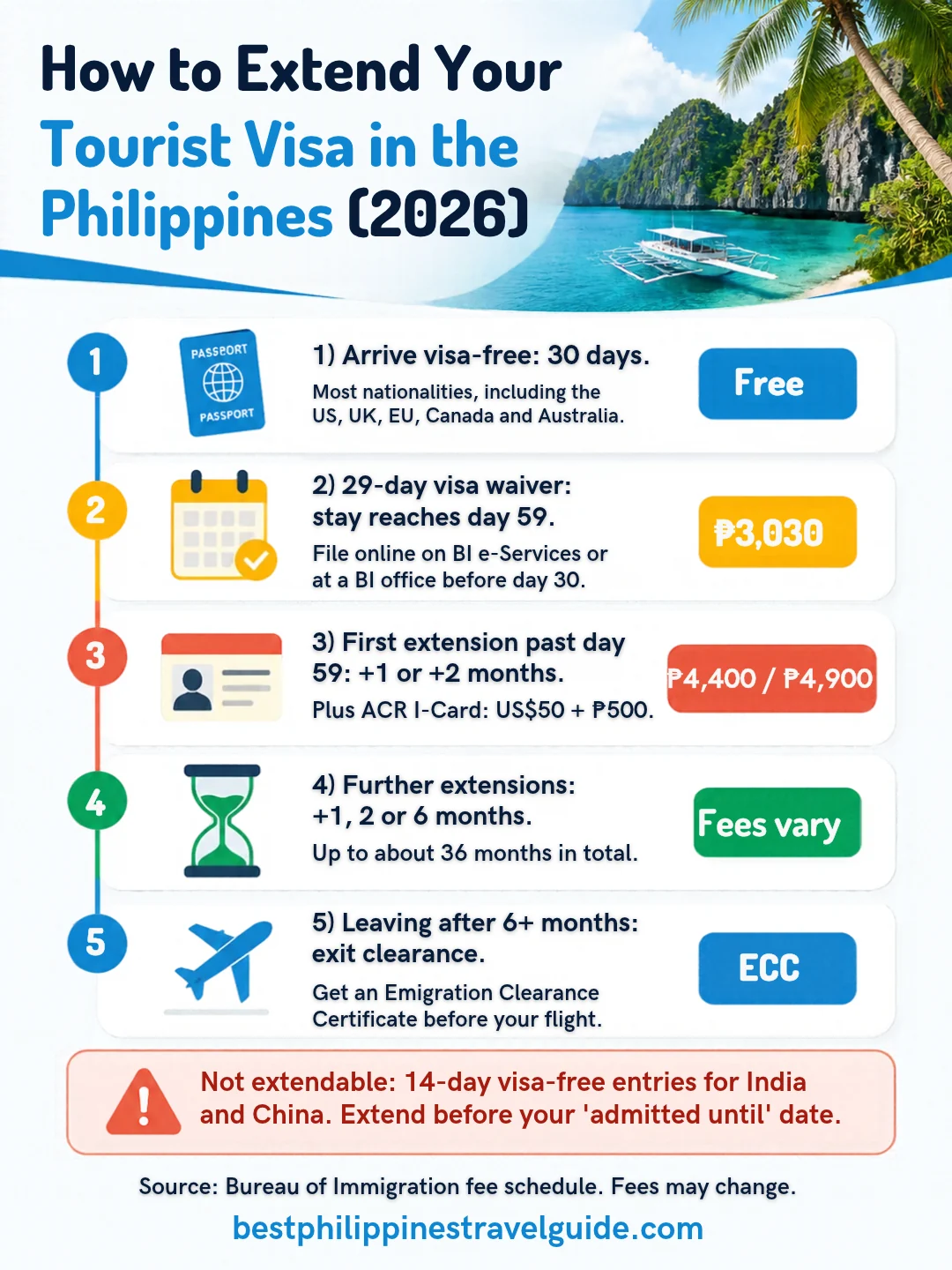
Totals from the Bureau of Immigration’s published fee schedule, which includes the express-lane fee. BI states that fees may change without notice; a few 2026 sources report slightly different amounts, so confirm the current figure on BI e-Services before paying.
Online vs at a BI office: which should you choose?
| BI e-Services (online) | BI office or satellite office | |
|---|---|---|
| Best for | The first 29-day visa waiver and routine extensions | Your first extension past 59 days (ACR I-Card biometrics), 6-month extensions and complicated cases |
| Payment | Card or e-wallets such as GCash and Maya | Cash or card at the cashier |
| Time | Apply from your hotel; approval can take a few days | Often same day, depending on the queue |
| Tip | Apply at least a week before your stay ends | Go early on a weekday; bring your passport and a photocopy of the arrival-stamp page |
Office services differ: not every satellite office handles 6-month extensions or ACR I-Card biometrics. Check with the office before you go.
Staying longer than a few months
- Maximum total stay: about 36 months for most visa-free nationalities, through repeated extensions, after which you’ll need to leave or change visa type.
- Leaving after 6 months or more: foreigners who have stayed 6 months or longer generally need an Emigration Clearance Certificate (ECC) from the BI before departure; apply ahead of your flight.
- Working remotely or living here? A tourist stay isn’t a work visa. See our digital nomad guide for long-stay and remote-work options, and our cost of living guide.
What happens if you overstay?
Overstaying, even by a day, means paying overstay fines plus the extension fees you missed, settled at a BI office (sometimes at the airport, which can cause delays). Long overstays can lead to being placed on the BI’s watchlist or blacklist, which can affect future entry. The simple rule: extend before your “admitted until” date.
Tips for a smooth extension
- Set a reminder about a week before your stay ends.
- Use the official portal only: e-services.immigration.gov.ph. Avoid fixers and lookalike sites.
- Keep copies of your passport, arrival stamp, receipts and approvals, on your phone and in the cloud.
- Visit early on weekdays if you go in person; offices are busiest around holidays. See our Philippine holidays 2027 list for office closures.
- Keep your travel insurance active for the extra time. See our travel insurance guide.
Add extension fees, the ACR I-Card, rent and daily costs in our free trip budget calculator.
Philippines visa extension: FAQ
How do I extend my tourist visa in the Philippines?
Apply with the Bureau of Immigration before your stay expires, online through BI e-Services or at a BI office. For your first extension after a 30-day visa-free entry, choose the 29-day “Visa Waiver,” which takes your stay to 59 days.
How much is a visa extension in the Philippines?
The first 29-day visa waiver costs ₱3,030. Past 59 days, extensions cost about ₱4,400 for 1 month or ₱4,900 for 2 months, plus a one-time ACR I-Card at US$50 plus ₱500. Confirm current fees with the BI.
Can I extend my Philippine visa online?
Yes. BI e-Services handles the 29-day visa waiver and many routine extensions, with payment by card or e-wallets. The first time you pass 59 days, expect one in-person visit for ACR I-Card biometrics.
Where can I extend my visa in the Philippines?
Online through BI e-Services, or in person at the Bureau of Immigration main office in Intramuros, Manila, or at a BI field or satellite office. Some offices are in malls, but not every office offers every service.
Can I get a 6-month visa extension in the Philippines?
Yes, after your first 59 days, but 6-month extensions are only available at select BI offices. Shorter 1- and 2-month extensions are available more widely.
What is the ACR I-Card?
The Alien Certificate of Registration Identity Card is a registration ID required for foreigners whose stay exceeds 59 days. For tourists it costs US$50 plus ₱500 and is issued with the first extension past day 59.
How long can I stay in the Philippines as a tourist?
Most visa-free nationalities can extend up to a total of about 36 months, starting with 30 days on arrival, a 29-day waiver to day 59, then 1, 2 or 6-month extensions.
Can Indian or Chinese tourists extend their 14-day visa-free stay?
No. The 14-day visa-free entries for Indian and Chinese citizens can’t be extended. For longer trips, apply for a proper visa before traveling.
What happens if I overstay in the Philippines?
You’ll pay overstay fines plus the missed extension fees at a BI office, and long overstays can lead to being placed on the BI watchlist or blacklist. Always extend before your admitted-until date.
Do I need an exit clearance to leave after a long stay?
Generally yes: foreigners who have stayed 6 months or longer usually need an Emigration Clearance Certificate (ECC) from the Bureau of Immigration before departing.

Born in Cebu City and raised in Dumaguete, Gio now lives in Zamboanga del Sur. He writes Best Philippines Travel Guide to help visitors handle Philippine travel rules with confidence, checked against official sources.