Best <a href="https://bestphilippinestravelguide.com/famous-lechon-in-cebu/">Lechon</a> Manok Franchise in the Philippines (2026 Guide)
Best Lechon Manok Franchise in the Philippines (2026 Guide)
By Giovanni Carlo Bagayas — Filipino entrepreneur and travel writer | Updated: June 2026
The Philippines’ top lechon manok franchise brands — Andok’s, Baliwag, and Chooks-to-Go dominate the market with hundreds of combined branches nationwide.
Quick answer
The best lechon manok franchise in the Philippines for 2026 is Andok’s for overall brand strength and support (franchise fee: ₱300K–₱500K), Baliwag for crispy skin and regional flexibility, and Chooks-to-Go for a modern take-out format. All three are nationwide brands with proven ROI. Total investment across most franchises runs ₱500,000–₱2,000,000 depending on store format and location. Lechon manok is one of the most recession-proof food businesses in the Philippines — demand is daily and consistent across all income groups.
Lechon manok is not a trend — it’s a daily Filipino meal staple. Walk down any commercial street in any Philippine city, town, or municipality and you will see at least one rotisserie chicken stall sending its smoke and aroma across the pavement. That aroma is money. Every Filipino knows it.
In this guide I’ve compiled the most complete, up-to-date comparison of the best lechon manok franchises in the Philippines — with real franchise fees, total investment ranges, pros and cons, and contact details for each. Whether you’re a first-time entrepreneur or looking to add a food business to your portfolio, this is the only guide you need.
Why Lechon Manok is One of the Best Food Franchises in the Philippines
Before comparing specific brands, it helps to understand why lechon manok specifically — not just Filipino food in general — is one of the most consistently profitable food franchise categories in the country.
Daily demand, not occasional. Lechon manok is eaten at breakfast (leftover rice + lechon), lunch, and dinner. It is not a special occasion food — it is Tuesday food. That frequency of purchase is rare in the food business.
All income groups. A whole lechon manok costs ₱200–₱350. A quarter piece costs ₱60–₱90. This price point is accessible to everyone — from working class to middle class — unlike premium food concepts that only target a narrow bracket.
Recession-resistant. During economic downturns, Filipinos trade down from restaurants to lechon manok stalls — not away from them. This makes the category more stable than most food businesses.
Repeat customers. Location-loyal customers return to the same stall daily or weekly. Once you have a good spot and a good product, retention is natural.
Complementary products. Every lechon manok franchise sells more than just chicken — liempo, pork chop, sinigang, rice meals. The ticket size per transaction is higher than the lechon alone.
Low spoilage risk. Rotisserie chicken is cooked to order or in predictable batches. Unlike wet markets or fresh produce, spoilage risk is manageable with basic operations discipline.
Gio’s view: I’ve watched lechon manok stalls thrive in Dumaguete, Cebu, and Zamboanga del Sur through typhoons, economic slowdowns, and the pandemic. The ones that survived all had the same thing: a good corner location, a consistent marinade, and regulars who came back every week. The franchise gives you the brand and the training — the location and the regulars are yours to build.
All Lechon Manok Franchises Compared — 2026
Franchise
Founded
Franchise fee
Total investment
Branches
Best for
Andok’sBest overall
1985
₱300K (take-out) ₱500K (dine-in)
₱800K–₱2M
300+
Brand strength, full support
Baliwag
1980
₱200K–₱500K
₱500K–₱1.5M
200+
Flexible budget, crispy skin
Chooks-to-GoModern
2009
Contact franchisor
₱500K–₱1.5M
1,800+
High-traffic take-out format
Sr. Pedro
1992
Negotiable
₱1M+
300+
Premium market, loyal base
LembestBudget
—
₱150K–₱250K
₱300K–₱600K
Regional
First-time entrepreneurs
Don CRegional
—
Contact franchisor
₱300K–₱800K
Iloilo region
Visayas charcoal flavor
24 Chicken
—
Contact franchisor
₱300K–₱700K
Urban areas
Modern rotisserie, delivery
Important: Franchise fees and investment costs change regularly. Always verify current pricing directly with the franchisor before making any financial commitment. Contact details for each brand are listed in their individual sections below.
1. Andok’s — Best Overall Lechon Manok Franchise
🍗 Andok’s (Andoks Litson Corp.)
Best overall
Founded in 1985 by Leonardo “Sandy” Javier Jr. in Quezon City, Andok’s is the most recognized lechon manok brand in the Philippines. Starting as a single litson manok stall on Baler Street, it grew into a national chain of 300+ branches through product consistency, affordable pricing, and a menu that expanded well beyond the original roasted chicken.
Franchise fee (take-out)
₱300,000
Franchise fee (dine-in)
₱500,000
Total investment
₱800K–₱2M
Term (take-out)
3 years (renewable)
Term (dine-in)
5 years
Space required
40–50 sqm (take-out) 200–250 sqm (dine-in)
✅ Pros
Strongest brand recognition nationwide · Comprehensive franchise support and training · Broad menu beyond just chicken (liempo, sinigang, pork chop) · Established supply chain · 300+ successful branches prove the model · Andok’s opened its first international branch in Singapore (2025)
❌ Cons
Higher total investment than smaller franchises · Prime locations are already occupied in major cities · Royalty fees apply on top of initial franchise fee · Dine-in format requires significant construction investment
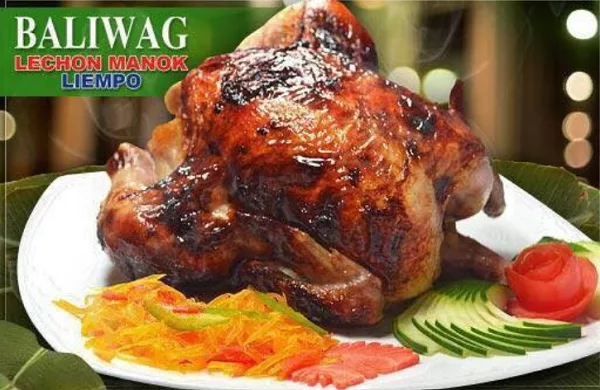
Founded in 1980 — five years before Andok’s — Baliwag is one of the oldest lechon manok brands in the Philippines. It built its reputation on an exceptionally crispy skin and a smoky, charcoal-touched marinade that remains distinctive. “Just by the smell of Baliwag’s chicken, you have already eaten” is a quote heard from loyal customers across the country. Baliwag currently operates 200+ branches nationwide.
Franchise fee
₱200K–₱500K
Total investment
₱500K–₱1.5M
Branches
200+ nationwide
✅ Pros
Oldest brand in the category — long-proven market loyalty · Distinctive crispy skin product that stands out from competitors · Flexible packages for different budgets and locations · Strong recognition in both urban and provincial markets
❌ Cons
Fewer branches than Andok’s — lower built-in brand recognition in some areas · Franchise support may vary by package tier · Less menu diversity compared to Andok’s
Chooks-to-Go is arguably the largest rotisserie chicken chain in the Philippines by branch count — with over 1,800 outlets nationwide under Bounty Agro Ventures Inc., founded in 2009. Its model is purpose-built for high-traffic convenience: small footprint, take-out focused, positioned in malls, wet markets, and busy street corners. Chooks-to-Go also has a strong delivery presence and a loyal urban customer base who value consistency and speed.
Total investment
₱500K–₱1.5M
Branches
1,800+
Format
Take-out, kiosk
✅ Pros
Largest branch network — strongest urban brand recognition · Modern, delivery-ready business model · Smaller space requirement suits high-rent urban locations · Strong product consistency across all branches
❌ Cons
Franchising availability varies — verify current status directly · No full dine-in format limits ticket size per transaction · Intense internal competition from other Chooks-to-Go branches in dense areas
🌐 chookstogo.com.ph — contact via website for current franchise availability
4. Ang Lechon Manok ni Sr. Pedro — Best Premium Positioning
🍗 Ang Lechon Manok ni Sr. Pedro
Premium
Founded in 1992 by Pedro Anakciano and his brother, Sr. Pedro built its reputation on a sweet-tasting, aromatic lechon manok made from home-grown chickens raised on Anakciano Inc.’s own farms. The farm-to-rotisserie model gives Sr. Pedro a quality and price control advantage — and a flavor profile that is noticeably different from competitors. Currently at 300+ branches, it remains one of the most loyally followed lechon manok brands in Metro Manila.
Most branches are company-owned — franchising can be harder to negotiate · Higher total investment than most competitors · Primarily strong in Metro Manila — less proven in provincial markets
📍 Key branches: A. Arnaiz Ave., Libertad, Pasay City · 980 Del Monte Ave., San Francisco del Monte, Quezon City — contact via branch visits or online search for current franchise inquiries
5. Lembest Lechon Manok and Liempo — Best Budget Franchise
🍗 Lembest Lechon Manok at Liempo
Budget-friendly
Lembest is the most accessible entry point into the lechon manok franchise category. Its budget-friendly franchise package makes it ideal for first-time food entrepreneurs who want to test the market without the larger capital commitment of an Andok’s or Chooks-to-Go franchise. While brand recognition is lower than the national giants, the lower investment means faster ROI in the right location.
Franchise fee
₱150K–₱250K
Total investment
₱300K–₱600K
Best for
First-time entrepreneurs
✅ Pros
Lowest investment threshold of major franchises · Faster ROI potential due to lower initial outlay · Good for provincial or suburban locations where national brands aren’t yet present
❌ Cons
Lower brand recognition requires stronger location and local marketing · Less franchise support infrastructure than larger brands · May face stiff competition from established national brands in busy areas
Other Lechon Manok Franchises Worth Considering
Don C Lechon Manok (Iloilo) — Known for a unique Ilonggo spice blend and traditional charcoal roasting. Strong competitive edge in the Visayas region where its flavor profile matches local preference. Limited outside the Visayas market.
24 Chicken — A modern rotisserie concept targeting the urban take-out and delivery market. Multiple flavor options and a contemporary brand identity. Better suited for Metro Manila and urban centers than provincial markets.
Five Star Chicken — Premium rotisserie chicken concept with gourmet sauces and higher-end market positioning. Higher investment, higher margins if the location supports a premium price point.
Camellias Lechon Manok at Liempo — Simple franchise package with competitive fees. A good option in areas without strong franchise competition.
Marinduqueños Lechon Manok — Brings the island’s distinctive lechon manok recipe to the mainland. Unique flavor differentiator in markets where island-style cooking is less common.
How to Apply for a Lechon Manok Franchise — Step-by-Step
1
Choose your franchise and confirm your budget. Use the comparison table above to match your capital with the right franchise tier. Be realistic — include construction, equipment, and 3 months of working capital in your total budget, not just the franchise fee.
2
Identify and secure your location before applying. All franchisors will ask for your proposed site details. High-traffic is non-negotiable — look for locations near wet markets, transport terminals, schools, churches, or busy street corners. Foot traffic beats everything else.
3
Submit a Letter of Intent to the franchisor. Specify the exact location, size, whether owned or leased, and estimated daily foot traffic. Keep it factual and specific — franchisors evaluate sites carefully.
4
Prepare your financial documents. Proof of financial capacity to meet total investment requirements — bank statements, ITR, or proof of assets — will be required during evaluation.
5
Attend the franchisor interview and site evaluation. The franchisor will assess your proposed location and may conduct an in-person or online interview to evaluate your business readiness and commitment.
6
Review and sign the franchise agreement. Have a lawyer review the agreement before signing — check royalty fees, renewal terms, territory exclusivity, and grounds for termination.
7
Complete training and build out your store. After payment and signing, franchisors provide training on operations, product preparation, customer service, and quality standards. Store build-out follows before opening day.
Tips for Choosing the Right Lechon Manok Franchise
Location is more important than brand. A Lembest in a perfect corner location will outperform an Andok’s in a dead street. Prioritize foot traffic above all other factors.
Visit existing franchisee branches before signing. Talk to actual franchisees — not just the franchisor’s marketing team. Ask about real daily sales, actual support quality, and whether they’d do it again.
Factor in ALL costs, not just the franchise fee. Construction, equipment, signage, permits, initial inventory, and 3 months of operating expenses must all be in your budget before you apply.
Check territory exclusivity. Some franchise agreements protect you from other branches of the same brand within a certain radius — others don’t. Clarify this before signing.
Consider provincial vs Metro Manila. Established brands like Andok’s and Chooks-to-Go have strong urban penetration — in many provincial areas, a regional brand or new entrant may face less competition.
Start with take-out, not dine-in. For first-time franchisees, take-out formats are lower risk — lower construction cost, faster ROI, simpler operations. Upgrade to dine-in after proving the location.
The single most important decision: Pick the right corner before you pick the right brand. I’ve seen unknown lechon manok brands outperform established franchises purely because they had the better spot. The chicken matters — but the location matters more.
Frequently Asked Questions
What is the best lechon manok franchise in the Philippines?
The best overall is Andok’s — strongest brand recognition, most comprehensive franchise support, and 300+ branches proving the model. Baliwag is the best for crispy skin enthusiasts and flexible budgets. Chooks-to-Go is the best for a modern take-out format with 1,800+ branches. For lower investment, Lembest is the best budget entry point. The right choice depends on your capital and your location.
How much does an Andok’s franchise cost?
Andok’s franchise fee is ₱300,000 for a take-out store (3-year renewable term) and ₱500,000 for a dine-in store (5-year term). Total investment including construction, equipment, furnishings, and initial working capital is approximately ₱800,000 to ₱2,000,000. Contact: franchise@andokscorp.com or (02) 372-4033 loc. 144.
Is lechon manok a good franchise business in the Philippines?
Yes — lechon manok is one of the most stable food franchise categories in the Philippines. It is an everyday staple, not a trend. Demand is consistent year-round, accessible to all income groups, and the category is recession-resistant — Filipinos trade down from restaurants to lechon manok stalls during economic downturns, not away from them.
What is lechon manok?
Lechon manok is Filipino spit-roasted chicken — a whole chicken marinated in local spices, herbs, and aromatics, then slow-roasted on a rotating spit over charcoal or motorized rotisserie. The result is crispy golden skin with juicy, flavorful meat. A whole chicken costs ₱200–₱350 at most franchise chains, making it one of the most affordable complete meal options in the Philippines.
How do I apply for a lechon manok franchise?
The process: (1) choose your franchise and confirm your budget covers the total investment; (2) identify a high-traffic location; (3) submit a Letter of Intent to the franchisor with site details; (4) prepare financial documents; (5) attend an interview and site evaluation; (6) review and sign the franchise agreement; (7) complete training and build your store. Contact details for all major franchisors are listed in the individual sections above.
What are the requirements to franchise Andok’s?
Andok’s requires: a Letter of Intent with exact location and site details, proof of financial capacity to meet ₱800K–₱2M total investment, proposed site information (owned or leased, size, traffic), and a completed franchise application. Take-out stores need 40–50 sqm; dine-in stores need 200–250 sqm. Preferred locations are high-traffic thoroughfares, near passenger terminals, malls, and markets.
What is the difference between Andok’s and Chooks-to-Go?
Andok’s (1985) focuses on traditional lechon manok with full dine-in and take-out formats and a broad Filipino menu. Chooks-to-Go (2009) focuses on modern convenience take-out rotisserie chicken in a smaller footprint suited for malls and busy streets. Andok’s is the heritage brand; Chooks-to-Go is the modern mass-market brand. Chooks-to-Go has more branches (1,800+); Andok’s has stronger dine-in market penetration.
Filipino entrepreneur · Travel writer · Based in Zamboanga del Sur, Mindanao
I’ve lived and worked across Cebu, Negros Oriental, and Mindanao — three regions where lechon manok stalls are as common as sari-sari stores. I’ve watched branches of every brand on this list open and operate in real Philippine conditions. This guide is written from that observation, not from press releases. I also run Best Philippines Travel Guide and Giobel Koi Center.