
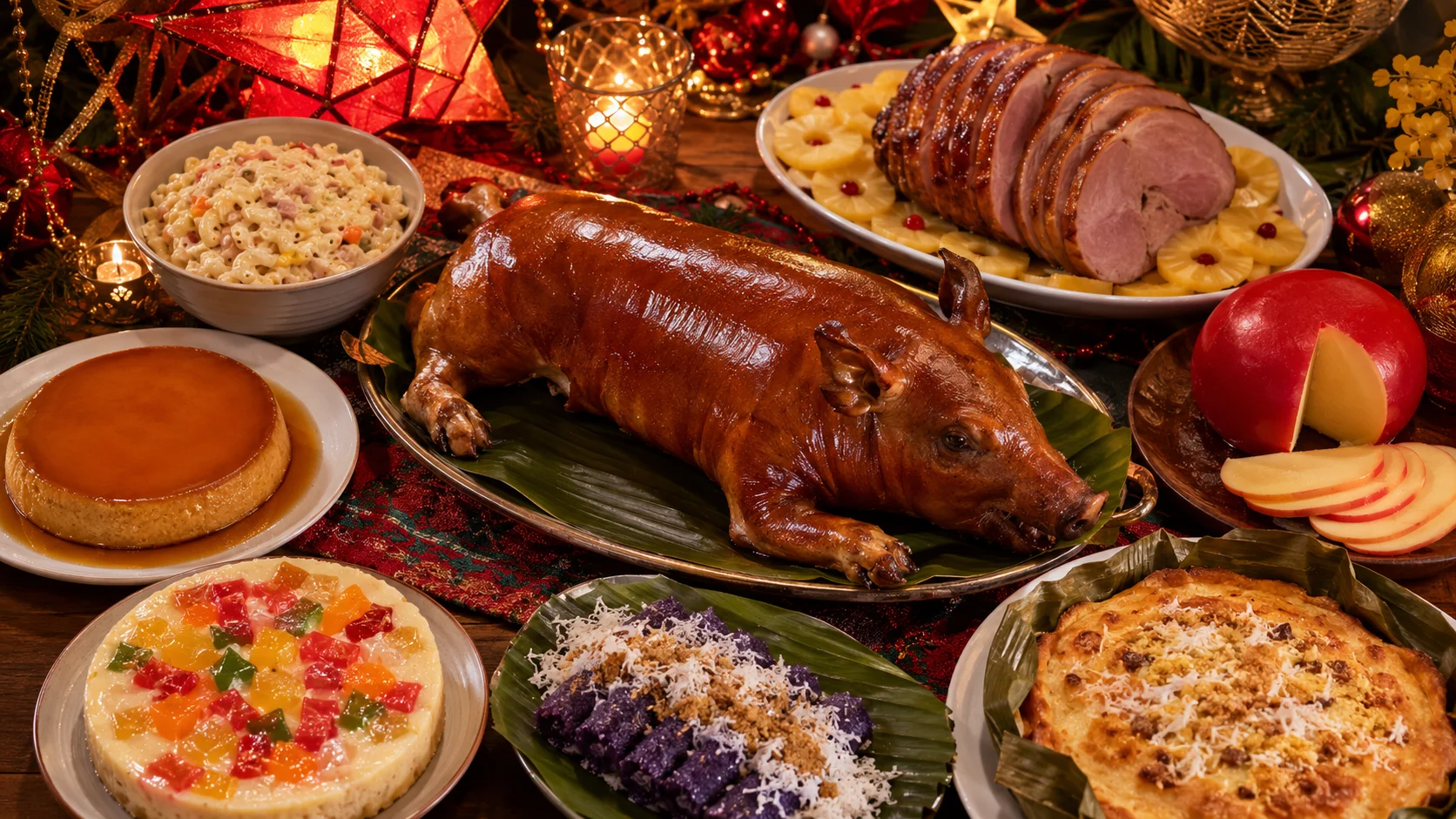
Traditional Filipino Noche Buena spread — hamon (Christmas ham), queso de bola (Edam cheese), bibingka, puto bumbong, and leche flan. The Philippine Christmas season officially starts in September and peaks on Christmas Eve.
Traditional Filipino Christmas food centers on the Noche Buena feast on Christmas Eve — a spread that always includes hamon (sweet pineapple-glazed ham), queso de bola (Edam cheese ball), lechon (roasted pig), bibingka and puto bumbong (from Simbang Gabi), pancit noodles, macaroni salad, crema de fruta, and leche flan. Media Noche (New Year’s Eve) adds the 12 round fruits tradition for prosperity. The Philippines has the world’s longest Christmas season — starting in September and ending in January.
I grew up celebrating Christmas across Cebu City and Dumaguete — two cities where Christmas is not a day but a season, and where the smell of bibingka from vendors outside the church at 4 AM is one of the most vivid sensory memories of my childhood. Filipino Christmas food is not just a menu. It is a calendar, a ritual, a language of love spoken in food. This guide covers everything — Noche Buena to Media Noche, Simbang Gabi food, every essential dish, and the traditions that give each one meaning.
Noche Buena vs Media Noche — What’s the Difference?
Many people confuse Noche Buena and Media Noche — they are two separate celebrations, each with distinct traditions and food significance.
When: Christmas Eve, December 24 — after midnight mass
Meaning: “Good Night” (Spanish)
Tradition: Family feast after Misa de Aguinaldo (midnight mass). The biggest family meal of the year. Tables overflow with hamon, queso de bola, lechon, bibingka, and desserts. Gift-giving follows the feast.
Centered on: Birth of Jesus Christ — primarily a religious celebration expressed through food and family.
When: New Year’s Eve, December 31 — at midnight
Meaning: “Midnight” (Spanish)
Tradition: New Year’s Eve feast at the stroke of 12. Often uses Noche Buena leftovers plus new dishes. The defining tradition: 12 round fruits on the table representing the 12 months and symbolizing prosperity.
Centered on: Welcoming the New Year with abundance and good fortune.
Simbang Gabi Food — Bibingka and Puto Bumbong
Before the Noche Buena feast, there is Simbang Gabi. From December 16–24, Filipino Catholics attend nine consecutive pre-dawn masses (4–6 AM) called Simbang Gabi (literally “Night Mass”) — and immediately after each mass, they gather outside the church around the food vendors who have been cooking since 3 AM. The smell of bibingka and puto bumbong in the cold pre-dawn air is one of the most distinctly Filipino sensory experiences on earth.
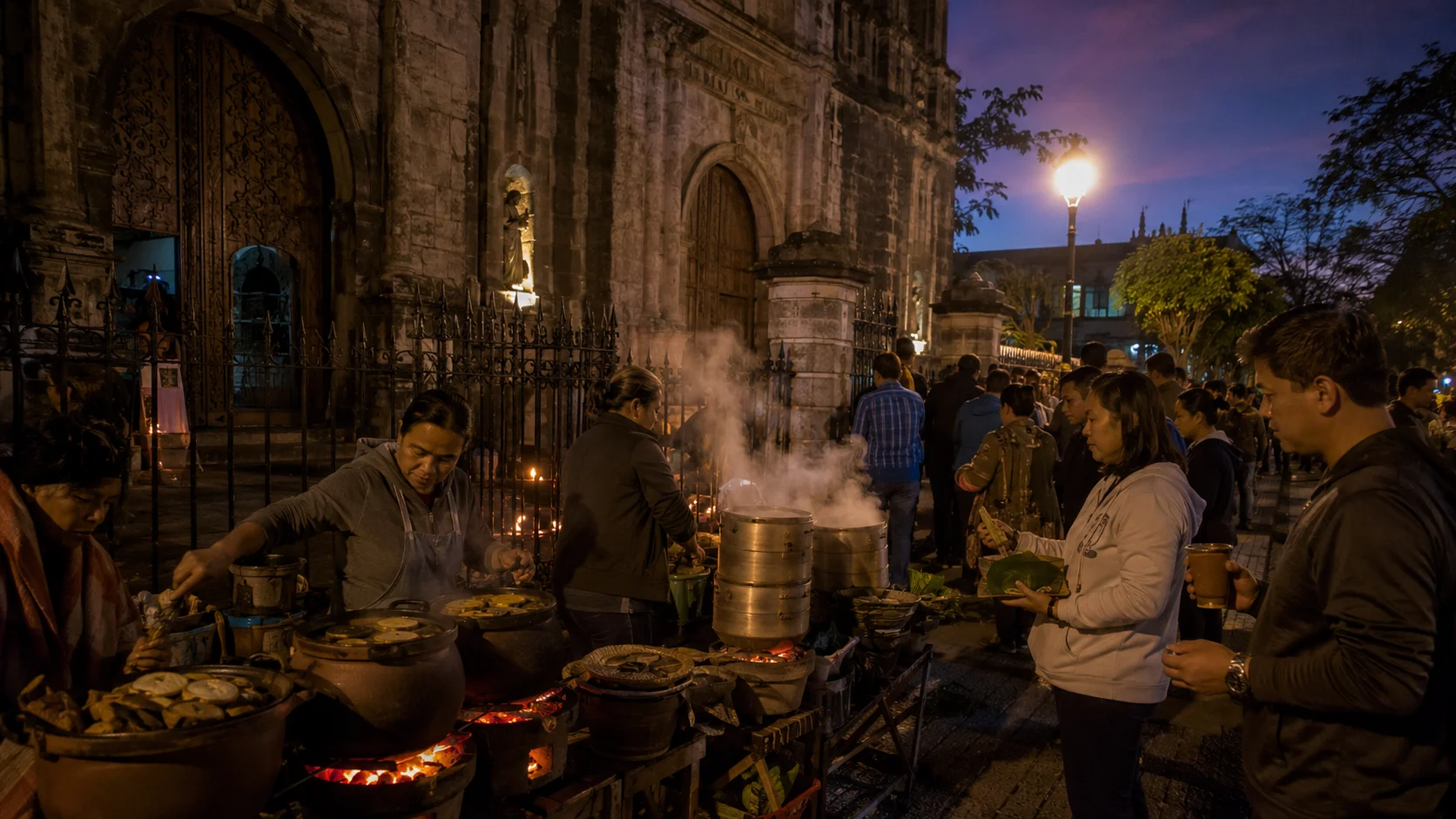
Simbang Gabi vendors outside a colonial Philippine church at 4:30 AM — bibingka clay pots glowing with charcoal, puto bumbong bamboo tubes steaming, Filipino families gathering after pre-dawn mass. This scene repeats at every parish church in the country from December 16–24.
🕯️ Simbang Gabi — traditional foods sold outside churches (Dec 16–24)
These are the foods sold by street vendors at church gates during the 9 nights of Simbang Gabi. Available from approximately 3:30–7 AM at most parish churches nationwide.
Bibingka is the definitive Filipino Christmas food — a slightly sweet, spongy rice cake made from galapong (soaked ground rice) or rice flour, coconut milk, eggs, butter, and sugar, traditionally baked in a clay pot (palayok) lined with banana leaves, with burning charcoal on both top and bottom. The banana leaf gives it its distinctive aroma — you can smell a bibingka vendor from half a block away. It is topped with sliced salted duck egg (itlog na pula), butter, and grated coconut before serving.
Bibingka is exclusively a Christmas food in the Philippines — it practically disappears from menus outside the November–January window. The combination of the salted egg (savory) and the sweet coconut rice cake is one of the most perfectly balanced flavor combinations in Filipino cuisine. Eating bibingka in the pre-dawn cold after mass — hands wrapped around it for warmth — is a memory that every Filipino who grew up Catholic carries for life.
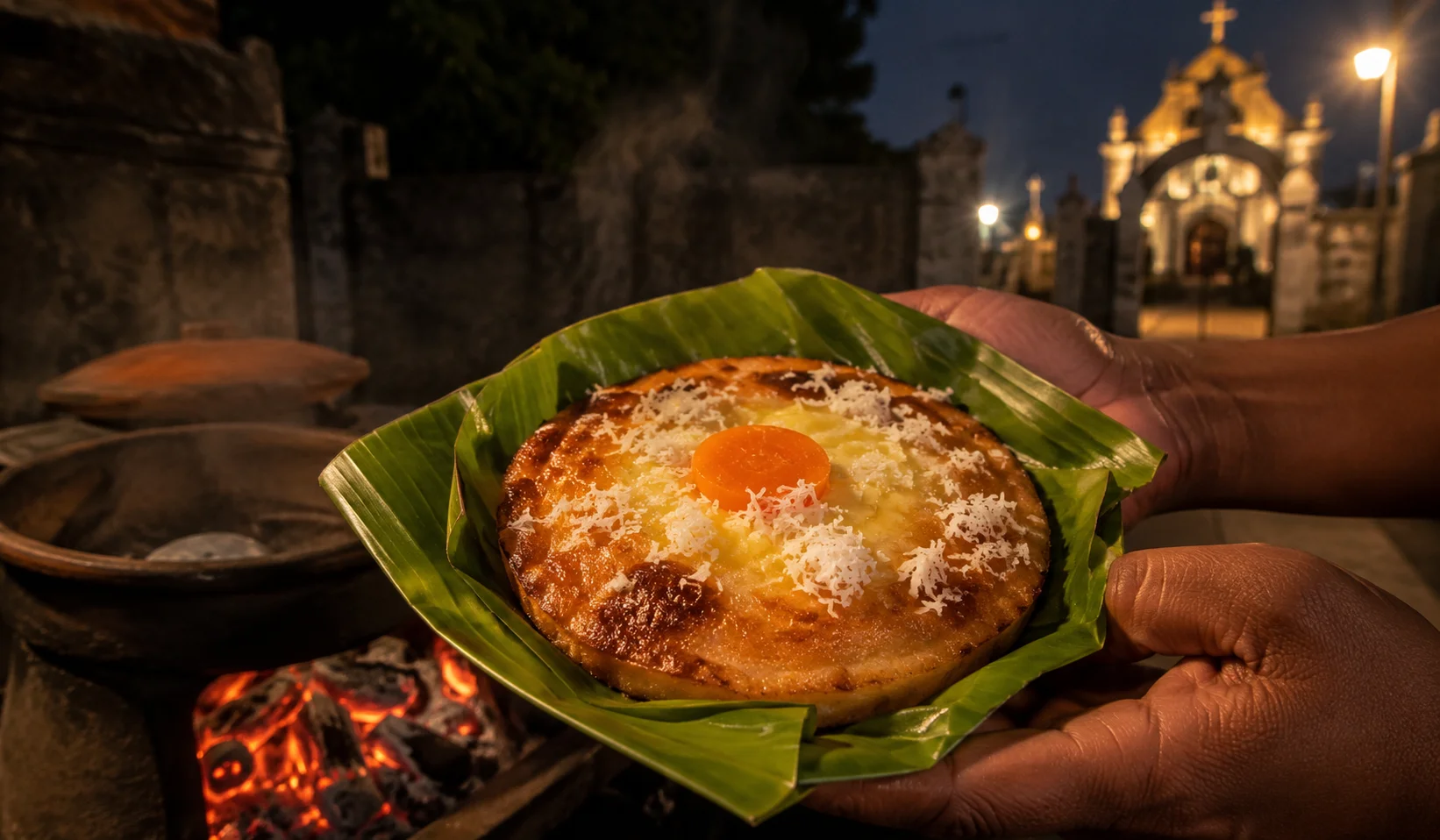
Bibingka — baked in banana leaf-lined clay pots with charcoal above and below. Topped with salted duck egg, butter, and grated coconut. Available outside every Philippine church at 4 AM during Simbang Gabi (December 16–24).
Puto bumbong may be the single most recognizable Filipino Christmas food in existence — nothing else has its purple color, its bamboo-tube cooking method, or its specific seasonal exclusivity. The name describes the dish exactly: puto (rice cake) cooked in bumbong (bamboo tubes). Traditionally made from pirurutong (black glutinous rice), it is now most commonly made with regular glutinous rice mixed with ube (purple yam) or food coloring for its signature purple hue.
The cooking process is theatrical — a bank of vertical bamboo tubes suspended over a steaming vessel, the purple rice packed inside and steamed, then tapped out onto banana leaves in a neat cylindrical log. Topped with melted butter or margarine, a sprinkle of muscovado (brown sugar), and grated coconut — and eaten immediately while warm. Puto bumbong cannot be reheated without losing its texture. It must be eaten fresh from the bamboo tube.
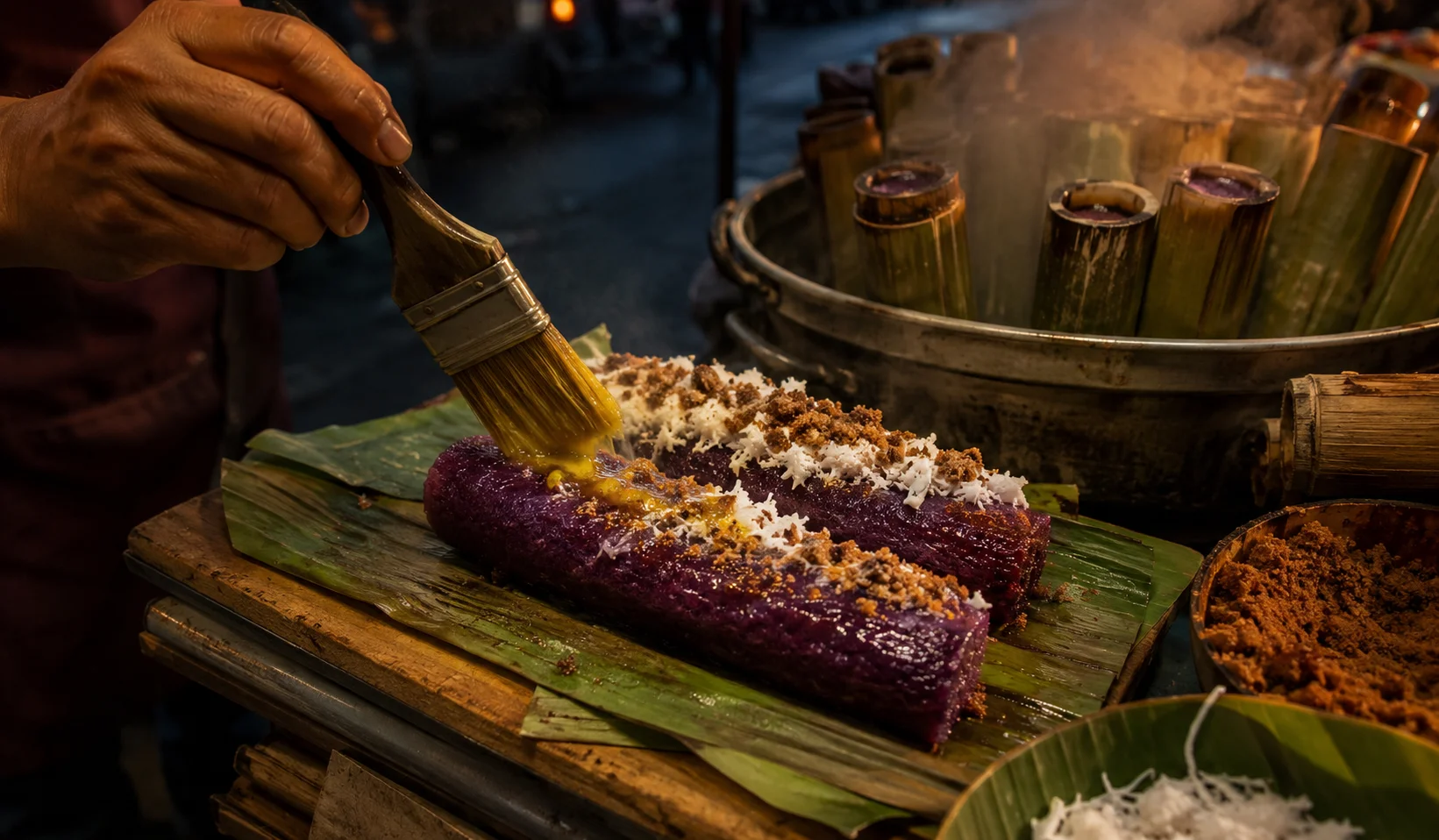
Puto bumbong — purple sticky rice steamed in bamboo tubes, served on banana leaf with butter, muscovado sugar, and grated coconut. Must be eaten immediately. Nothing else in Filipino cuisine looks or tastes quite like it.
The Complete Traditional Noche Buena Menu
The Noche Buena spread varies by region and economic status, but certain dishes appear on virtually every Filipino Christmas table. Here are the 15 most essential:
Hamon is the quintessential Filipino Christmas ham — a boneless pork leg marinated in pineapple juice and soy sauce overnight, then slow-cooked in a sweet glaze until tender, with pineapple chunks added for a tropical sweetness that is distinctly Filipino. It is carved and served at room temperature alongside queso de bola and pandesal as the iconic Noche Buena combination.
The most popular commercially available hamons are Purefoods Fiesta Ham, CDO Bibbo Ham, and Virginia Smokehouse — all recognizable by their plastic-wrapped, vacuum-sealed packaging that appears in grocery stores every October. Receiving a holiday ham as a gift from an employer or company is a beloved Filipino Christmas tradition, often the most anticipated “13th month” bonus for many Filipino workers.
For international visitors: Filipino hamon is significantly sweeter than Western Christmas ham. The pineapple glaze and banana ketchup pairing — unusual to non-Filipino palates — is what makes it distinctly Pasko (Christmas).
Queso de bola (Spanish: “ball of cheese”) is a round ball of Dutch Edam cheese covered in red paraffin wax and wrapped in characteristic red crinkly plastic — the single most recognizable symbol of Filipino Christmas. It appears in Philippine supermarkets exclusively from September onwards and disappears after the New Year. Many Filipino families don’t even eat the queso de bola — its mere presence on the dining table is enough to signal that Christmas has truly arrived.
Its salty, nutty flavor is best experienced sliced thin and paired with pandesal (Filipino soft rolls) and the sweet hamon. The contrast between the salty cheese and the sweet ham, with the soft pandesal as a vehicle — eaten in the early hours of Christmas morning after Noche Buena — is one of the most specifically Filipino flavor memories in existence. Marca Piña is the most famous brand, though supermarket-brand Edam is equally good.
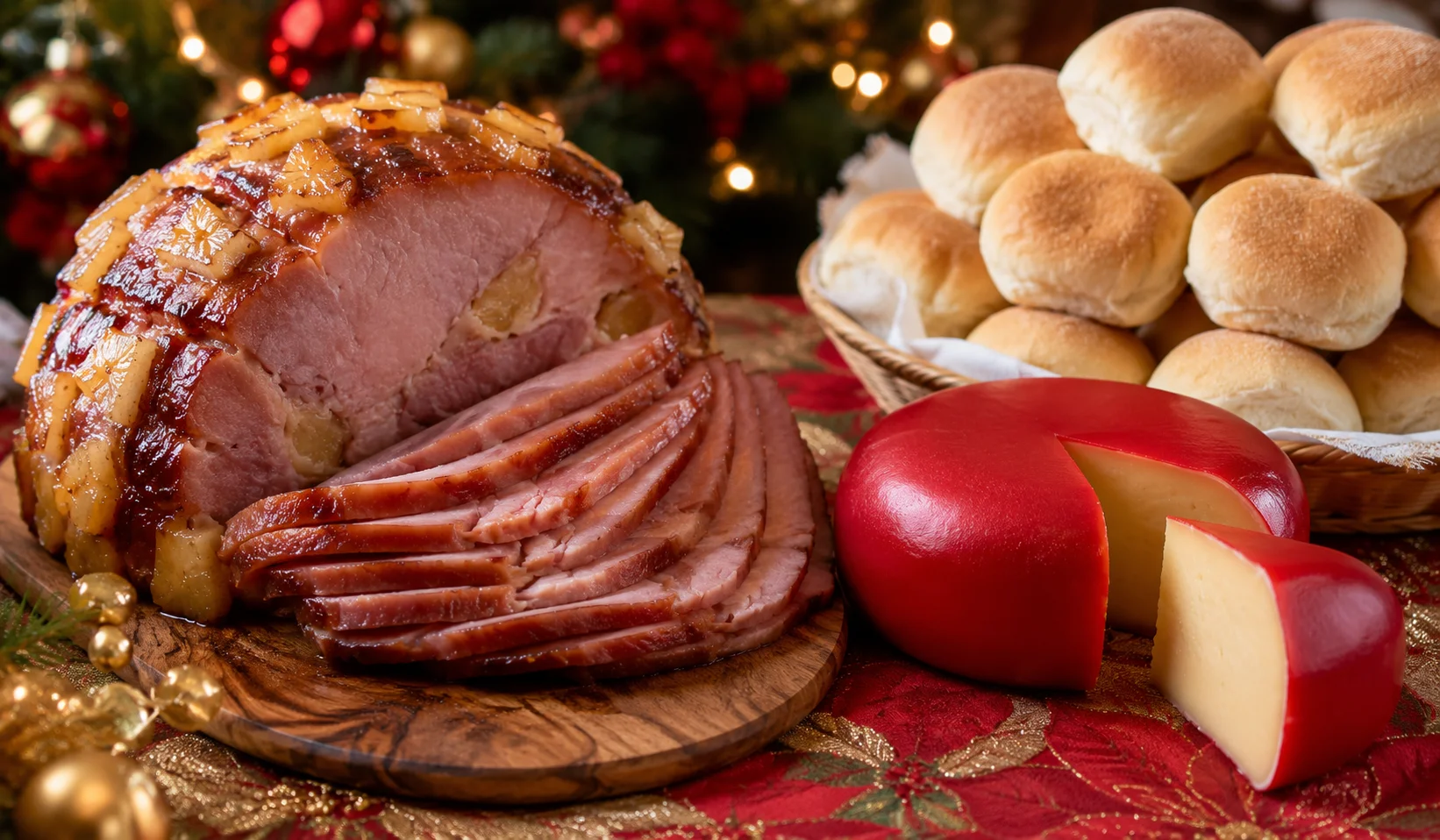
Hamon and queso de bola — the classic Filipino Noche Buena combination. Sweet pineapple-glazed Christmas ham beside a red-waxed Edam cheese ball, eaten with pandesal in the early hours of Christmas morning. No Noche Buena table is complete without both.
Lechon at Christmas takes on an even greater significance than its already elevated status at Filipino parties. A whole lechon on the Noche Buena table is the declaration of a household’s prosperity and generosity — it says: “we are celebrating, and we are celebrating fully.” Christmas lechon orders are placed weeks in advance, and lechoneros across the country begin roasting on December 23 in preparation for the Christmas Eve rush.
Christmas lechon is slightly different from regular party lechon in some regions — more herbs, more aromatics, sometimes a special marinade kept secret by the lechonero family. The Christmas version is considered the best of the year. Not every Filipino family can afford a whole lechon, but the aspiration is universal — and lechon kawali (crispy pork belly) is the dignified substitute for those working within a tighter budget.
Pancit is as essential at Christmas as it is at birthdays — the long noodles representing long life for everyone at the table. The Christmas version tends to be more elaborate than everyday pancit: Pancit Malabon (thick rice noodles with orange shrimp paste sauce, topped with seafood, chicharon, and boiled eggs) or Pancit Palabok (same sauce concept, thinner noodles) are the preferred Christmas varieties because they feel more festive and substantial than simple bihon. Never cut the noodles before serving — even at Christmas, this rule holds.
Embutido is Filipino Christmas meatloaf — ground pork mixed with minced carrots, raisins, cheese, bread crumbs, and sautéed onions, wrapped around a center of sliced Vienna sausage and hard-boiled egg, then rolled in aluminum foil and steamed. When sliced, the cross-section reveals the colorful filling — the egg in the center like a golden sun, the sausage surrounding it. It is made days before Christmas because it reheats beautifully and actually improves with time. Served sliced, with banana ketchup on the side.
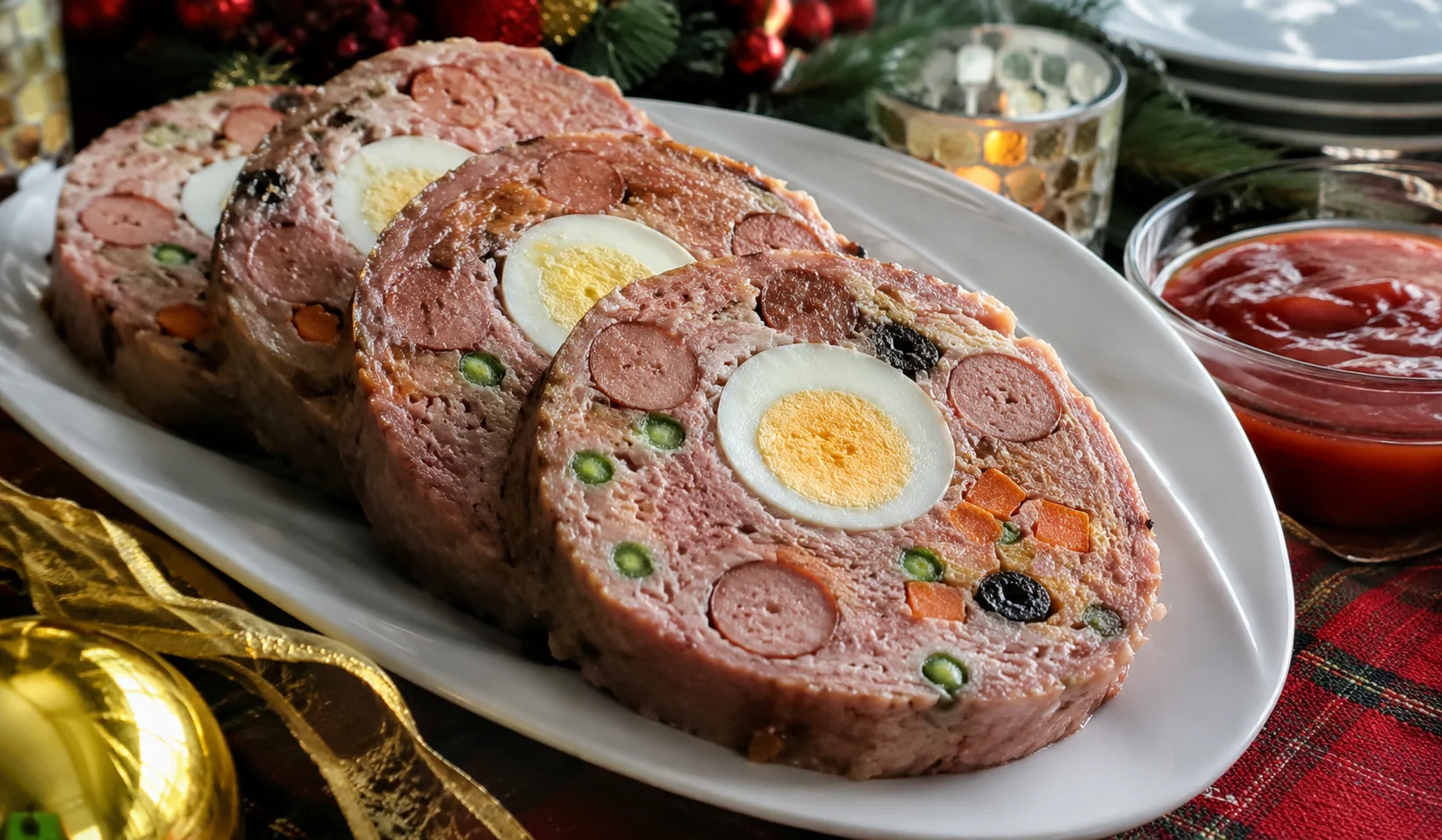
Embutido sliced — the beautiful cross-section reveals the hard-boiled egg center, Vienna sausage, and colorful pork filling. Made days before Christmas, it improves with refrigerator rest time. A Noche Buena staple served cold or reheated.
Morcon is one of the most special-occasion Filipino dishes — a beef flank steak pounded flat, marinated in soy sauce, calamansi, and garlic, then stuffed with chorizo de Bilbao (or hotdog), hard-boiled egg, carrots, pickles, and cheese, tied with kitchen twine into a tight roll, and braised for 2–3 hours in tomato sauce until meltingly tender. When sliced, the cross-section is as beautiful as it is delicious. Morcon is served almost exclusively for Noche Buena and major fiestas — its labor-intensive preparation makes it too special for ordinary occasions.
Rellenong Manok (stuffed chicken) is the Christmas centerpiece for families who cannot afford lechon — an entire chicken, deboned except for the leg bones, stuffed with a savory filling of ground pork, Vienna sausages, raisins, gherkins, hard-boiled eggs, and Chinese sausage, then sewn shut and oven-roasted or deep-fried until golden. When carved, the stuffed interior spills out with all its components — a single dish that is simultaneously meat, stuffing, and garnish. Served with banana ketchup or Filipino-style gravy.
Filipino Christmas macaroni salad is not the Western version — it is a sweet, creamy cold salad made with elbow macaroni, mayonnaise, all-purpose cream, condensed milk, diced ham, cheddar cheese, pineapple tidbits, raisins, and sometimes carrots and celery. The sweetness from the condensed milk and pineapple makes it distinctly Filipino — closer to a dessert than a salad by Western standards. It is made the day before and refrigerated overnight to let the flavors meld. The American influence is unmistakable (mayonnaise-based pasta salads arrived with US occupation) but the Filipino palate transformed it completely.
Filipino Christmas Desserts
Crema de Fruta is the most visually spectacular of all Filipino Christmas desserts — a no-bake refrigerated cake made from layers of graham crackers, thick all-purpose cream and condensed milk filling, and a top layer of colorful canned fruits (peaches, pineapple, cherries) sealed under a clear gelatin glaze that gives the surface a jeweled, Christmas-ornament appearance. It requires no baking, is made the night before, and is served cold from the refrigerator. The contrast between the creamy filling, the slightly crunchy graham cracker, and the cold sweet fruit is exactly what you want after the richness of lechon and hamon.
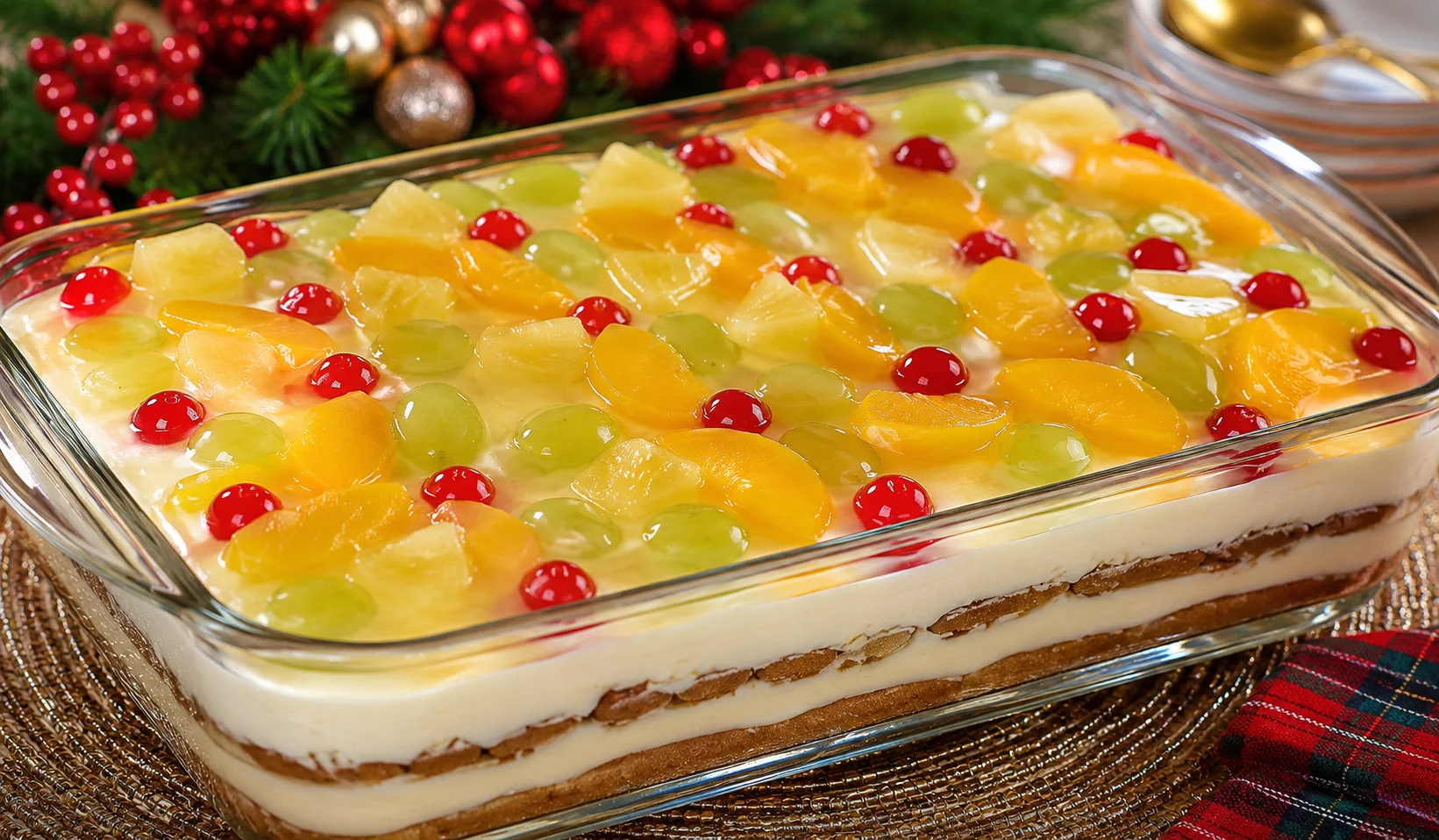
Crema de fruta — no-bake, refrigerated, and visually spectacular. Made the night before Noche Buena, served cold. The jeweled fruit-and-gelatin top layer is one of the most recognizable sights on a Filipino Christmas table.
Leche flan is present at virtually every Filipino celebration — and Christmas is no exception. The Christmas version is often made in larger quantities (8–10 llaneras instead of the usual 4–6) and sometimes garnished with a dusting of muscovado or a caramelized pineapple ring on top as a seasonal variation. Made from egg yolks, condensed milk, and evaporated milk, steamed in oval aluminum molds. Make 2 days before Christmas — it improves significantly with refrigerator rest time.
Filipino Christmas fruit salad is the same year-round version — all-purpose cream, condensed milk, kaong, nata de coco, canned mixed fruits — but at Christmas it often gains a buko pandan variation: bright green pandan-flavored jelly cubes (gulaman) added to the standard fruit salad base, giving it a vivid green color and a distinctly tropical pandan fragrance. The buko pandan version has become almost synonymous with Filipino Christmas dessert in Metro Manila and urban areas.
The 12 Round Fruits Tradition for Media Noche ⭐ Competitor gap
The 12 round fruits tradition is one of the most specifically Filipino-Chinese New Year customs — and one of the most underreported in international guides. For Media Noche (New Year’s Eve), 12 different varieties of round fruits must be present on the table at midnight. The rules are specific:
- Exactly 12 different varieties — one for each month of the year
- All must be round — circles represent coins, symbolizing financial prosperity
- Present at the stroke of midnight — eating them at 12:01 AM is believed to attract wealth in the new year
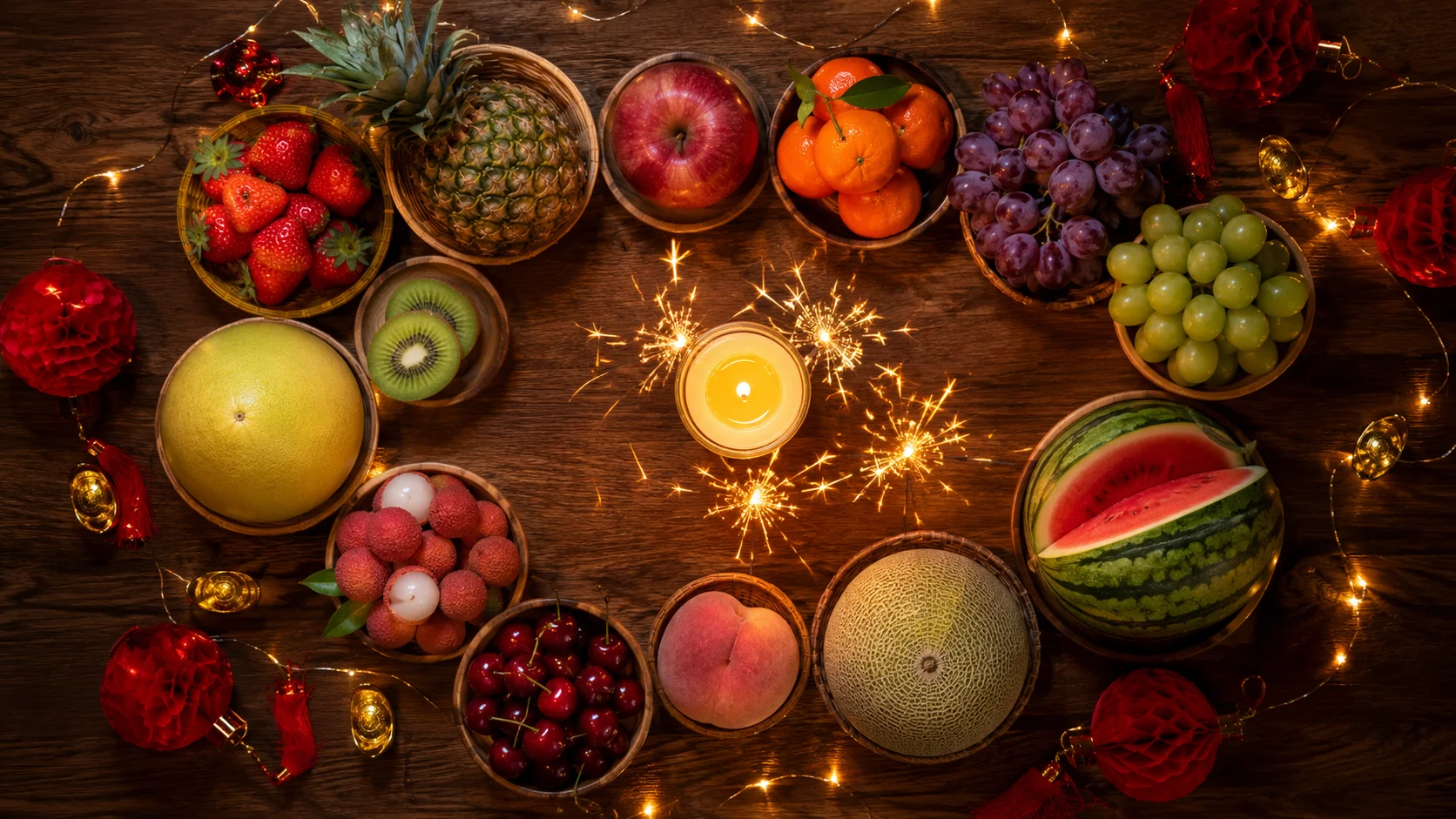
The 12 round fruits for Media Noche (New Year’s Eve) — one fruit for each month of the year. Round fruits symbolize coins and attract prosperity for the coming year. Present on the table at the stroke of midnight.
Practical tip: Not all 12 fruits need to be native Philippine fruits. Use whatever round fruits are available at your local market. The tradition is Chinese in origin and arrived in the Philippines through Filipino-Chinese cultural exchange — the specific fruits matter less than having 12 different varieties. In cold-climate countries, Filipinos abroad often supplement with tropical canned fruits to reach 12 varieties.